If you sell gifts online or buy seasonal products for retail, you already know the problem: a soap flower bouquet can look beautiful in photos and still feel underwhelming when it arrives.
That gap is where a lot of retail disappointment begins.
I have found that buyers usually do not lose confidence because of one dramatic flaw. More often, the bouquet simply feels less refined than expected. It may look too flat, too shiny, too light, or too “assembled.” On a product page, those details are easy to miss. In real life, they become the whole story.
This article is my practical guide to one question I hear again and again from retailers, gift shops, and e-commerce sellers:
How can I tell whether a soap flower bouquet will look premium before I place an order?
If you are reviewing new bouquet styles and want a second opinion from a manufacturer, email us at inquiry@sweetie-group.com.
Executive Summary
A premium-looking soap flower bouquet is not defined by price alone. It is usually the result of six things working together: bouquet shape, flower consistency, leaf quality, packaging coordination, clean construction, and post-shipping presentation.
For retail buyers, the real test is simple: does the bouquet still feel gift-ready after unpacking, not just in the listing photo?
Why “Premium” Matters in Soap Flower Retail
In the soap flower bouquet category, customers are not just purchasing a decorative item. They are buying a ready-to-gift product.
That means presentation affects more than aesthetics. It affects:
- whether the bouquet looks worth gifting
- whether the product feels priced fairly
- whether it performs well in product photos
- whether it arrives in a condition that supports positive reviews
- whether the buyer will reorder the same style
A bouquet that looks polished and complete usually has a better chance of succeeding in retail. A bouquet that looks thin or low-grade may struggle even if the color theme is attractive.
What “Premium-Looking” Actually Means
When I talk about a premium-looking soap flower bouquet, I do not mean something overly elaborate or expensive.
I mean a bouquet that feels:
- balanced
- complete
- cleanly finished
- visually coordinated
- suitable for gifting without apology
A cheap-looking bouquet usually gives the opposite impression. It may still be colorful, but something feels off. The end customer may not explain it clearly, but the reaction is immediate: “This doesn’t feel as nice as I expected.”
That reaction often comes from a handful of repeated problems.
The 6 Signals Retail Buyers Should Evaluate First
1. Bouquet Shape and Visual Volume
The first thing most people notice is the overall body of the bouquet.
Not the flower formula. Not the wrapping material. The shape.
A bouquet tends to feel more premium when it has:
- a full front view
- enough depth from the side
- a clear focal area
- a silhouette that feels intentional, not collapsed
A bouquet tends to feel cheaper when it looks:
- too narrow
- too flat
- visually empty in the center
- smaller in impact than the photos suggested
This matters a lot for online selling, because customers form expectations from angles and styling. If the real bouquet feels visually “lighter” than the listing, perceived value drops quickly.
2. Flower Head Uniformity
A premium bouquet does not need perfect flowers. It does need consistent flowers.
Buyers should look at whether the flower heads are:
- reasonably even in size
- stable in shape
- neatly placed
- clean in edge finish
- harmonious in color balance
When flower heads vary too much, or when petals look rough and inconsistent, the arrangement begins to feel less deliberate. The bouquet may still be pretty, but it no longer feels polished.
For B2B buyers, this is important because inconsistency is one of the fastest ways to create the “photo looks better than reality” problem.
3. Leaf Quality
Leaves are often underestimated.
I think that is a mistake.
In many soap flower bouquets, the flowers themselves are acceptable, but the leaves weaken the whole presentation. Overly glossy leaves, stiff leaves, bright synthetic greens, or awkward placement can make the bouquet look much more artificial than it needs to.
Leaves should support the bouquet quietly. They should not steal attention for the wrong reasons.
If the leaves look fake, the bouquet rarely feels high-end, no matter how nice the main flowers are.
4. Wrapping and Ribbon Coordination
Retail buyers should evaluate the bouquet as a gift unit, not just as a floral arrangement.
That means asking:
- Does the wrapping support the flowers?
- Does the ribbon add finish or add clutter?
- Do the colors work together naturally?
- Does the paper hold shape well?
Low-grade ribbon, flimsy paper, excessive shine, or poor color matching can instantly lower perceived value.
The bouquet may still be saleable, but it may no longer look premium.
5. Construction Cleanliness
This is where factory discipline becomes visible.
A bouquet can lose value fast if the customer notices:
- exposed ties
- visible glue residue
- unstable internal fixing
- loose or uneven assembly
- obvious shortcuts in finishing
These are small production details, but they are not small in retail. They directly affect trust.
When customers see messy construction, they often assume the entire product was made carelessly. That feeling can be hard to reverse.
6. Condition After Shipping
A bouquet is not truly premium if it only looks good before transit.
Retail buyers need to know how the product performs after:
- inner packing
- carton loading
- long-distance shipping
- unpacking
- shelf placement
A bouquet that arrives compressed, crooked, wrinkled, or upside down may still technically be intact, but it no longer feels gift-ready.
This is one of the most practical sourcing questions in the category: Will the bouquet still look like a gift when it reaches the final buyer?
If you want to review bouquet structure, packaging options, or shipping presentation with our team, reach us at inquiry@sweetie-group.com.

Common Reasons a Bouquet Looks Cheap in Real Retail Conditions
From a sourcing perspective, these are some of the most common reasons a bouquet loses value in the market:
- the bouquet appears smaller than expected
- the center looks empty or underfilled
- the leaves look obviously plastic-like
- the ribbon feels too thin or too glossy
- the wrapping is wrinkled or weak
- construction flaws are visible at close range
- the bouquet arrives deformed after shipping
- the final product does not feel immediately giftable
None of these issues sound dramatic in isolation.
That is exactly why they are dangerous.
They are easy to dismiss during development, but easy for end customers to notice during gifting.
A Quick Evaluation Framework for Buyers
Here is the checklist I recommend using when reviewing a new soap flower bouquet SKU.
Visual Check
- Does the bouquet feel full from the front?
- Does it still look balanced from the side?
- Do the flowers look coordinated rather than random?
- Do the leaves support the design instead of weakening it?
Packaging Check
- Does the ribbon feel gift-worthy?
- Does the wrapping hold its shape well?
- Does the packaging color match the bouquet tone?
- Does the overall presentation feel complete?
Detail Check
- Are glue marks visible?
- Are ties or fixing points obvious?
- Does the bouquet look clean up close?
- Are there any details that feel rushed or cheap?
Shipping Check
- Will the bouquet keep its shape in transit?
- Is the protection method suitable for the product structure?
- Does the bouquet still look ready after unpacking?
- Can the retailer sell it without extra fixing or repacking?
This kind of review takes a little more time at the start, but it usually saves much more time later.
Why This Matters for E-Commerce Sellers in Particular
E-commerce makes this issue sharper.
In-store buyers can handle a product before buying it. Online buyers cannot. They build expectations from images, titles, bullet points, and reviews.
That means any mismatch between promise and real presentation becomes more dangerous online.
For e-commerce sellers, a bouquet that looks premium usually helps with:
- stronger first-click appeal
- better perceived value
- lower review risk
- fewer “smaller than expected” complaints
- more confidence in gifting scenarios
A bouquet that looks unfinished may create the opposite effect, even if the item technically matches the listing.
Why This Matters for Gift Shops and Seasonal Retailers
Gift shops and seasonal buyers have a different pressure point.
They are often looking for products that can sell quickly during moments like:
- Valentine’s Day
- Mother’s Day
- graduations
- birthdays
- anniversary gifting
- year-end gift seasons
In those cases, the bouquet must do its job fast.
It has to look:
- attractive on display
- giftable without explanation
- worth the shelf price
- appropriate for the occasion
If the bouquet feels low-grade in person, the customer often moves on immediately.
That is why premium presentation is not just a design issue. It is a merchandising issue.
How We Approach This at Sweetie-Gifts
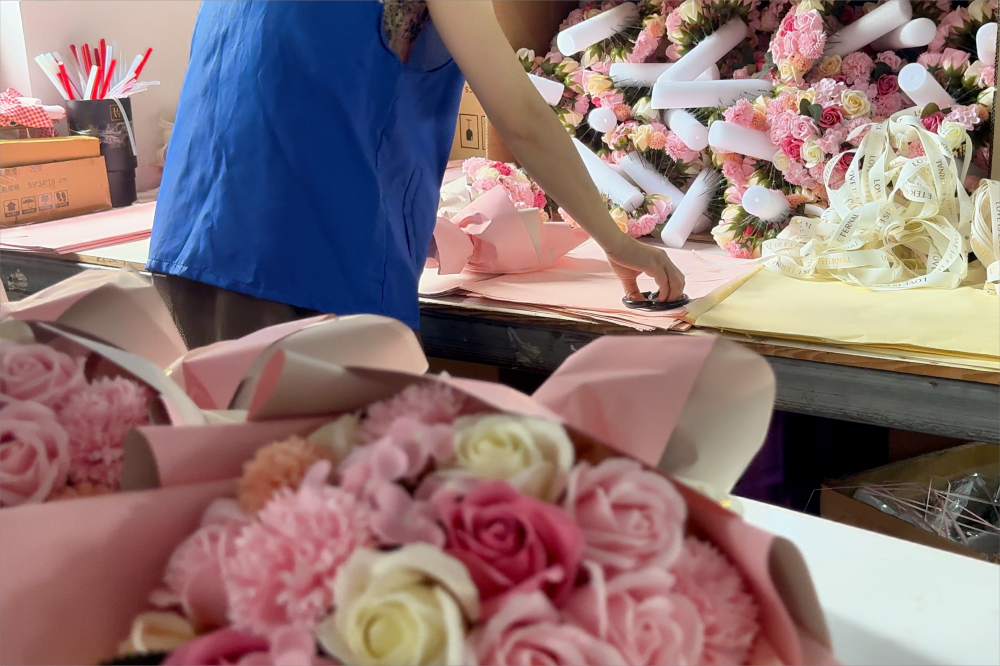
At Sweetie-Gifts, we do not look at soap flower bouquets as simple decorative bunches. We look at them as retail gift products.
That changes the way we develop and review them.
We pay attention to:
- bouquet fullness
- flower balance
- leaf texture
- packaging finish
- shipping protection
- final unpacked presentation
Because we work with different types of B2B buyers, we also understand that the right bouquet for a gift shop may not be the right bouquet for parcel-heavy e-commerce. Channel fit matters. Packaging fit matters. Shipping reality matters.
For me, a good bouquet is not only the one that photographs well. It is the one that still looks convincing when a real customer opens the box.
FAQ
What should a retail buyer check first when reviewing a soap flower bouquet sample?
Start with the overall silhouette, flower consistency, leaf realism, and packaging coordination. Then check close-up details like glue marks, visible ties, and wrapping quality. Finally, ask how the bouquet performs after shipping.
Do premium-looking bouquets always have to be more expensive?
No. Price is only one factor. A bouquet can look premium if its design, finishing, and packaging are handled well. A higher-priced bouquet can still feel low-grade if the details are weak.
Why do some bouquets look good in photos but not in person?
Listing images often show the bouquet from the most flattering angle and under controlled lighting. In person, buyers also notice depth, density, leaves, wrapping texture, and construction details.
Are leaves really that important?
Yes. Leaves often have an outsized impact on how artificial or refined a bouquet feels. If the leaves look obviously fake, the bouquet rarely feels high-end.
What is the biggest mistake B2B buyers make in this category?
Many buyers focus too much on color and front-view styling, and not enough on side profile, construction, packaging finish, and shipping performance.
How can a buyer reduce the risk of sourcing a bouquet that looks cheap?
Ask for multiple-angle sample photos, unpacked product photos, close-up detail shots, carton packing photos, and shipping method confirmation. A good supplier should be able to support this review process clearly.
Final Takeaway
If I had to reduce this entire topic to one line, it would be this:
A premium soap flower bouquet is not built by one dramatic feature. It is built by many small decisions that hold together in real retail conditions.
For B2B buyers, that means the smartest question is not “Is this bouquet pretty?”
It is “Will this bouquet still feel gift-worthy when the customer actually receives it?”
That is the difference between a photo-friendly product and a retail-ready one.
If you are sourcing soap flower bouquets for gift shops, online stores, or seasonal promotions, and want styles that hold their value better in real selling conditions, contact us at inquiry@sweetie-group.com.

Annie Zhang, CEO of Sweetie Group