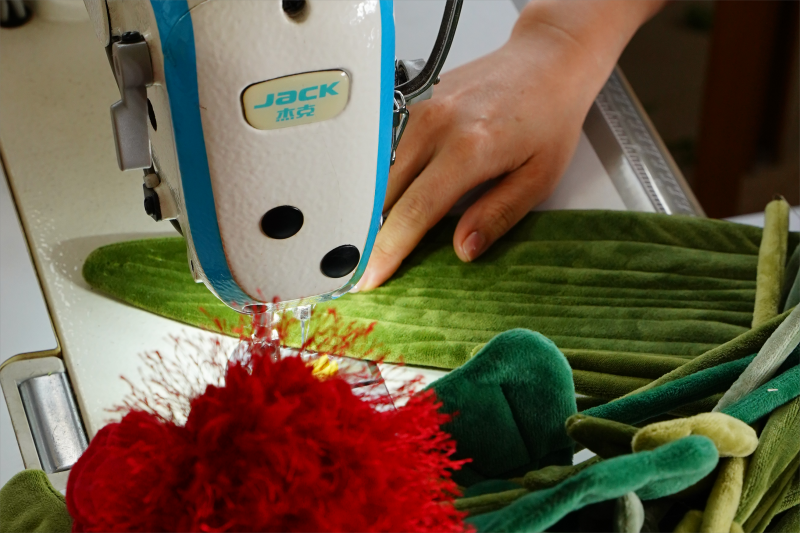
Plush flowers look simple at first glance. A soft flower head, a fabric stem, a sweet color, a giftable shape.
Then production begins.
That is where the real difference appears. One flower looks beautiful. Another from the same batch looks a little off. A stamen comes loose. A petal sits at the wrong angle. A small glue mark catches the light. A tiny hole in the fabric makes the whole item feel less polished.
For retail programs, event gifts, brand merchandise, campus shops, and wholesale collections, these small details matter. Plush flowers are bought with the eyes first. They need to look clean, balanced, and ready to give.
A reliable China plush flower factory should be judged by more than a sample photo or a low unit price. The stronger signs are flower-shape control, clean hand assembly, stable detail attachment, retail-aware packaging, realistic customization support, and a clear way to compare bulk goods with the approved sample.
What Makes Plush Flowers Difficult to Produce Well?
Plush flowers are not produced exactly like traditional plush toys.
A plush toy usually depends on a body pattern, stuffing, sewing, and character details. A plush flower depends on a different set of details: petal layers, leaf placement, flower center parts, hand assembly, stem structure, and the way the final piece looks in a bouquet or display box.
That difference matters.
A flower can feel soft but still look unfinished. It can use a nice fabric but lose value because the petals look messy. It can look good alone but feel inconsistent when 200 pieces are placed together in a display.
The challenge is not softness. The challenge is floral appearance.
A good plush flower should feel like a soft gift, but it still needs the visual logic of a flower. The petal direction, flower center, leaves, color balance, and overall proportion all work together. When one part is careless, the product becomes less giftable.
Sweetie-Gifts works with plush flower collections for retail, display, and custom gift programs. For current catalog options, email inquiry@sweetie-group.com.
The First Check: Does the Sample Look Like a Flower?
A sample should not be judged only by whether it looks “cute.”
That word is too broad. Many products look cute in one photo. A better question is whether the sample has a clear flower identity.
For example:
- Does the rose look like a rose?
- Does the tulip have the right softness and shape?
- Do the petals open naturally?
- Does the flower center look secure and clean?
- Do the leaves support the design visually?
- Does the product still look good when placed with other colors?
This is especially important for wholesale plush flowers because they are often sold as a collection. A single sample can be charming, but a retail display needs a group effect. The products should look coordinated when placed together.
| Sample Check | Why It Matters |
|---|---|
| Flower identity | The product should be recognizable, not just soft and colorful |
| Petal shape | Petal direction affects the whole flower appearance |
| Flower center | Loose or rough details reduce perceived quality |
| Leaf placement | Leaves change the balance of the design |
| Color grouping | Mixed colors should look like one collection |
| Display effect | Retail presentation depends on how many pieces look together |
A strong sample should answer one quiet but important question: would this still look attractive when repeated in bulk?
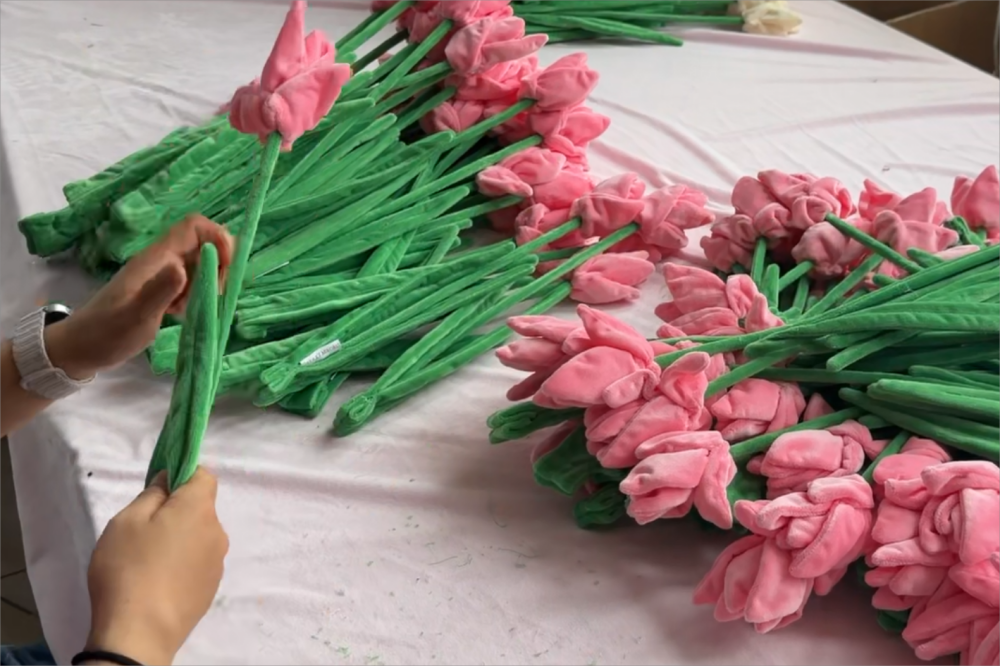
Workmanship Details That Decide Retail Quality
For plush flowers, workmanship is easy to overlook until the product is in hand.
The most common concerns are usually small. That is exactly why they matter. Plush flowers are close-view products. People pick them up, turn them around, touch the petals, and look at the details.
The key areas to check are fabric surface, flower center, petal and leaf attachment, glue control, and overall finishing.
| Workmanship Area | Good Standard | Warning Sign |
|---|---|---|
| Fabric surface | Clean, soft, no visible holes | Small holes, stains, heavy shedding |
| Flower center | Secure and neat | Loose stamen or uneven detail parts |
| Petal attachment | Firm and naturally layered | Loose, twisted, or uneven petals |
| Leaf attachment | Cleanly placed and stable | Leaves that look random or fall easily |
| Glue control | Hidden or cleanly applied | Visible glue overflow |
| Final appearance | Giftable and tidy | Rough handmade look |
A handmade product does not need to look machine-perfect. In fact, too much stiffness can make a plush flower feel lifeless. But there is a difference between handmade charm and careless finishing.
A good factory knows that difference.
How Bulk Production Should Stay Close to the Approved Sample
Every handmade plush flower will have small differences. That is normal.
The problem is not natural variation. The problem is uncontrolled variation.
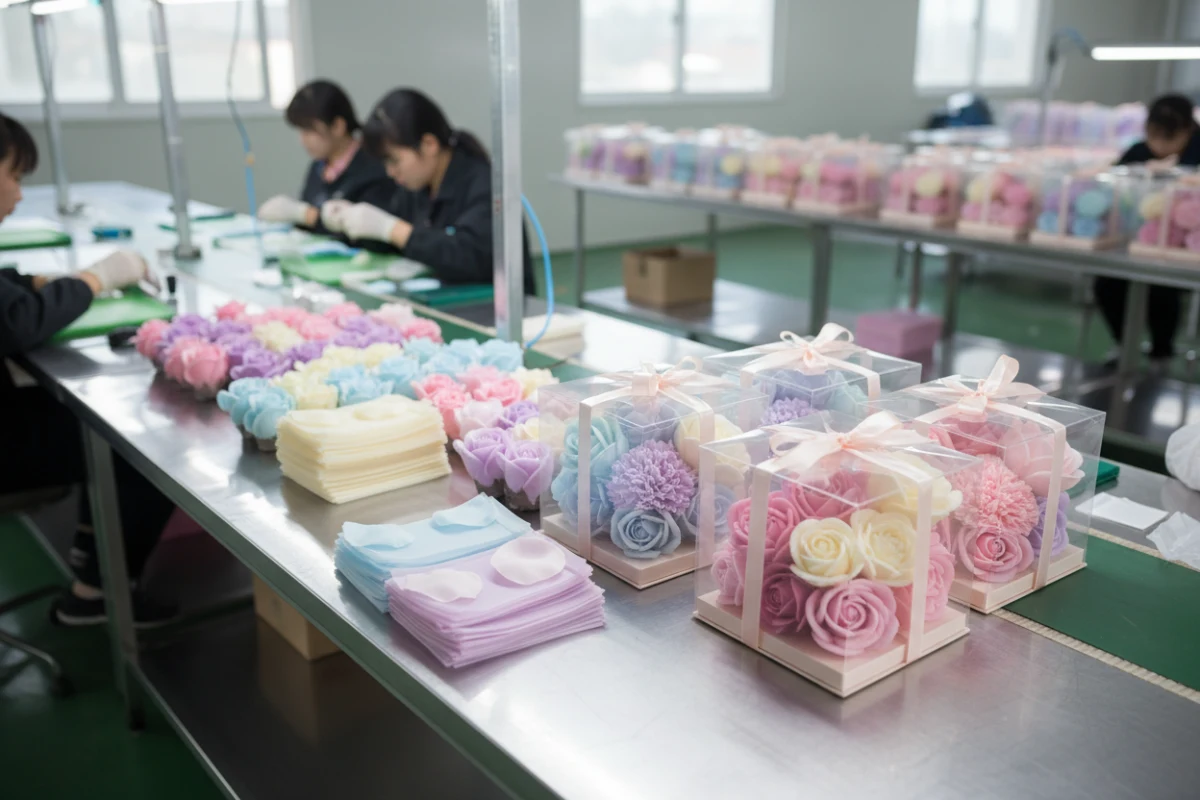
In a good production process, the approved sample becomes the reference point. It sets the standard for flower shape, flower center position, petal fullness, leaf placement, fabric color direction, and finishing quality.
For custom styles or larger programs, a pre-production sample is often useful. It confirms whether the design can be repeated before the full production run starts.
Useful control points include:
- Approved sample kept as reference
- Pre-production sample for new or custom styles
- Clear photo standard for flower shape and details
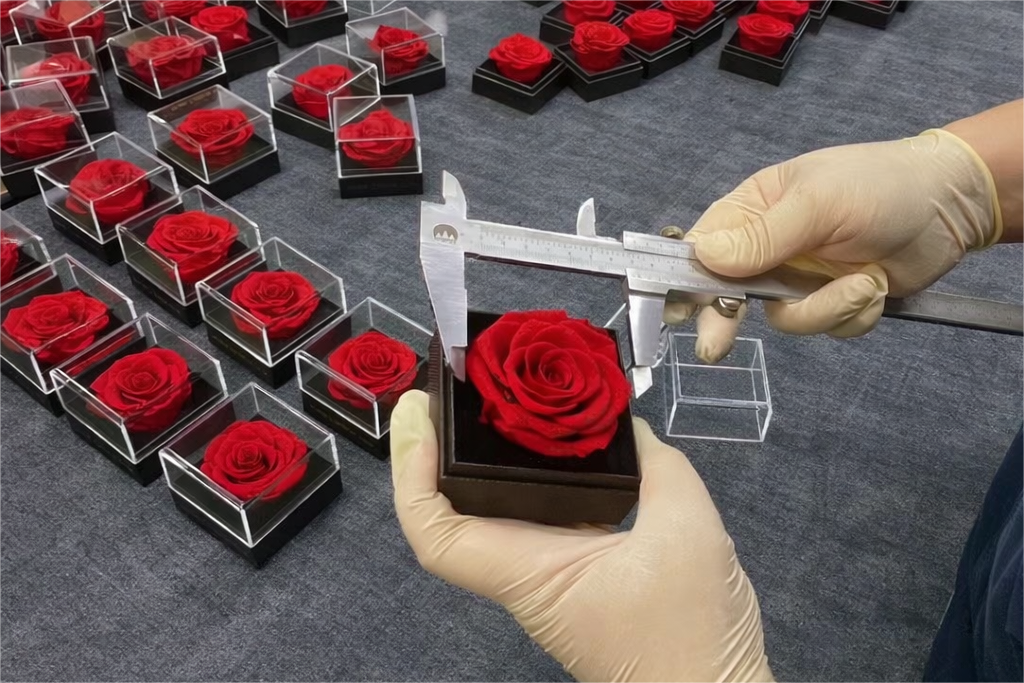
- Inspection of multiple pieces together, not only one piece
- Checking glue marks, holes, loose parts, and color consistency
- Packing review before shipment
The goal is not to make every flower identical. The goal is to make the collection feel stable, clean, and retail-ready.
For OEM or ODM plush flower projects, Sweetie-Gifts can help review style direction, sample standards, and packaging options. Contact inquiry@sweetie-group.com.
Packaging Is Part of the Product
For plush flowers, packaging does more than hold the item.
It affects how the product is seen, picked up, scanned, stored, and gifted. A nice flower in weak packaging may look unfinished. A simple flower in a clean display box may feel more valuable.
Different sales channels need different packaging logic.
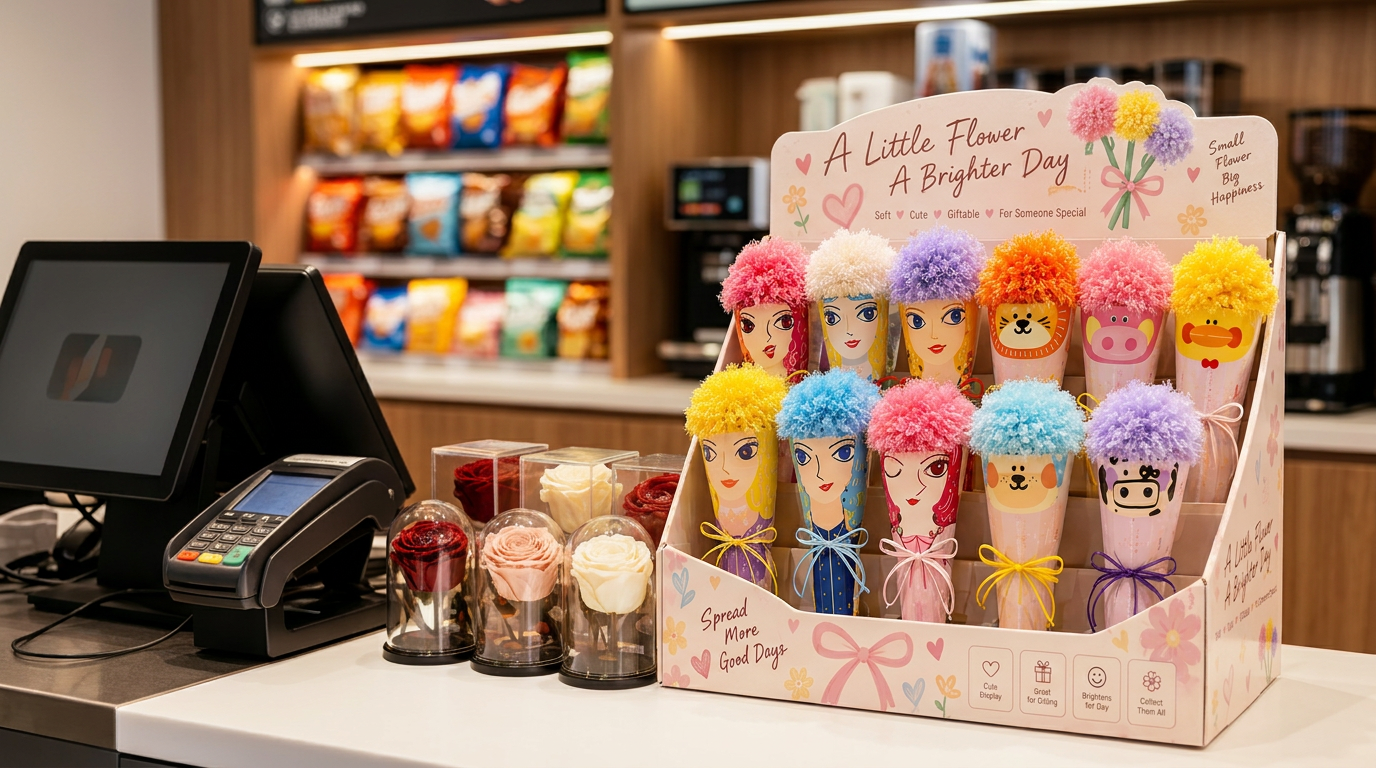
Single-stem plush flowers often work well in sleeves, display boxes, or bucket-style displays. These formats are suitable for supermarkets, campus stores, souvenir shops, lifestyle stores, and gift retailers.
Gift boxes are better for premium sets, brand events, seasonal programs, and promotional gifts.
Blind boxes can work for collectible retail, but they need better SKU control. The outside packaging must be clear enough for operation while keeping the surprise element.
| Packaging Format | Best Use | Main Point to Check |
|---|---|---|
| Sleeve pack | Single-stem retail | Clean handling and easy display |
| Display box | Gift shops, supermarkets, campus stores | Organized color and style presentation |
| Gift box | Premium gifts and brand programs | Higher perceived value |
| Blind box | Collectible and novelty retail | SKU coding and assortment control |
| Bulk carton | Wholesale distribution | Clean sorting and easy receiving |
Good packaging should keep the product clean, organized, and easy to sell. It should not make the flower look crowded, messy, or difficult to inspect.
Custom Plush Flowers: What Is Easy and What Needs Development?
Customization is one reason plush flowers are attractive for brand programs and retail collections.
But not every customization request has the same complexity.
Simple branding is usually the easiest place to start. This may include hangtags, logo stickers, greeting cards, sleeve artwork, barcode stickers, or display-box graphics.
Collection-level customization is more involved. This may include a color series, bouquet combinations, flower pots, baskets, seasonal themes, or gift-box sets.
Full product development takes more time. New flower shapes, special fabrics, character-related concepts, IP ideas, or exclusive event designs often require pattern development, sample revisions, and more detailed approval.
| Customization Type | Examples | Practical Note |
|---|---|---|
| Basic branding | Hangtag, sticker, card, barcode, sleeve artwork | Fastest and most flexible |
| Retail collection | Color series, bouquet mix, pot, basket, display box | Good for stores and seasonal programs |
| Full development | New flower shape, special fabric, IP concept | Needs more sampling and review |
A practical factory should be honest about what is easy, what needs testing, and what may affect cost or production time. Overpromising at the sample stage often creates trouble later.
Labeling and Classification Should Be Discussed Before Printing
Plush flowers may be sold as decorative gifts, event merchandise, souvenirs, or retail floral gifts. In some channels, especially child-focused channels, product classification needs extra care.
The classification depends on product design, label wording, age grading, marketing claim, and sales channel.
For the EU market, toys must meet safety requirements under the Toy Safety Directive. The European Commission explains that toy safety requirements cover general risks as well as physical, mechanical, flammability, chemical, electrical, hygiene, and radioactivity risks. The Commission also states that all toys sold in the EU must carry CE marking.
For the U.S. market, the CPSC explains that ASTM F963 is a mandatory consumer product safety standard for children’s toys, and defines a toy as an object designed, manufactured, or marketed as a plaything for children under 14 years of age. (U.S. Consumer Product Safety Commission)
For general consumer products in the EU, product safety and labeling requirements may still apply under broader product safety rules. (European Commission)
Before packaging is printed, it is sensible to clarify:
- Intended use
- Product name
- Material information
- Country of origin
- Barcode
- Warning label if needed
- Small parts or decorative details
- Inner support material if used
- Importer or retailer label requirements
This is not legal advice. It is a practical sourcing reminder: label discussions should happen early, not after cartons are ready.
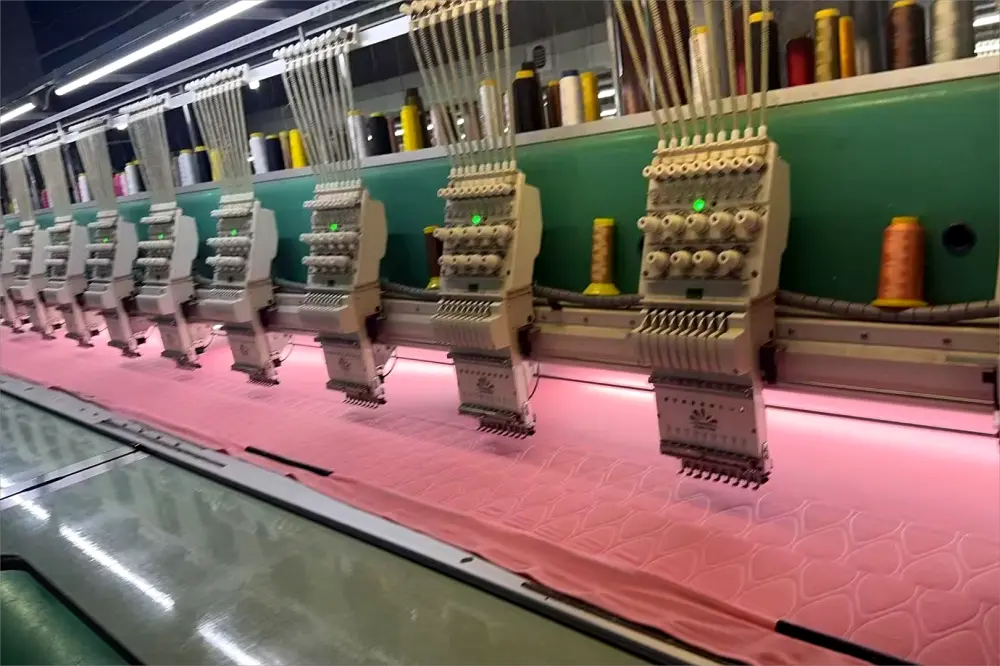
Factory Capability Signals Worth Checking
A strong plush flower factory is not only a place that can make a sample.
It should also be able to repeat the sample, adjust packaging, support retail presentation, and manage hand-assembled details in bulk.
The following signals are worth checking before moving further:
| Capability Signal | What It Shows |
|---|---|
| Existing plush flower experience | The factory understands this category, not only regular plush toys |
| Floral styling awareness | Petals, leaves, center details, and colors are handled with flower logic |
| Clean hand assembly | Glue, loose parts, and detail placement are controlled |
| Sample approval process | Bulk production has a clear reference standard |
| Retail packaging support | Display boxes, sleeves, gift boxes, or hangtags can be arranged |
| Customization process | The factory can separate simple branding from full development |
| Inspection support | Photos, videos, or sample comparisons can be provided |
| Export awareness | Labeling, carton sorting, and retail requirements are considered |
A low price may help a trial order, but reliable execution protects the whole program.
A Quiet Checklist Before Moving Forward
Before confirming a plush flower order, the final review can stay simple. A short checklist often prevents long conversations later.
| Area | What to Confirm |
|---|---|
| Product direction | Single stem, bouquet, pot, basket, gift box, display box |
| Flower style | Rose, tulip, orchid, seasonal, fantasy, or brand-specific |
| Visual standard | Flower shape, petal layers, center detail, color direction |
| Workmanship | Holes, glue marks, loose threads, stains, loose parts |
| Assembly quality | Petals, leaves, stamen, decorative details |
| Packaging | Sleeve, display box, blind box, gift box, bulk carton |
| Labeling | Material, barcode, country of origin, warning if needed |
| Customization | Logo, card, color series, artwork, exclusive style |
| Production control | Approved sample, pre-production sample, inspection photos |
| Retail presentation | How the product looks when displayed as a group |
A plush flower is a small product with a visible personality. When the flower shape, workmanship, packaging, and sample standard are clear, the whole sourcing process becomes easier to manage.
For wholesale plush flowers, retail-ready packaging, or custom development projects, email inquiry@sweetie-group.com.
FAQ
What should a China plush flower factory be able to control?
A China plush flower factory should control flower shape, petal placement, stamen attachment, fabric finishing, glue marks, hand assembly quality, packaging presentation, and sample-to-bulk consistency.
Are plush flowers made the same way as plush toys?
No. Plush flowers may use plush fabrics and sewing techniques, but the final quality depends more on floral shape, petal layers, leaves, center details, and hand assembly than on body stuffing or character design.
What are common plush flower quality problems?
Common issues include uneven flower shape, loose stamen parts, visible glue marks, small fabric holes, loose threads, stains, messy petals, weak attachment, or inconsistent appearance across bulk production.
What should be confirmed before making a plush flower sample?
The most useful points are product format, flower style, size range, color direction, packaging type, and sales channel. Technical construction details can usually be handled by the factory after the product direction is clear.
Can plush flowers be customized for brands?
Yes. Common customization includes hangtags, logo stickers, greeting cards, barcode stickers, sleeve artwork, display boxes, color series, bouquet combinations, gift boxes, and seasonal themes. New shapes or IP-related designs need deeper development.
Are plush flowers toys or gifts?
It depends on design, labeling, marketing, age grading, and sales channel. Some plush flowers are decorative gifts. Others may need toy-related review if they are marketed for children or sold in child-focused channels.
What packaging works best for plush flowers?
Single stems often work well in sleeves, buckets, or display boxes. Premium sets may need gift boxes. Blind boxes can work for collectible retail, but they need clear SKU control and packaging codes.
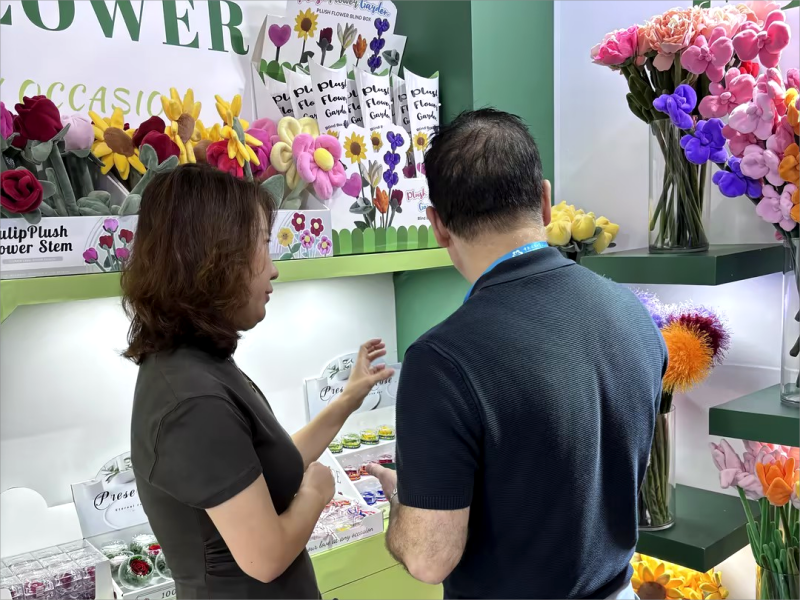
Annie Zhang, CEO of Sweetie Group