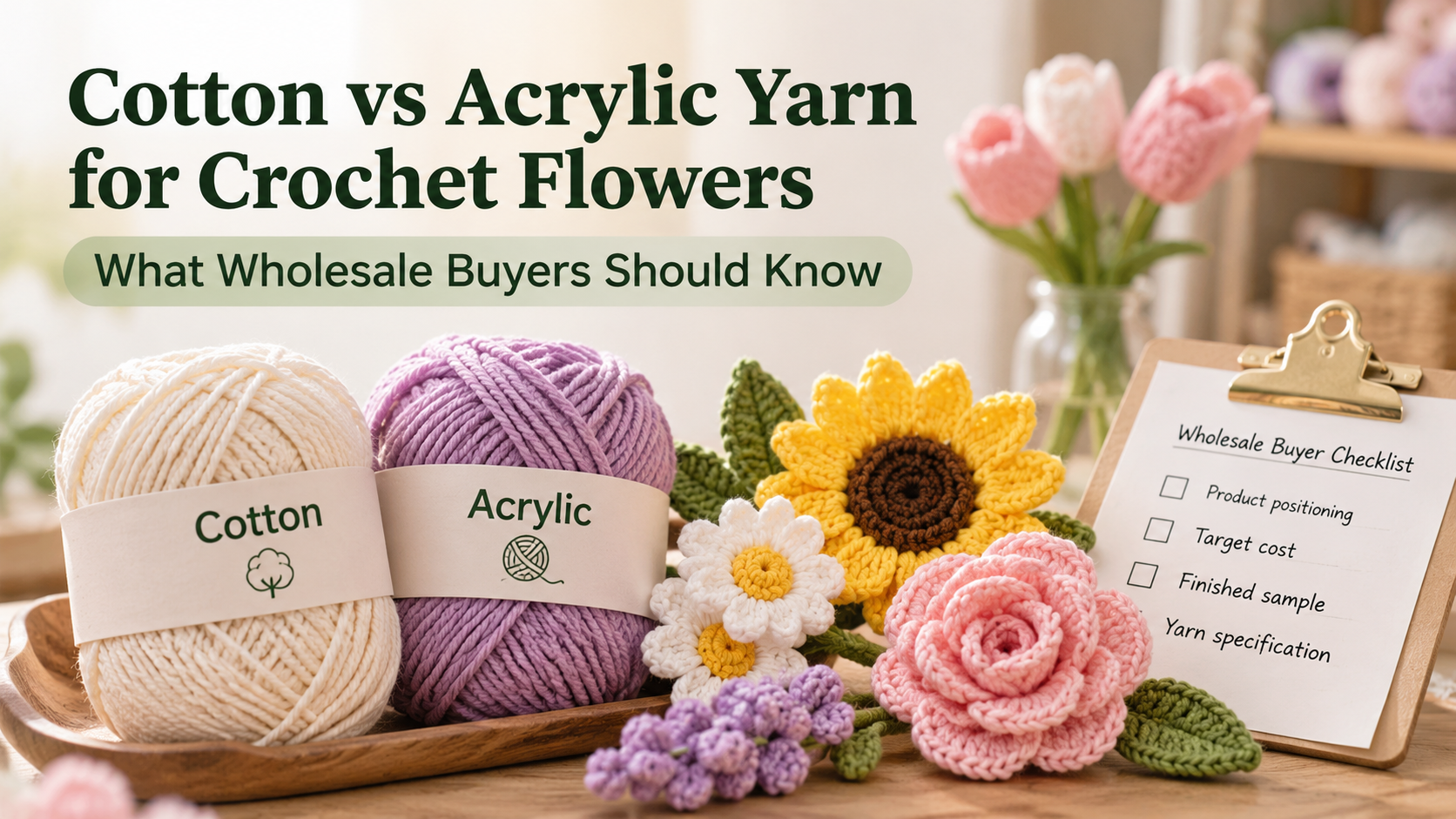
Two crochet flowers can look almost identical in a product photo. Once you hold them, compare the stitches, or place dozens of the same design together, the differences become easier to see.
For a wholesale buyer, this makes yarn selection more than a material question. It can affect the feel of the finished flower, how well the design takes shape, the cost of production, and how consistently the product can be reproduced in bulk.
So, is cotton or acrylic yarn better for crochet flowers?
There is no universal winner. Cotton and acrylic have different fiber characteristics, but the better choice depends on the flower design, target price, desired feel, retail positioning, and production requirements.
For wholesale orders, the most useful question is not simply “cotton or acrylic?” It is:
Which yarn will give this particular crochet flower the right look, cost, and production consistency?
Cotton vs Acrylic Yarn: The Short Answer
Cotton is a natural cellulosic fiber. It has relatively low resiliency, meaning it does not recover from deformation as readily as many synthetic fibers. Acrylic is a synthetic fiber that is generally soft, flexible, and capable of producing good loft.
Those differences are useful to understand, but they do not tell the whole story.
A tightly constructed cotton yarn can behave very differently from a softer cotton yarn. Two acrylic yarns can also produce noticeably different results. Yarn thickness, construction, hook size, crochet tension, and the flower pattern all affect the finished product.
For buyers, this is a more practical comparison:
| Buyer Factor | Cotton Yarn | Acrylic Yarn |
|---|---|---|
| Fiber type | Natural fiber | Synthetic fiber |
| Resiliency | Generally lower | Generally higher, depending on yarn construction |
| Hand feel | Depends on yarn construction and finishing | Depends on yarn construction and finishing |
| Finished flower shape | Must be checked on the actual sample | Must be checked on the actual sample |
| Color consistency | Requires batch control | Requires batch control |
| Cost | Depends on specification, usage, labor, and sourcing | Depends on specification, usage, labor, and sourcing |
The important takeaway is that fiber content is the starting point, not the final buying decision.
A wholesale buyer should approve the finished crochet flower, not the yarn name alone.
For crochet flower samples, custom development, or help comparing material and packaging options for a bulk project, email inquiry@sweetie-group.com.
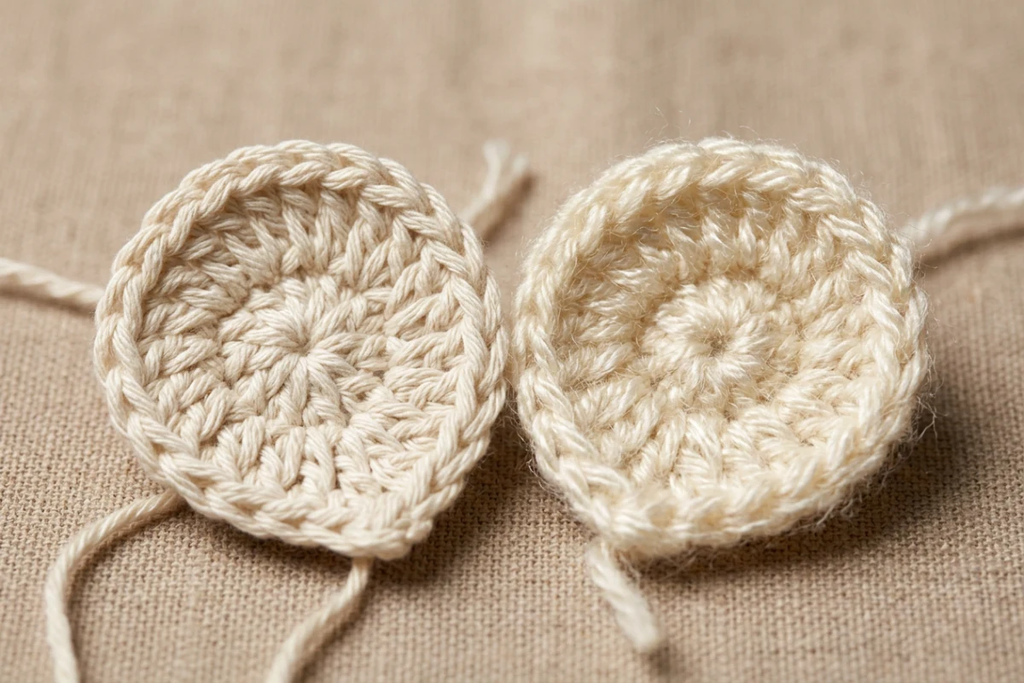
When Cotton Yarn Makes Sense for Crochet Flowers
Cotton yarn can be a good choice when a natural-fiber material direction fits the product and the finished texture works with the intended flower design.
When natural material is part of the product positioning
Some gift, lifestyle, and boutique collections are designed around natural materials and a visible handmade character. Cotton can fit well with that type of product concept.
That does not mean cotton automatically makes a crochet flower more premium.
The perceived quality of a finished flower also comes from the yarn quality, stitch consistency, flower proportions, stem construction, accessories, packaging, and overall presentation. A well-made acrylic flower can look more refined than a poorly executed cotton one.
Material should support the product positioning rather than define it by itself.
When hand feel matters to the retail experience
Crochet flowers are tactile products. Customers often pick them up, touch the petals, or hold a bouquet before buying.
This makes hand feel relevant for products sold in gift shops, flower shops, lifestyle stores, and other physical retail environments.
However, buyers should judge the finished flower rather than relying on a loose yarn swatch. The same yarn can feel quite different once it has been crocheted into multiple layers of petals or a dense flower center.
For an important retail program, the finished sample is a better decision tool than the fiber label.
What buyers should check
When reviewing cotton yarn for crochet flowers, focus on a few practical points:
- yarn thickness
- approved color
- finished flower dimensions
- stitch appearance
- surface texture
- availability for future production
These specifications are more useful than simply writing “cotton yarn” on a purchase requirement.
When Acrylic Yarn Makes Sense for Crochet Flowers
Acrylic yarn can also work well for crochet flower products when its feel, resilience, and finished appearance suit the design.
When the yarn works well with the flower structure
Acrylic fibers are generally soft, flexible, and high in loft. These characteristics can be useful in textile products, but they should not be turned into a blanket claim that acrylic always holds a crochet flower shape better than cotton.
The actual result depends on the yarn and the flower.
A multi-layer rose, for example, places different demands on yarn than a simple tulip or daisy. A yarn that works well for one design may produce a completely different result in another.
That is why material selection should happen at the SKU level rather than setting one rule for an entire crochet flower category.
When the approved yarn fits a larger assortment
Retailers often want several colors or flower types within the same collection.
In that situation, acrylic can be a practical option when the selected yarn offers the required colors, hand feel, flower structure, and supply availability.
The key point is not that every acrylic yarn offers a wider color range. Color availability depends on the actual yarn supplier and specification.
For a wholesale buyer, the more useful questions are:
Can the supplier obtain all the colors needed for the collection? Can those colors be maintained during the production run? If the product sells well, will a similar yarn still be available for the next order?
These questions matter more than the generic fiber category.
What buyers should check
When approving an acrylic yarn, look closely at the finished surface.
Check whether the flower is too fuzzy, whether the softness suits the retail positioning, whether stitches remain clear enough for the design, and whether the finished piece has the expected proportions.
Again, the goal is not to choose “acrylic” as a category. It is to approve a specific acrylic yarn in a specific crochet flower.

What Matters Beyond Fiber Type?
When buyers compare cotton yarn for crochet flowers with acrylic alternatives, fiber composition is only one part of the specification.
Three other factors can change the finished result significantly.
Yarn thickness
Yarn weight refers to yarn thickness. The Craft Yarn Council groups yarn into standardized weight categories and provides corresponding ranges for crochet gauge and hook sizes.
Buyers do not need to memorize the yarn-weight system, but they should understand why thickness matters.
Changing to a thicker or thinner yarn can change the size, proportions, stitch appearance, and material consumption of a crochet flower. The Craft Yarn Council also notes that substituting one yarn weight for another can change the size and appearance of a finished project.
For bulk production, yarn thickness should therefore be connected to the approved flower dimensions.
“Cotton yarn” is not a complete specification. Neither is “acrylic yarn.”
Crochet tension and hook size
Crochet tension affects how tightly the stitches are formed. Hook size affects gauge as well. Craft Yarn Council guidance recommends checking gauge when hook size or yarn is changed because the finished dimensions can change with it.
This becomes particularly important with handmade flowers.
Even when two workers follow the same design, small tension differences can influence flower diameter, petal shape, or firmness. The goal in wholesale production is not to remove every sign that a product is handmade. It is to define an acceptable tolerance and keep the bulk order within that range.
Flower construction
A simple daisy and a multi-layer rose should not be treated as the same product with different shapes.
Petal count, stitch density, flower center, leaves, internal support, and stem construction all influence how the yarn behaves.
This is another reason why the best yarn for crochet flowers cannot be decided at category level. A material that works very well for one design may not be the best option for another.
How Yarn Choice Affects Wholesale Cost
Material matters to cost, but the price of the yarn itself is only one part of the calculation.
A useful way to think about crochet flower cost is:
Yarn cost + yarn consumption + crochet labor + flower complexity + accessories + assembly + packaging + order quantity = finished product cost
This matters because a lower-priced yarn does not automatically create a lower-priced finished flower.
One flower may require more yarn because of its size or density. Another may use less material but require much more manual work to create layered petals or detailed leaves. A third design may have additional stems, wrapping, ribbons, gift boxes, or other components.
Labor is particularly important because crochet flowers are handmade.
For this reason, wholesale buyers should compare the finished product cost against the approved specification, rather than deciding between cotton and acrylic based on the yarn price alone.
If you are developing a crochet flower collection and want help reviewing the material direction, design, target price, quantity, or packaging before sampling, contact inquiry@sweetie-group.com.

Why Yarn Consistency Matters in Bulk Production
Choosing the yarn for the sample is only the first part of the job.
The next question is whether the material can remain consistent when production moves from a few samples to hundreds or thousands of flowers.
Dye lots can create color differences
Yarn dyed in separate batches can have subtle shade differences. Craft Yarn Council guidance recommends using the same dye lot when applicable because different dye batches can vary in color.
For a consumer making one crochet project, a slight variation may be manageable. In wholesale retail, it can be more noticeable.
Imagine twenty pink crochet roses displayed next to each other in the same store. A small shade difference that looked harmless on an individual sample may become obvious across the display.
Color control becomes particularly important for:
- monochrome bouquets
- wedding collections
- branded color programs
- large displays
- repeat orders
For those projects, buyers should approve a clear color reference and ask how yarn batches will be managed during production.
Yarn substitutions should be controlled
Supply chains change. A yarn used for the original sample may eventually become difficult to source, or a supplier may propose another yarn that looks similar.
That does not necessarily create a problem. The problem comes when the substitution is treated as insignificant.
A different yarn can affect the surface, dimensions, firmness, stitch appearance, or color of the finished flower. For that reason, a meaningful material change should normally go through sample review rather than being accepted simply because the replacement looks similar on a yarn card.
In our product development process, customer requirements such as design style, color, materials, and accessories are reviewed before sampling. After the sample and revisions are confirmed, the project moves into production.
The same principle applies to crochet flower materials: approve the specification first, then use it as the production reference.
How to Choose the Right Yarn for a Wholesale Crochet Flower Order
A buyer does not need to become a yarn specialist to make a good material decision.
A more useful approach is to work backward from the product you actually want to sell.
Step 1: Define the retail positioning
Start with the customer and sales channel.
Is the product intended for a lifestyle boutique, flower shop, chain retailer, supermarket, online store, promotional program, or seasonal gift collection?
A boutique gift may place more emphasis on tactile details and presentation. A high-volume retail program may give more weight to cost control, consistency, packaging efficiency, and reliable replenishment.
Material selection becomes easier once the commercial role of the product is clear.
Step 2: Set the target cost
Share the target market, expected order quantity, and target buying price before developing too many samples.
This gives the supplier a realistic framework for recommending yarn, flower complexity, bouquet size, accessories, and packaging.
Without a cost target, it is easy to approve a beautiful sample and discover later that the design cannot support the intended retail price.
Step 3: Compare finished samples
If the yarn decision matters, compare finished flowers rather than loose yarn alone.
Look at the flower from the front, side, and back. Check the petals, flower center, leaves, and stem. Compare several samples next to one another and handle the product as a customer would.
The purpose is not simply to decide which yarn feels nicer.
It is to determine which finished product best matches the intended design and price position.
Step 4: Lock the production specification
Once the final sample is approved, record the material and product details that production needs to reproduce.
A practical yarn approval checklist includes:
- fiber composition
- yarn thickness
- approved color reference
- flower dimensions
- stitch and surface appearance
- approved finished sample
- material availability for the planned order
- expectations for future reorders
For custom projects, this becomes especially important because changes that seem small at yarn level can become much more visible across a complete bouquet.
If you are still deciding which floral products fit your budget, market, or sales channel, Sweetie AI can help you compare product options and build a preliminary purchasing plan before sampling.

Frequently Asked Questions
Is cotton or acrylic yarn better for crochet flowers?
Neither is universally better. Cotton and acrylic have different fiber properties, but the finished flower also depends on yarn thickness, hook size, tension, stitch construction, and product design. Wholesale buyers should make the final decision from a finished sample rather than fiber content alone.
Does cotton yarn make crochet flowers more expensive?
Not necessarily. The final wholesale cost also depends on yarn consumption, crochet time, flower complexity, accessories, assembly, packaging, and order quantity. A more expensive yarn does not always produce a more expensive finished flower, and a cheaper yarn does not always reduce total product cost.
Does acrylic yarn hold crochet flower shapes better?
Acrylic generally has higher resiliency than cotton at the fiber level, but this does not mean every acrylic crochet flower will hold its shape better. The yarn construction, thickness, crochet tension, hook size, and flower design also influence the finished structure.
Can cotton and acrylic yarn be used in the same crochet flower collection?
Yes. A collection does not have to use the same fiber for every SKU. What matters is whether each flower has an approved material specification and whether the collection looks coherent when the products are displayed together.
How can buyers reduce color differences in bulk crochet flower orders?
Approve a clear color reference and confirm the yarn specification before production. Where dye lots apply, controlling yarn batches can help reduce visible shade differences. Buyers should also compare products from different parts of the production run rather than checking only one sample.
Final Takeaway
Cotton and acrylic can both work well for crochet flowers. The better choice is the one that produces the right finished look, meets the target cost, and can be reproduced consistently when the order moves into bulk production.
For wholesale buyers, approving the finished sample and locking the yarn specification are more useful than choosing a fiber based on its name alone. Start with the product you want to sell, then select the yarn that supports that product.
For crochet flower samples, custom development, or help comparing material and packaging options for a bulk project, email inquiry@sweetie-group.com.
Annie Zhang