Most grocery teams don’t struggle because shoppers “don’t buy flowers.” They struggle because flowers behave like a fragile department inside a system that demands repeatability.
I’ve seen this pattern over and over: a floral gift test looks great in a few stores, then falls apart when it expands. Packaging scuffs. Displays look inconsistent. Store teams don’t have time to babysit product. Shrink becomes unpredictable. The category gets labeled “nice, but messy,” and it loses priority to categories that scale more cleanly.
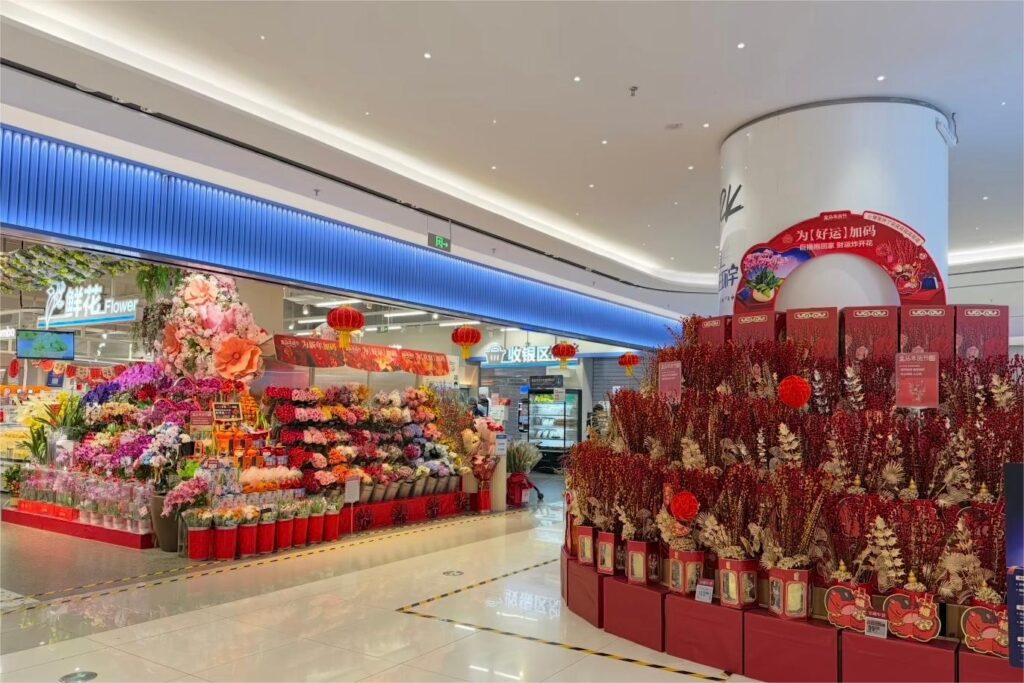
What changed my view was watching Alibaba’s Freshippo treat floral as an engineered retail program, not a decorative add-on. Through Freshippo Garden, they built a way to run flowers with the same discipline as any serious seasonal category: clear roles for product formats, a calendar that respects retail reality, and packaging designed to survive the supply chain.
This post is written for grocery buyers and retail operators. I’m not asking you to copy China’s market. I’m sharing the parts that translate directly to conditions: labor constraints, last-mile pressure, seasonal spikes, and the need for “store-ready” execution.
If you’re planning Mother’s Day, Valentine’s season, or Q4 gifting and want a fast sanity check on what typically breaks at scale, email me at inquiry@sweetie-group.com. I’ll share a simple evaluation checklist we use before a program goes wide.
Why floral gifts fail when you scale them in grocery
When a program expands from 10 stores to 300, three things usually happen:
- Store labor becomes the bottleneck.
The more “hands-on” a product is, the more it depends on the best associates in the best stores. That’s not scalable. - Damage and presentation drift get expensive.
A floral gift doesn’t have to arrive broken to be unsellable. A scratched box, a shifted arrangement, or a crushed corner can kill conversion fast. - The format doesn’t match the job.
Fresh is powerful, but not every retail mission should be built on perishability. Some missions need stability and a longer selling window.
Freshippo Garden’s approach works because it starts with those constraints, not with a mood board.
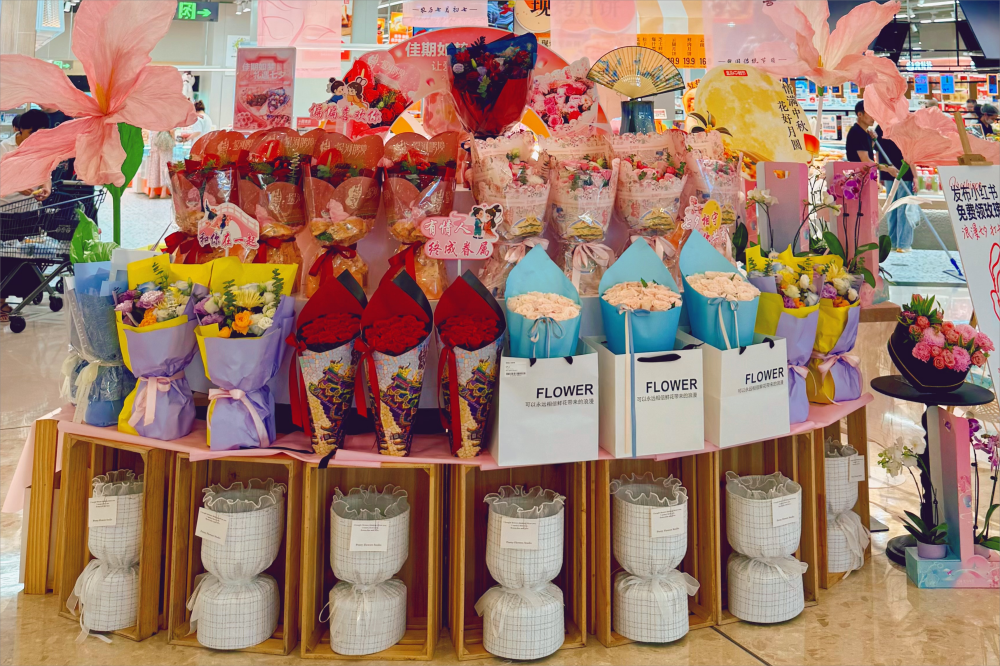
The friendly way to think about flowers: “traffic” vs “gifting”
In grocery, I like to separate floral into two goals:
1) Traffic flowers
These are everyday purchases. They drive impulse and routine: a shopper grabs something quick, usually price-sensitive, often tied to freshness cues.
2) Gifting flowers
These are seasonal and occasion-driven. The shopper is buying “meaning,” not stems. Presentation matters more, and packaging becomes part of the value.
Here’s the key: traffic flowers depend on store execution and shrink management. Gifting flowers depend on program design and packaging survival.
Freshippo Garden’s play is strong because it doesn’t force one model to do both jobs.
Where preserved floral fits in a grocery environment
A lot of teams treat preserved flowers as a niche “boutique” item. I see them differently when the goal is scale.
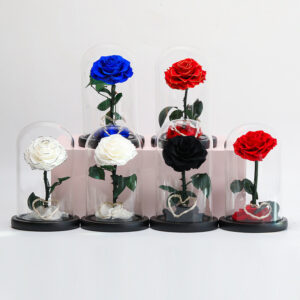
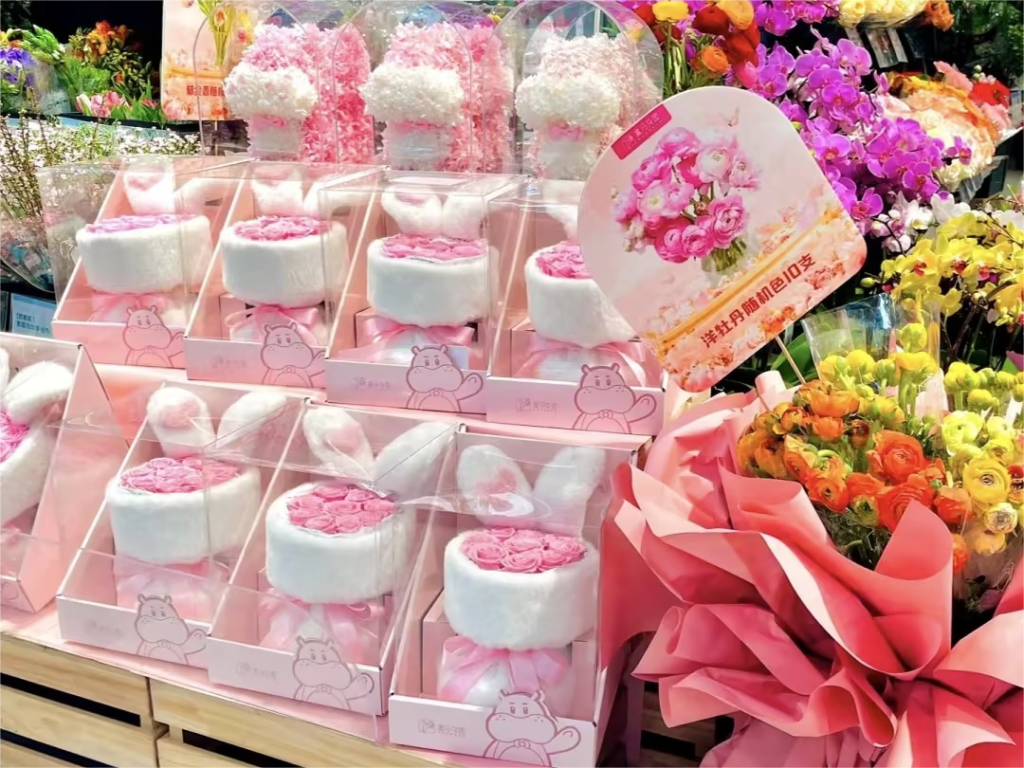
Preserved floral gifts can be a practical tool when you need:
- A longer selling window for seasonal displays
- More predictable arrival condition after shipping and handling
- Less store maintenance compared to perishable product
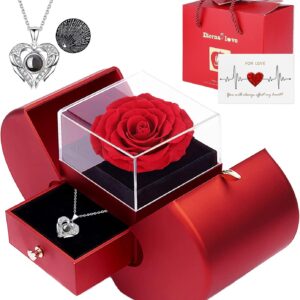
- Giftable packaging that communicates value quickly
This isn’t a “fresh vs preserved” argument. It’s format selection based on operational truth. Fresh wins when you want immediacy. Preserved wins when you need reliability.
The most scalable programs I’ve seen use both formats intentionally, with clear roles.
The scaling lever most grocery teams underestimate: store-ready packaging
In grocery, packaging isn’t just branding. It’s an operational control system.
When I evaluate a floral gift concept for chain rollout, I focus on four questions:
- Will it still look premium after transport, stocking, and customer handling?
- Can a busy associate merchandise it in under 30 seconds?
- Does the customer understand the gifting value in three seconds on shelf?
- Does the packaging protect the product while improving display?
This is where Freshippo Garden’s mindset is worth copying. They treat packaging as the bridge between a good design and a stable in-store experience.
In practice, “store-ready” packaging often includes:
- strong internal fixation so the arrangement doesn’t shift
- surface protection to reduce scuffs and scratches
- a structure that stands cleanly on shelf or in a PDQ-style display
- a clear front-of-pack message that matches the occasion
If you’re trying to reduce damage rates in a grocery rollout, email inquiry@sweetie-group.com and tell me your channel (grocery, drug, club, convenience) and target price points. I’ll respond with packaging options that typically work in retail environments.
A simple rollout framework you can use for grocery chains
This is the part I wish more teams wrote down before they launch. It saves money and protects timelines.
Step 1: Build a “good, better, best” gift ladder
You don’t need dozens of SKUs. You need a ladder that makes sense.
- Good: entry gift, fast decision, small footprint
- Better: stronger packaging, more perceived value
- Best: statement gift, premium presentation, fewer units but high impact
A ladder improves conversion because customers don’t have to guess what’s appropriate.
Step 2: Define your merchandising method before you pick the design
Choose where and how it will sell:
- endcap
- checkout and impulse zones
- seasonal table
- floral department adjacency
- front-of-store promotional area
This decision drives packaging shape, stability needs, and how “grab-and-go” the product must be.
Step 3: Lock “non-negotiables” that protect chain-wide consistency
In grocery scale, consistency is profitability. Your non-negotiables should include:
- acceptable range for color and presentation
- packaging durability requirements
- drop and vibration tolerance during transit
- carton configuration that matches DC and store workflows
- labeling and compliance needs for your market
When these are set early, you avoid expensive rework mid-season.
Step 4: Treat seasonal floral as a repeatable program, not a one-off
The strongest retailers run a feedback loop:
- What damaged out?
- What sold through early?
- Which price points overperformed?
- Which displays were easiest for stores to maintain?
Then they improve the next season instead of reinventing everything.
That’s how a category compounds.
What we’ve learned from working with Freshippo Garden
I’ll keep this grounded and practical. The most transferable lessons are:
- Design for store reality, not studio perfection.
A product that’s 10 percent less delicate can be twice as profitable at scale. - Make gifting obvious at shelf distance.
Occasion cues, color stories, and packaging structure should reduce decision time. - Plan around retail calendars like a supply chain program.
The earlier you lock packaging and “must-have” specs, the smoother rollout becomes. - Protect execution simplicity.
Anything that requires careful handling will break somewhere in a 500-store network.
These principles aren’t China-specific. They’re retail-specific.
Where Sweetie fits if you want to build a scalable floral gift program
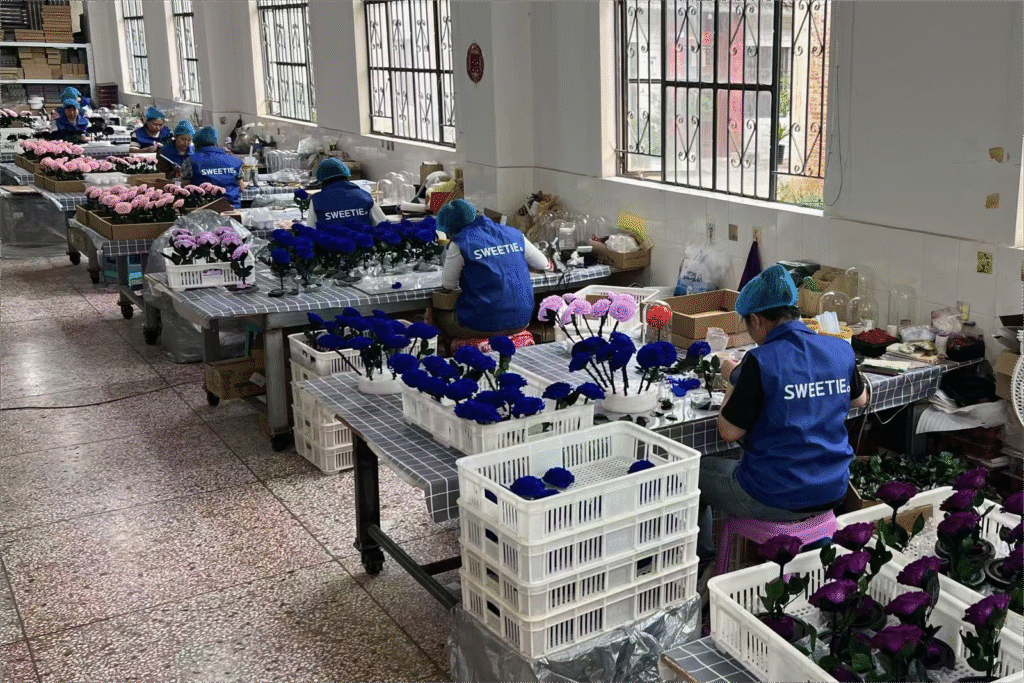
When Sweetie-Gifts support retail programs, we focus on the parts that usually block scale: product structure, packaging engineering, sampling discipline, and reliable mass production.
I’m not trying to convince you with big claims. I prefer to start with your constraints: channel, price ladder, display method, shipping path, and seasonality. From there, we can recommend formats and packaging that are realistic for grocery execution.
If you’d like to explore a program, email inquiry@sweetie-group.com with:
- your target holidays or seasons
- your channel type and store count
- your target retail price points
- whether you prefer fresh-forward, preserved-forward, or mixed formats
I’ll reply with a practical starting plan and what we’d need to move fast.
Final thought
Grocery is a hard place to scale floral gifts. That’s exactly why the category can be valuable when it’s engineered correctly. The goal isn’t to make flowers “fancier.” The goal is to make them behave like a real retail program: predictable, repeatable, and easy for stores to execute.
Annie Zhang, CEO of Sweetie Group