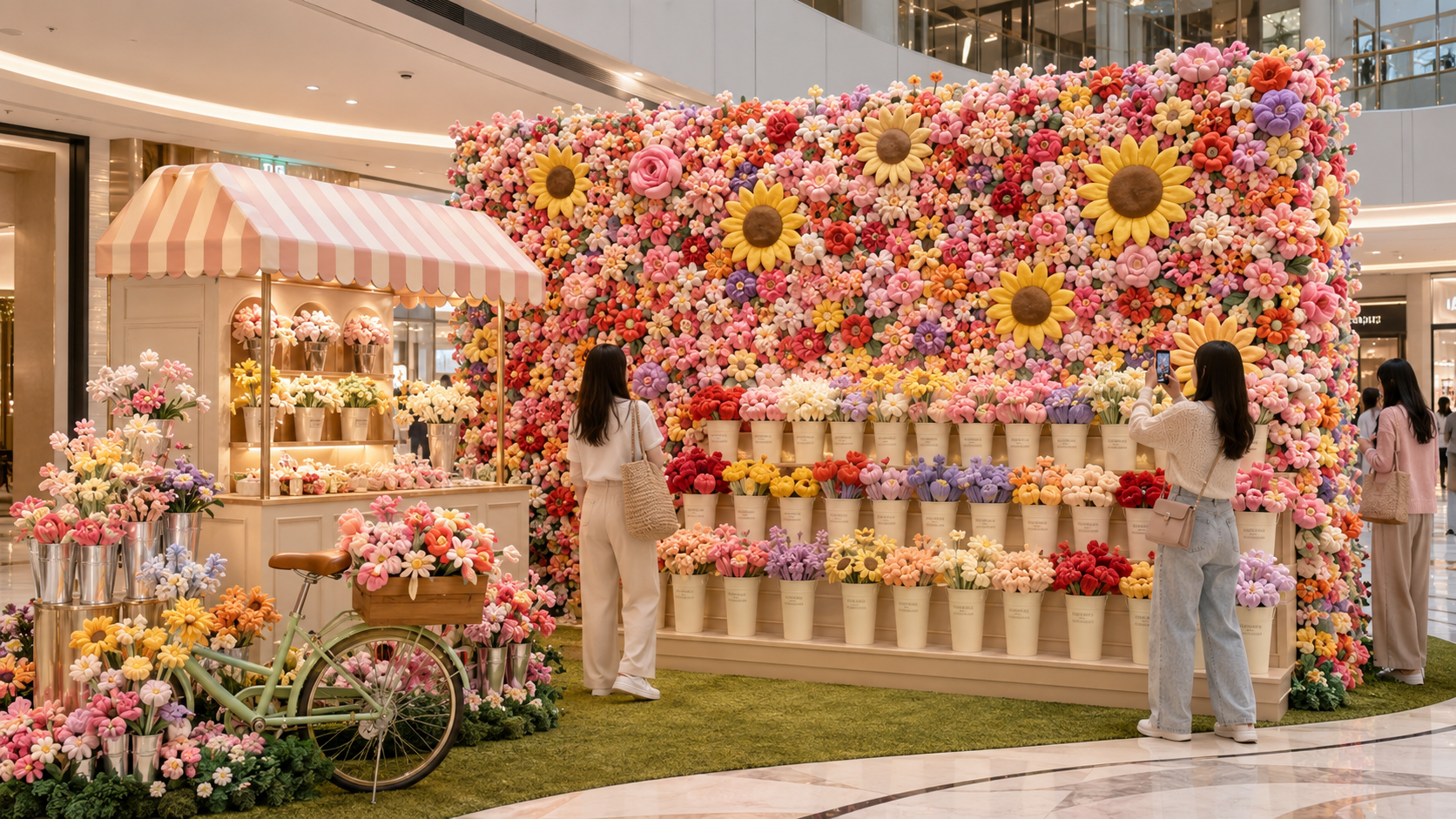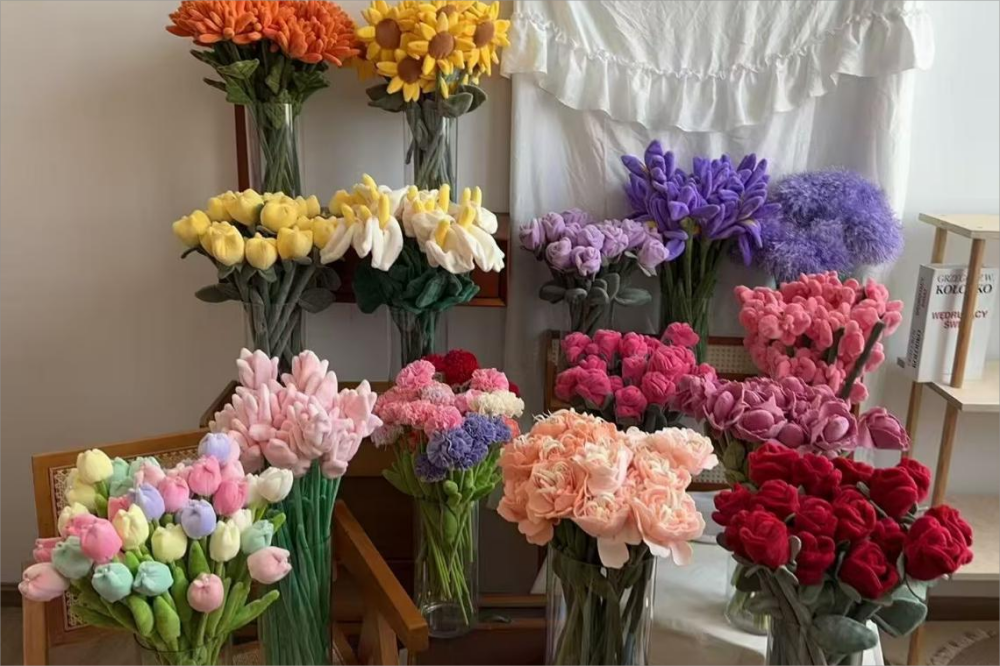
Plush flowers have already proved one thing: they can make people stop.
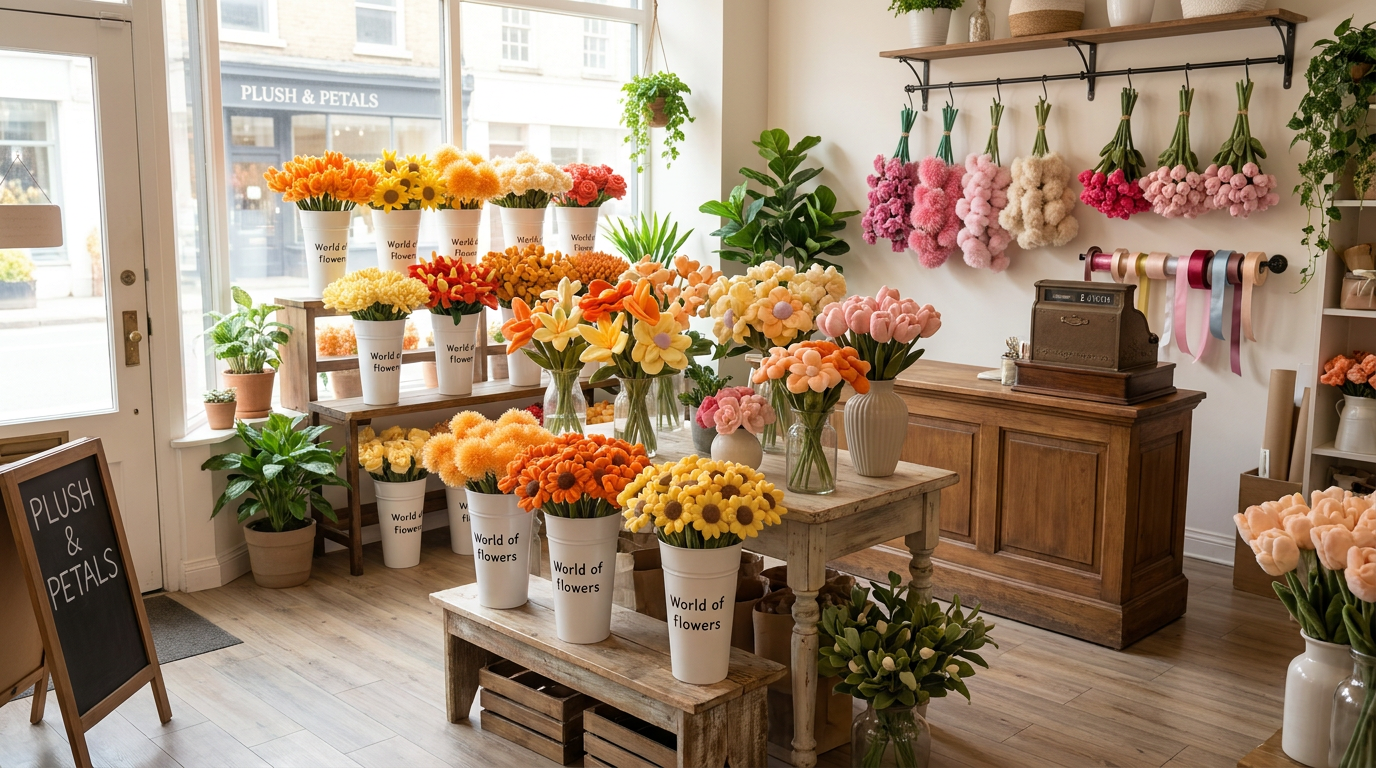
A colorful flower wall, a soft flower bar, or a playful pop-up display has the kind of visual pull that many retail products dream of. People notice it. They touch it. They take photos. Some want to bring one home.
But a retail shelf is a much harder place to win.
There is no event lighting. No crowd. No “limited-time” excitement. The product has to sit there quietly, inside packaging, with a price tag, competing with every other gift idea around it.
So the real question is not whether plush flowers can create attention. They can.
The better question is:
Can plush flowers become everyday retail gifts that customers actually buy, stores can display, and buyers can reorder?
The answer is yes — but only when the product is designed for retail, not just for a beautiful pop-up moment.
Pop-Up Success Is Only the First Signal
Pop-ups are useful because they show emotional response.
When people see a large plush flower display, they usually understand it immediately. It feels cheerful, soft, and easy to approach. Unlike some new gift products that need explanation, plush flowers carry a familiar symbol: the flower.
That is why recent plush flower installations and flower-market-style events matter. They show that people are willing to interact with this product, not just look at it. Choosing a flower, holding it, building a small bouquet, or taking it away from an event are all behaviors that move closer to retail.
But pop-up success can also be misleading.
In a pop-up, the environment does a lot of the work. The scale, colors, layout, and crowd make the product feel exciting. On a retail shelf, those supports are gone. The product must explain itself in seconds.
That is the gap between event attention and retail performance.
A pop-up answers:
Will people notice it?
Retail answers:
Will people buy it, gift it, and come back for more?
Planning a retail test for plush flowers? Email inquiry@sweetie-group.com for format and packaging suggestions.
Why Plush Flowers Have Real Retail Potential
Plush flowers are interesting because they combine two strong emotional triggers: flowers and softness.
Flowers already mean something. Love, thanks, celebration, comfort, apology, care. Customers do not need a long story to understand why a flower might be given.
Softness adds another feeling. It makes the product warmer, more casual, and more approachable. A preserved flower may feel elegant. A fresh bouquet may feel romantic. A plush flower feels friendly, cheerful, and easy to give.
That gives plush flowers a useful retail position.
They are not exactly toys.
They are not exactly artificial flowers.
They are not a replacement for fresh flowers.
They sit somewhere between floral gifts, soft gifts, seasonal décor, and lifestyle accessories.
That middle space is valuable because it opens several selling moments:
- Valentine’s Day
- Mother’s Day
- birthdays
- graduation gifts
- thank-you gifts
- spring displays
- small comfort gifts
- flower shop add-ons
- beauty or fragrance gift sets
- event giveaways
- museum or cultural souvenirs
The opportunity is not only in one holiday. That matters. If plush flowers depend only on Valentine’s Day, the inventory risk becomes too high. A stronger product line should work across several gift occasions.
The best plush flower products make customers feel:
“This is a flower gift, but softer, easier, and longer-lasting.”
That is a strong idea for retail.
The Three Tests Before Plush Flowers Reach the Shelf
Before plush flowers can become everyday retail gifts, they need to pass three simple but serious tests.
1. The Display Test
Can the product still look attractive in a normal store?
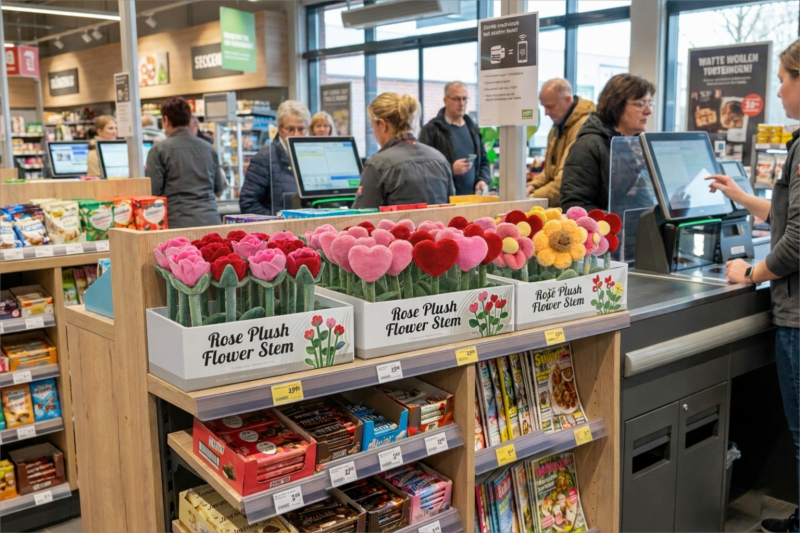
This is not as easy as it sounds. Plush flowers look wonderful when grouped in volume. But on a shelf, there may be only a small display, a few bouquets, or a single PDQ box.
If stems bend, flower heads flatten, or colors are mixed without order, the display can quickly look tired. A product that looked charming in a pop-up can feel cheap in-store if the presentation is not controlled.
Good display planning should make the product easy to understand, easy to touch, and easy to put back.
2. The Packaging Test
Can the packaging protect the flower and increase its value?
Packaging for plush flowers is not only about shipping. It shapes how customers read the product.
A single stem with no tag may feel unfinished. The same stem with a clean sleeve and small message card can feel like a ready gift. A boxed flower can feel premium, but only if the box shows the texture and does not hide the product too much.
The packaging needs to protect shape, show color, keep the product clean, and support the gift occasion.
3. The Reorder Test
Can the same product be supplied again with stable quality?
This is where the category becomes serious.
A first order may sell because the product is new. A second order shows whether it can become business. Color stability, flower shape, filling, stem quality, packaging size, and delivery timing all matter.
If the second shipment looks different from the first, confidence drops quickly.
| Retail Test | Main Question | Why It Matters |
|---|---|---|
| Display Test | Does it still look good in-store? | Keeps the product attractive after handling |
| Packaging Test | Does it protect and sell the product? | Improves value and reduces damage |
| Reorder Test | Can the same style be repeated? | Supports seasonal planning and repeat sales |
These tests may not sound exciting, but they decide whether plush flowers remain an event idea or become real retail SKUs.
Product Format Decides How Customers Buy
A plush flower is not just one item. It can become several different retail products depending on format.
That format changes how customers behave.
Single Stems
Single stems are the easiest entry point. They feel casual and low-risk. Customers can pick one up as a small gift, add-on item, or event takeaway.
They work well for checkout areas, display boxes, flower bars, and low-cost seasonal testing.
The risk is that loose single stems can look unfinished. A simple sleeve, hang tag, display bucket, or PDQ box helps them feel more intentional.
Mini Bouquets
Mini bouquets feel more like complete gifts. They are better for birthdays, thank-you gifts, Mother’s Day, and flower shop add-ons.
The key is proportion. A bouquet should feel full enough to be giftable, but not so large that packaging and shipping become inefficient.
Flower Pots and Baskets
Pots and baskets move plush flowers toward lifestyle décor. They can sit on a desk, shelf, bedside table, or gift counter.
This format can work well for gift shops, bookstores, museum shops, and lifestyle stores where the customer may buy the item for both gifting and decoration.
Gift Boxes
Gift boxes increase perceived value. They are suitable for beauty, fragrance, jewelry, corporate gifts, and holiday campaigns.
The box should not hide the flower completely. Plush flowers sell partly because customers want to see and feel softness. If the packaging blocks that, the product loses part of its charm.
Display Boxes and PDQ
Display boxes are especially practical for chain stores.
They help keep the shelf organized, reduce staff work, and make the product easier to place in seasonal aisles or checkout zones. For supermarkets and convenience stores, that practical value can be just as important as the flower design.
The lesson is simple: the format should match the way the product will be sold.
Different Channels Need Different Plush Flower Strategies
Plush flowers can work in several channels, but not with the same product plan.
Chain Supermarkets and Convenience Stores
These channels need clear display, simple pricing, and fast recognition.
Single stems, mini bouquets, and display boxes usually make more sense than complex gift arrangements. The product should be easy to pick up, easy to scan, and easy to restock.
Gift Shops and Lifestyle Stores
Gift shops need stronger emotion.
Color stories, wrapping, small cards, and gift-ready presentation matter here. Customers in this channel are often looking for something small but thoughtful.
Florists
For florists, plush flowers should be treated as a supplement, not a replacement.
They can work as long-lasting add-ons, young customer gifts, or seasonal corners. But the product needs to keep a floral feeling. If it looks too toy-like, it may not fit the shop’s image.
E-Commerce Sellers
For e-commerce, the biggest challenge is delivery.
The product must arrive close to the photo. Flower heads should recover after packing. Bouquets should not collapse. Packaging should protect shape without making freight cost unreasonable.
Beauty, Fragrance, and Jewelry Brands
For brand gift teams, plush flowers can add softness and emotion to a main product.
A small plush flower in a brand color can make a fragrance set feel warmer. A boxed flower beside jewelry can make the gift feel more complete. In this channel, the flower supports the brand story.
Museum Shops and Cultural Retail
This channel needs meaning.
A city flower, exhibition-inspired flower, artist color, or limited edition can make the product feel like a souvenir rather than a generic gift.
Need help choosing the right plush flower format for your sales channel? Contact inquiry@sweetie-group.com.
How to Test Plush Flowers Without Overbuying
A good test does not need to be big. It needs to be clear.
When a first order has too many styles, the sales result becomes hard to read. Did customers dislike the product? Was the color wrong? Was the price too high? Was the display weak?
A focused test gives better answers.
Start With One Channel
Do not test the same assortment everywhere at once. A supermarket shelf, a florist counter, and an e-commerce listing need different product formats.
Choose one main channel first.
Choose One Gift Moment
Connect the test to a clear occasion: Valentine’s Day, Mother’s Day, spring gifting, graduation, birthday, thank-you gifts, or a brand event.
A clear occasion gives customers a reason to buy.
Keep the Assortment Small
A practical first test may include:
- two or three single stem styles
- one mini bouquet
- one gift-ready or boxed option
That is enough to compare customer behavior without creating confusion.
Plan Display Before Production
The display should not be solved after the goods arrive.
Decide early whether the product needs a PDQ box, shelf tray, flower bucket, sleeve, hook card, or gift box. This helps avoid messy retail execution.
Review More Than Sales
Sales matter, but shelf condition matters too.
Ask:
- Did the display stay neat?
- Did customers understand the product quickly?
- Which color sold first?
- Did the packaging protect the flower?
- Did staff need to fix the display often?
- Was there a reorder request?
The second order should be sharper than the first. Keep what worked. Remove what only looked good in the catalog.
What Supplier Support Matters Most
A useful plush flower supplier should not only ask, “Which flower do you like?”
The better question is:
Where will this product be sold, and what does it need to do there?
For plush flowers, supplier support may include:
- product format suggestions
- packaging options
- display box or PDQ development
- seasonal color planning
- custom tags, cards, or belly bands
- trial order support
- OEM/ODM service
- color and shape consistency
- quality inspection before shipment
- realistic production timing for holidays
At Sweetie-Gifts, plush flowers are viewed as part of the broader floral gift market, not as ordinary soft toys. This is important. A plush flower carries the emotional meaning of a flower, but it also needs the execution discipline of a retail gift product.
Sweetie-Group works across preserved flowers, soap flowers, artificial floral gifts, rose bears, and plush flower products. Our customers include chain supermarkets, gift companies, online stores, flower shops, gift shops, convenience stores, and brand gift projects.
That experience helps us think beyond a single sample. We look at the selling channel, gift occasion, packaging structure, display method, and reorder potential.
For plush flower samples, wholesale programs, or custom gift packaging, email inquiry@sweetie-group.com.
Final Thought: Early Category, Real Opportunity
Plush flowers are not a fully mature retail category yet.
The market is still mixed. Some products are refined. Some look too childish. Some work well for events but not for shelves. Some photograph beautifully but lose shape after shipping.
But this does not mean the opportunity is weak.
It means the category is still being shaped.
Pop-ups proved that plush flowers can attract attention. Retail will decide which products can become stable gifts. The winners will not simply be the most colorful or the cutest. They will be the plush flowers that are easy to display, easy to gift, easy to ship, and easy to reorder.
That is how plush flowers move from a photo moment to everyday retail gifts.
Annie Zhang, CEO of Sweetie Group