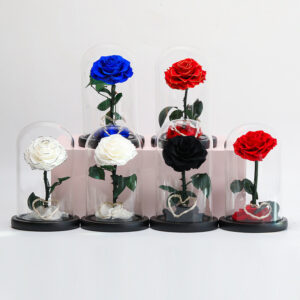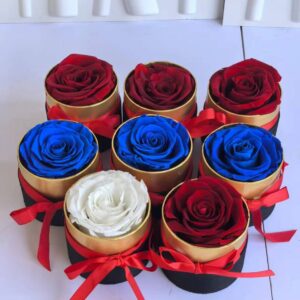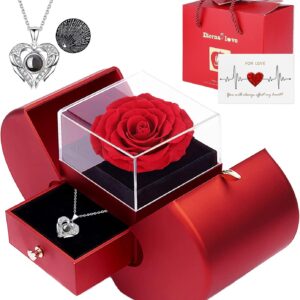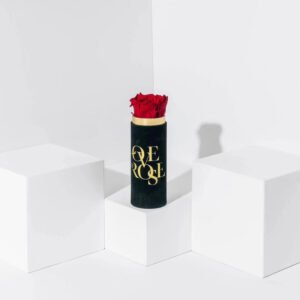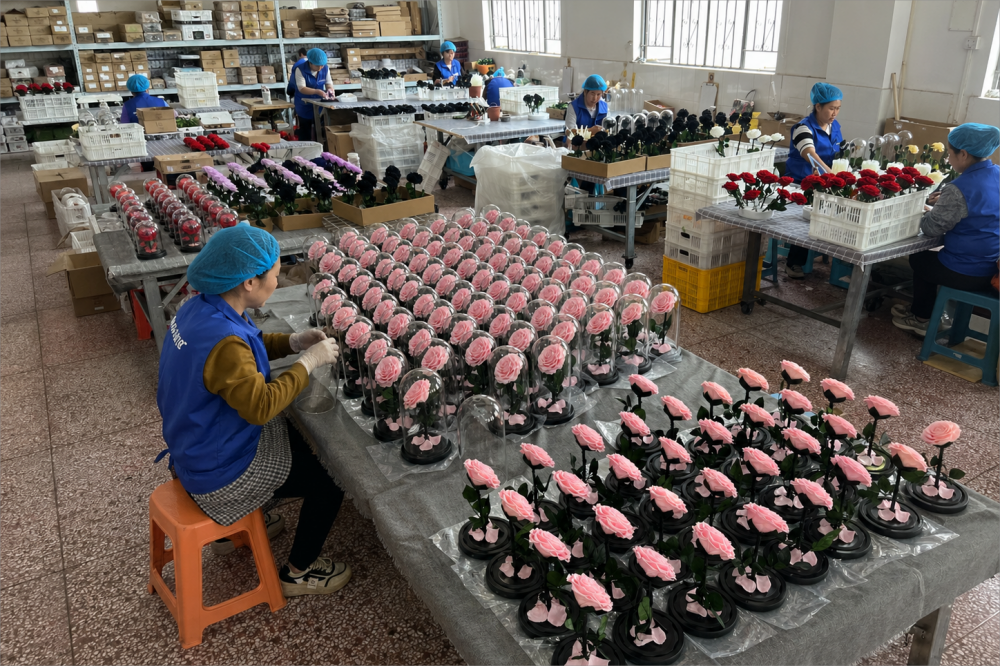
A preserved rose in glass dome is a gift product. That means the buyer is not only judging the rose. They are judging the full experience: the photo, the packaging, the delivery, the unboxing, and the emotional reaction of the person receiving it.
That is why sourcing this product requires a different mindset.
A pretty sample is a good start. But for e-commerce, the real question is:
Can this supplier help you sell the same product again and again without creating returns, complaints, or unnecessary work for your team?
Expert Answer
For online sellers, the right preserved rose in glass dome production partner is not simply the one with the lowest price. A reliable partner should understand e-commerce packaging, bulk consistency, raw material control, fragile shipping, customization, seasonal delivery, and customer review risks.
Why This Product Is More Complicated Than It Looks
At first glance, a preserved rose in a glass dome seems easy to source.
It has a clear shape.
It photographs well.
It is romantic.
It fits many gift occasions.
But online selling adds pressure that a showroom sample never faces.
A product may look perfect on a supplier’s table, but it still needs to survive:
- Bulk production
- Warehouse handling
- Long-distance transportation
- Parcel delivery
- Customer unboxing
- Public reviews
- Repeat orders during peak seasons
That is where many sourcing problems appear.
For this category, the most common e-commerce risks are broken glass domes, loose stems, fallen rose heads, weak gift boxes, color differences, lights not working, and products that look smaller or less premium than expected.
A good supplier should understand these risks before the first bulk order is placed.
If you are comparing preserved rose in glass dome options for an online store, you can contact our team at inquiry@sweetie-group.com for product and packaging suggestions.
Start With the Selling Channel Before Choosing the Product
A reliable sourcing decision starts with one basic question:
Where will this product be sold?
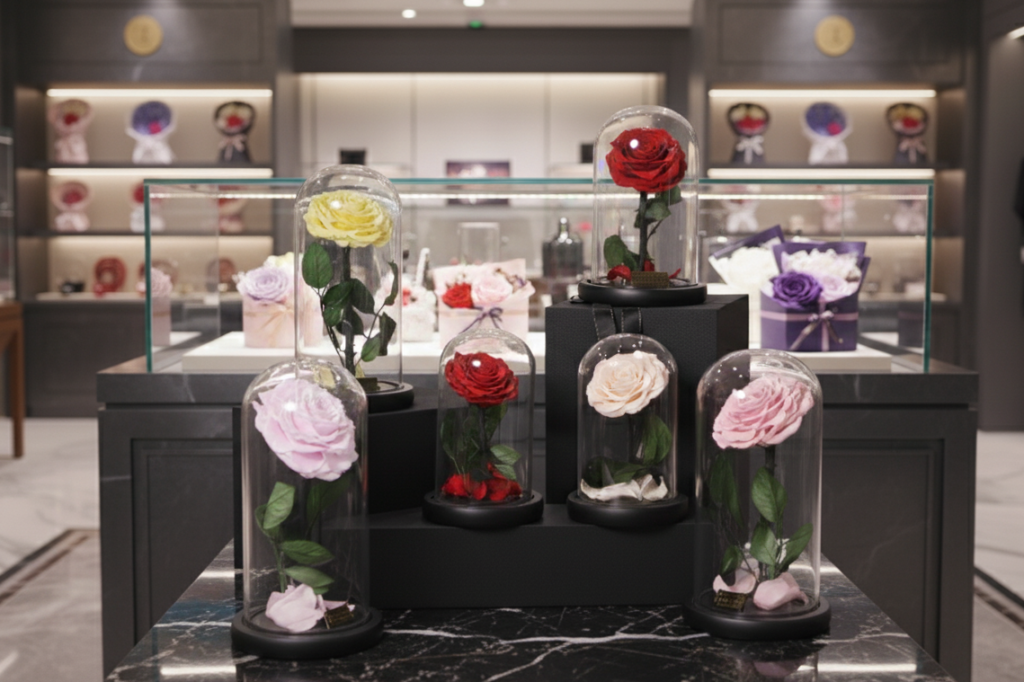
A preserved rose in glass dome for Amazon may need a different design from one sold on Etsy, a Shopify store, a gift marketplace, or a seasonal retail program.
Amazon Sellers
Amazon sellers usually need stable quality, clear dimensions, strong packaging, simple SKU management, and low complaint risk. A product that looks beautiful but breaks easily is dangerous for this channel.
Etsy Sellers
Etsy sellers may care more about personalization, special colors, engraving, handmade feeling, and gift messages. The product can be more emotional and niche.
Independent Online Stores
Brand-owned stores often need stronger packaging identity, storytelling, premium presentation, and better perceived value.
Gift Retail and Seasonal Programs
Gift retailers may care about shelf appeal, holiday themes, carton efficiency, display packaging, and delivery before fixed sales windows.
A supplier who understands e-commerce should not start only by asking for your quantity. They should ask how you plan to sell, ship, display, and position the product.
That answer affects almost every decision afterward.
Check Whether the Supplier Controls the Important Parts
For online sellers, the word “manufacturer” is not enough by itself.
Some suppliers own production facilities. Some coordinate production through long-term factory partners. Some are mainly trading companies. The name matters less than the level of control.
The key question is:
Can they control the details that affect your customer experience?
For preserved rose in glass dome products, important control points include:
- Preserved rose head quality
- Handmade flower appearance
- Stem and base stability
- Glass dome fitting
- Gift box quality
- Protective packaging
- Production schedule
- Final inspection
- Repeat order consistency
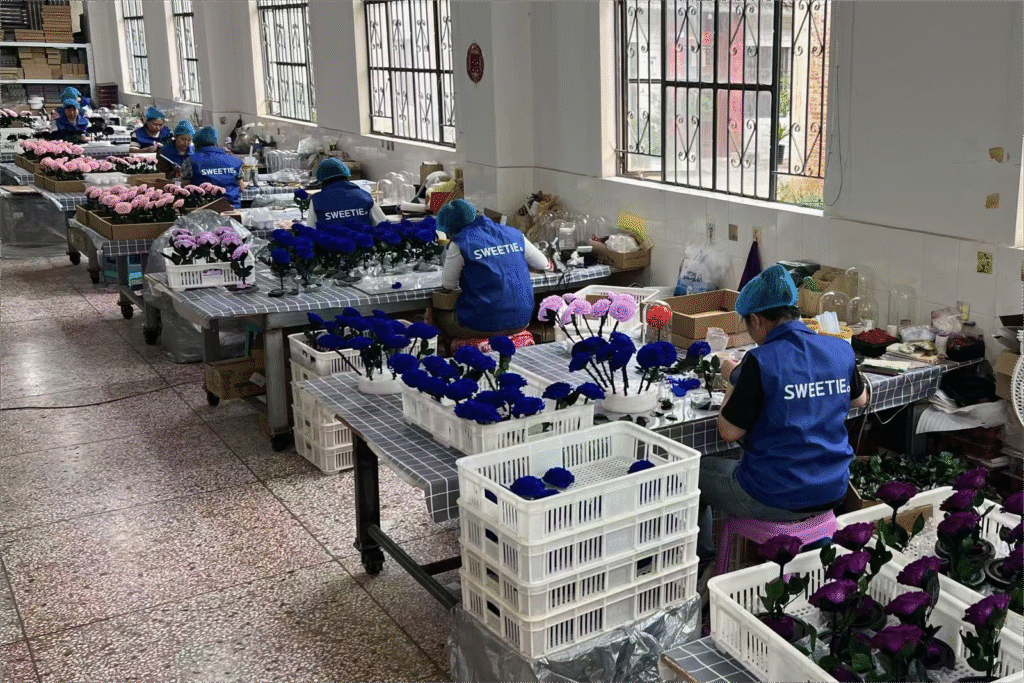
A reliable supplier should be able to explain how these parts are managed. They should know which steps are handmade, how workers are trained, how samples are approved, and how bulk production is checked.
For e-commerce, quality control is not only about whether the product leaves the factory looking acceptable. It is about whether it arrives to your customer looking gift-worthy.
A Sample Is Not the Same as a Scalable Product
One of the biggest mistakes in sourcing this product is approving a beautiful sample too quickly.
A sample tells you what is possible.
Bulk production tells you what is repeatable.
There is a big difference.
A preserved rose in glass dome often includes handmade work. The rose head must look full. The stem should stand naturally. The leaves should look clean. The product should sit well inside the dome. The gift box should protect the product without making the unboxing feel cheap.
One excellent sample does not prove that every unit in a bulk order will look the same.
When reviewing samples, online sellers should request more than one unit when possible. Look at consistency across pieces, not only the best-looking one. Check the flower from the front, side, and top. Look at the stem angle. Shake the product gently to see if anything feels loose. Review the box as carefully as the rose.
A reliable supplier should welcome this level of review. Serious e-commerce customers are not being difficult. They are protecting their future reviews.
Skilled Workers Matter More Than Many Buyers Realize
This product category depends on human hands more than many buyers expect.
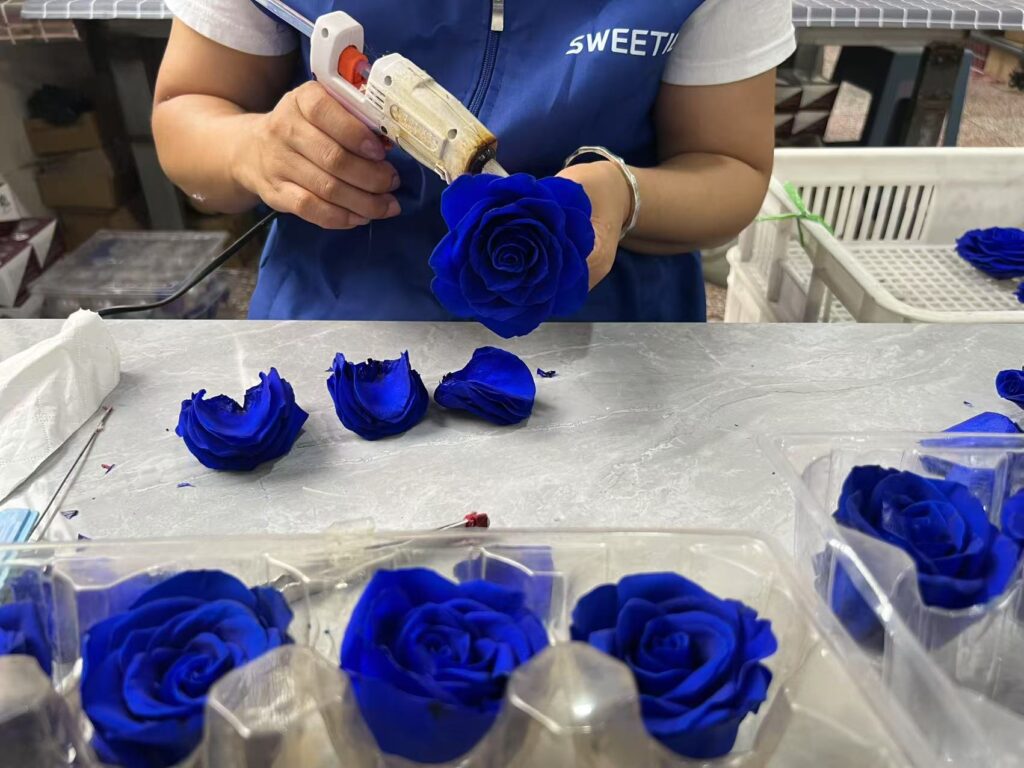
The quality difference is often not obvious in a quotation sheet. It appears in the shape of the rose, the balance inside the dome, the neatness of the leaves, the cleanliness of the glue points, and the stability of the finished piece.
Experienced workers usually produce more stable results. They understand how the rose should look inside the dome, how to avoid a flat or loose appearance, and how to keep the product visually balanced.
For large orders, worker stability becomes even more important.
A supplier may be able to produce one good batch with careful attention. But can they keep the same standard when the order volume increases before Valentine’s Day or Mother’s Day?
That is why e-commerce buyers should ask about production teams, not only production capacity.
Useful questions include:
- Are the key handmade steps handled by trained workers?
- How do you keep flower shape consistent across large orders?
- Do you use approved samples as production standards?
- How do you inspect handmade appearance during production?
- What happens if finished products do not match the approved sample?
In handmade gift products, stable workers often lead to stable product appearance.
Raw Materials Decide More Than Cost
When two preserved rose in glass dome products look similar in photos, it is tempting to choose the lower price.
That can be risky.
The lower price may come from a smaller rose head, thinner glass, weaker packaging, an unstable base, fewer handmade adjustments, or artificial materials instead of real preserved flowers.
Raw material control should include more than the rose itself.
A serious supplier should manage:
- Rose head size and color
- Rose preservation quality
- Stem and leaf materials
- Base material and finish
- Glass dome clarity and thickness
- LED components, if included
- Gift box paper, structure, and surface treatment
- Inner protection and outer cartons
- Labels, care cards, and inserts
For online selling, raw material differences become customer experience differences.
A weak box looks cheap.
Thin glass breaks more easily.
Unstable flower color affects photos and reviews.
A poorly finished base lowers perceived value.
A small flower head makes the product look less premium.
Before negotiating hard on price, make sure the supplier is not quietly reducing the very details that make the product sell.
The Best Suppliers Know the Common Complaints Before They Happen
Every product category has predictable problems.
For preserved rose in glass dome gifts, many complaints can be predicted before shipping.
Common customer complaints include:
- “The glass arrived broken.”
- “The rose fell off.”
- “The stem is tilted.”
- “The product is smaller than expected.”
- “The light does not work.”
- “The color is different from the picture.”
- “The box was damaged.”
- “It does not look like a gift.”
A reliable production partner does not treat these as random accidents. They should already know why these problems happen.
For example, broken glass may point to weak packaging or poor dome fixation. A leaning stem may point to unstable base structure. A fallen rose head may point to poor attachment. Color differences may come from raw material variation or unrealistic product photography. Size complaints may come from unclear listing images.
A good supplier helps you prevent these issues before your customers write them in reviews.
That prevention mindset is one of the strongest signs of a reliable e-commerce partner.
Packaging Should Be Decided Early, Not After Production
Packaging is often discussed too late.
For preserved rose in glass dome products, that is a mistake.
The packaging has to protect a fragile item and still feel suitable for gifting. It also needs to fit shipping cost, warehouse handling, and platform requirements.
A good package should keep the dome stable, prevent the rose from touching the glass, protect the gift box surface, and reduce shock during transport. At the same time, the customer should still feel that the product is clean, elegant, and ready to give.
This balance is not easy.
Too little packaging creates breakage.
Too much packaging increases shipping cost.
Ugly protective packaging weakens the gift experience.
A beautiful box without internal protection creates return risk.
For e-commerce, the right packaging is not only about safety. It is about profit, reviews, and repeat purchase confidence.
If your current preserved rose packaging is causing breakage, high shipping cost, or poor unboxing experience, you can email inquiry@sweetie-group.com to discuss possible improvements.
Customization Should Solve a Sales Problem
Customization is valuable only when it helps the product sell better.
Adding a logo is not the whole story.
Good customization can help an online seller create a clearer market position. It can make the product more giftable, more seasonal, more premium, or more suitable for a specific platform.
But unnecessary customization can also increase cost, slow production, complicate inventory, or create packaging risk.
A good supplier should help you choose useful customization, not push every option.
Customization That Often Matters
For this category, useful customization may include rose color, dome size, base color, gift box design, care card, greeting card, LED or non-LED version, engraved nameplate, seasonal sleeve, logo placement, or small decorative elements.
The best choice depends on the channel.
Amazon may need simple, stable, mainstream products.
Etsy may benefit from engraving and unusual colors.
A brand website may need premium packaging.
A Valentine’s Day program may need red roses, romantic cards, and strong delivery planning.
A Mother’s Day line may need softer colors and warmer gift messaging.
Good customization is not decoration for decoration’s sake. It should make the product easier to understand, easier to sell, or more memorable to receive.
Timeline and Repeat Orders Are Part of Supplier Reliability
Gift products are seasonal.
That makes timing critical.
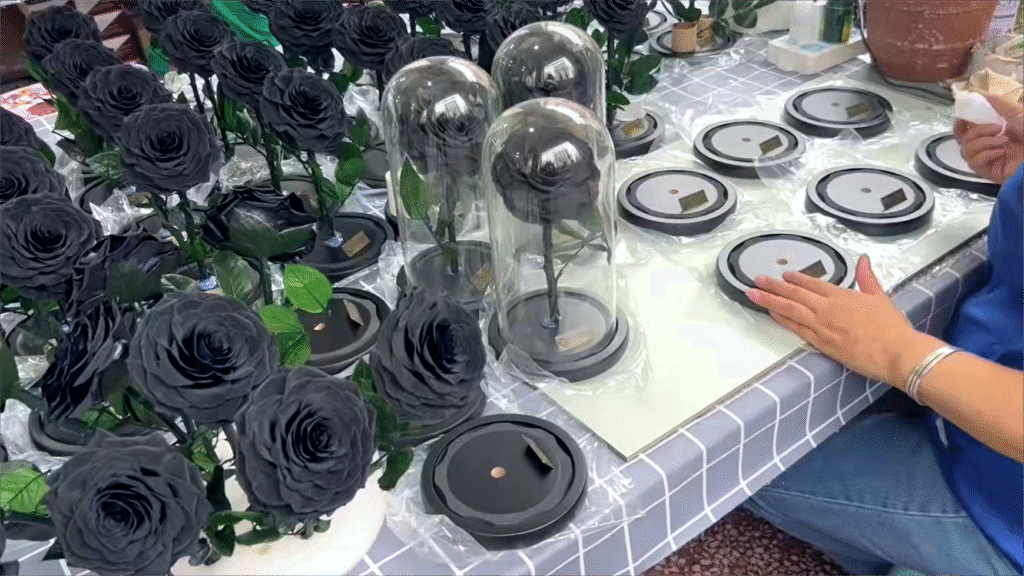
A delayed shipment before Valentine’s Day is not just late. It may miss the main selling window. A late Mother’s Day order may sit as dead inventory. A slow reorder can cause stockouts when a product starts selling well.
Before choosing a supplier, confirm whether they can support your selling rhythm.
Important timeline questions include:
- How long does sampling take?
- How long does bulk production take?
- Can packaging materials be prepared early?
- How much capacity is available during peak season?
- Can the supplier support repeat orders?
- Can they keep the same quality across reorders?
- What is the realistic deadline for holiday programs?
A reliable supplier should be honest about timing. Overpromising before peak season creates stress for everyone.
In e-commerce, delivery timing affects advertising plans, inventory planning, reviews, and cash flow. It should be discussed as part of the product strategy, not only after the order is confirmed.
Documentation Awareness Helps You Scale With Less Friction
Compliance and documentation requirements vary by product and market.
A preserved rose in glass dome without LED lights may have different considerations from one with batteries, switches, or electronic parts. Requirements may also differ between the United States, European Union, United Kingdom, Japan, Australia, or other markets.
A reliable supplier should not make careless promises. They should ask where you plan to sell and what documentation your importer, platform, or retail partner may require.
Depending on the product, buyers may need to discuss:
- Material descriptions
- Care instructions
- Product labels
- Outer carton labels
- Battery warnings, if applicable
- LED or electronic component information, if applicable
- Packaging details
- Market-specific documents requested by the buyer
The supplier may not be responsible for every legal requirement in the destination market, but they should understand that documentation matters.
This becomes more important when an online seller grows from small test orders to larger platform or retail programs.
Choose a Partner Who Makes Your Work Easier
A good preserved rose in glass dome supplier should not only produce goods.
They should reduce your workload.
That may mean helping you choose a better size, warning you about fragile structures, improving packaging, preparing basic product information, suggesting colors for different seasons, or helping analyze customer complaints after launch.
This kind of support saves time.
For e-commerce sellers, time is often as valuable as unit price. Every unclear detail becomes an email. Every packaging problem becomes a customer service case. Every inaccurate product photo becomes a return risk. Every unstable batch becomes a review problem.
A strong partner helps reduce those problems before they reach your team.
At Sweetie-Gifts, we work with preserved flower gifts every day. We support online sellers, gift brands, importers, and retail partners with product development, sampling, packaging improvement, customization, and bulk production for preserved rose gifts, including preserved roses in glass domes.
The goal is not to push every customer toward the most expensive version. The goal is to help each customer choose the version that fits their market, price point, packaging needs, and sales channel.
For preserved rose in glass dome sourcing, product planning, or packaging support, you can contact us at inquiry@sweetie-group.com.
Quick Checklist for Online Sellers
Before choosing a preserved rose in glass dome supplier, ask yourself:
- Do they understand my sales channel?
- Can they control production quality?
- Are raw materials clearly explained?
- Can handmade appearance stay consistent in bulk?
- Do they know the common failure points?
- Is the packaging suitable for real e-commerce shipping?
- Can they support useful customization?
- Can they meet seasonal deadlines?
- Do they understand basic documentation needs?
- Will they reduce my workload instead of adding to it?
If the answer is yes, you may have found more than a supplier. You may have found a long-term production partner.
FAQ: Preserved Rose in Glass Dome Sourcing for E-Commerce
What is the most important factor when choosing a preserved rose in glass dome supplier?
The most important factor is not price alone. For e-commerce sellers, the supplier must control product consistency, packaging safety, shipping risk, and repeat order quality.
Is a real preserved rose better than an artificial rose in a glass dome?
It depends on your market position. A real preserved rose usually supports a more premium gift story, while artificial roses may fit lower-price decorative products. The key is to describe the product honestly.
Why do preserved rose in glass dome products break during shipping?
Breakage is usually related to weak glass protection, poor internal fixation, unsuitable gift box structure, or packaging that was not designed for parcel shipping.
What should Amazon sellers check before ordering this product?
Amazon sellers should check size accuracy, packaging strength, product consistency, clear care instructions, carton information, and whether the product can survive warehouse and parcel handling.
Can preserved rose in glass dome products be customized?
Yes. Common customization options include rose color, dome size, base color, logo, gift box, greeting card, care card, LED version, engraved plate, and seasonal packaging.
When should sellers start preparing Valentine’s Day or Mother’s Day orders?
Sellers should prepare early enough to allow time for sampling, packaging testing, production, inspection, shipping, and listing preparation. Waiting until the last few weeks is risky for seasonal gift products.
Conclusion: Choose the Supplier Who Protects the Customer Experience
A preserved rose in glass dome is not just a decorative item. For online shoppers, it is often a romantic gift, a birthday surprise, a Mother’s Day present, or a keepsake.
That makes the customer experience especially important.
The right supplier should help you protect that experience from the factory floor to the final unboxing. They should understand production control, material consistency, handmade appearance, packaging safety, customization value, seasonal timing, and e-commerce review risk.
A low price can win attention.
But stable quality, safe delivery, and fewer complaints are what help an online seller build a lasting product line.
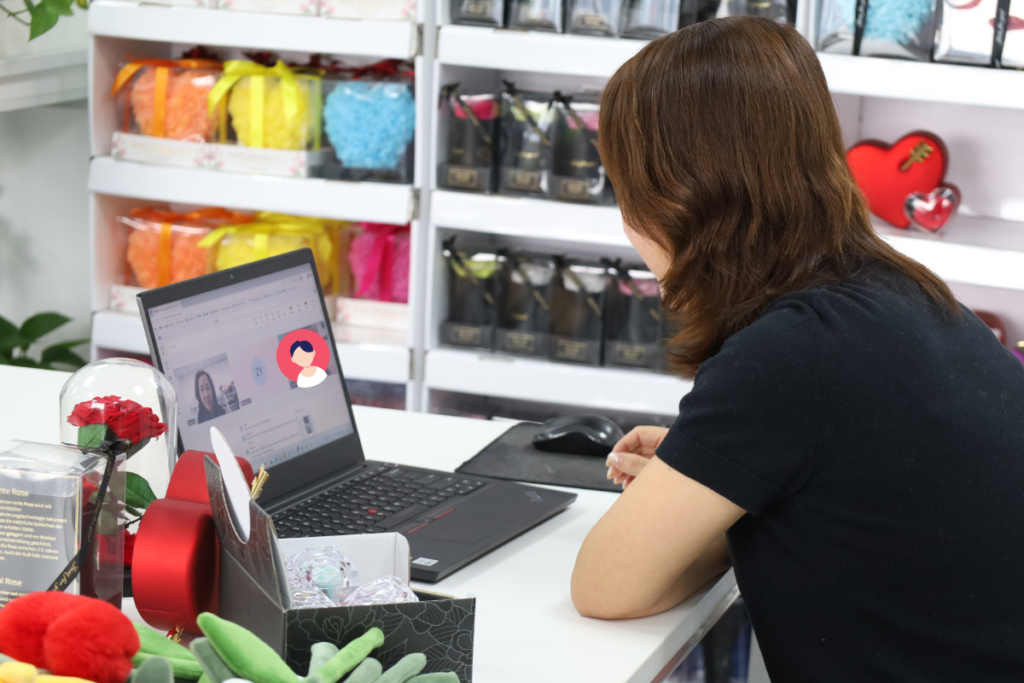
Annie Zhang, CEO of Sweetie Group