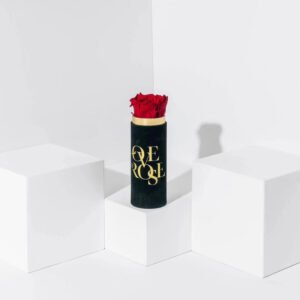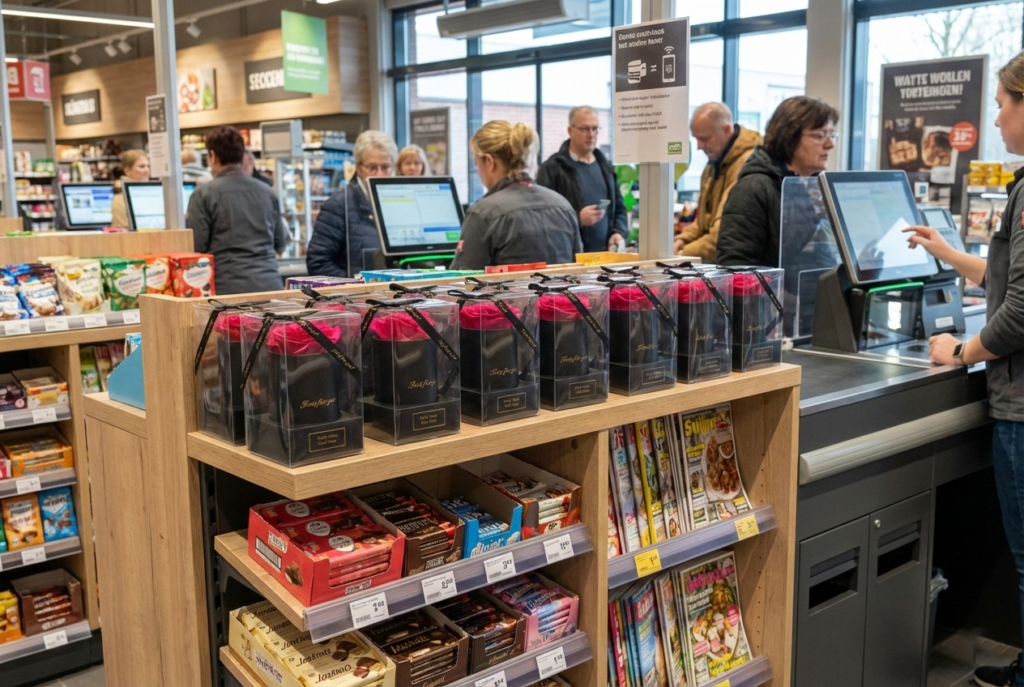
A small gift can look perfect in a sample room and still struggle on the shelf.
That is the part many suppliers overlook.
Retail buyers are not short of small gift options. Every season brings more mini boxes, single flowers, plush items, candles, cards, keychains, novelty gifts, and seasonal add-ons. The real pressure is not finding products. It is choosing SKUs that can move fast enough, fit the store environment, and avoid becoming leftover stock after the holiday window closes.
For buyers, the question is practical:
Will this small gift sell in my store, with my shoppers, in the space I can actually give it?
That is the question this article answers.
Direct Answer
A small gift SKU is retail-ready when it is easy for shoppers to understand, simple for store teams to display, priced for quick decisions, protected well enough for transport, and flexible enough to sell across more than one occasion. For supermarkets, pharmacies, convenience stores, and other offline retailers, the best small gift is not just “cute.” It must earn its place in a real store.
Why Small Gifts Still Matter in Retail
Small emotional purchases are not disappearing. Circana’s 2025 “little treats” research found that 73% of Americans say small indulgences are important to their quality of life, and 62% say little treats are part of their self-care routine. This is not a floral gift study, but it does show a useful consumer behavior: people still make room for small, emotionally rewarding purchases when the product feels easy to justify.
Seasonal gifting also remains strong. NRF reported that U.S. Valentine’s Day spending in 2025 was expected to reach $27.5 billion, including $2.9 billion on flowers, $2.5 billion on candy, and $1.4 billion on greeting cards. These are exactly the kinds of categories that often sit near small gifts in supermarkets, pharmacies, and convenience retail.
Mother’s Day tells a similar story, but with an important lesson for buyers. NRF expected U.S. Mother’s Day spending to reach $34.1 billion in 2025, and nearly half of consumers said finding a unique or different gift was most important to them. That means shoppers are not only looking for something low-cost. They are looking for something that feels thoughtful.
So the opportunity is real.
But the competition is real too.
A small preserved flower gift is not only competing with another flower product. It is competing with chocolate, greeting cards, candles, beauty minis, plush toys, gift cards, seasonal decorations, and every other item that says, “Pick me up while you are already here.”
That is why retail-ready thinking matters.

The First Filter: What Role Will This SKU Play in the Store?
Before looking at color, material, or packaging style, a buyer should know what job the SKU is supposed to do.
A small gift can play different retail roles:
- A checkout impulse item
- A seasonal aisle product
- A Mother’s Day or Valentine’s Day gift
- A greeting card add-on
- A pharmacy gift aisle item
- A convenience store last-minute gift
- A promotional or private-label SKU
- A small emotional self-purchase item
Each role has a different standard.
A checkout item needs speed. A seasonal aisle product needs visual impact. A pharmacy gift item needs to feel clean, presentable, and safe to give. A supermarket gift SKU needs to work with traffic flow, shelf labels, stock replenishment, and fast shopper decisions.
This is why a product should not be judged only by how it looks in a photo. A good buyer asks:
Where will this product sit, and what must it do there?
That one question prevents many sourcing mistakes.
Planning a checkout, seasonal, or small gift display program? Email inquiry@sweetie-group.com and we can help review product formats based on your target channel and display location.
The Second Filter: Can Shoppers Understand It Quickly?
A small gift in a real store has very little time to explain itself.
The shopper should understand the product almost immediately:
- What is it?
- Who is it for?
- Is it ready to give?
- Is the price reasonable?
- Does it feel appropriate for the occasion?
If the answer is not obvious, the shopper may move on.
This is especially important in convenience stores. NACS reported that U.S. convenience stores reached record in-store sales in 2024, with foodservice accounting for 27.7% of in-store sales and 38.6% of in-store gross margin dollars. Convenience retail is built around speed, frequency, and immediate needs. A small gift SKU for that environment cannot require a long explanation.
The same applies to pharmacy and supermarket settings. Most shoppers are not browsing the gift section like they would in a boutique. They are often solving a quick problem.
“I need something for Mom.”
“I forgot a birthday.”
“I want something small to add to this card.”
“This looks nice enough to bring.”
That is the moment a small gift has to win.
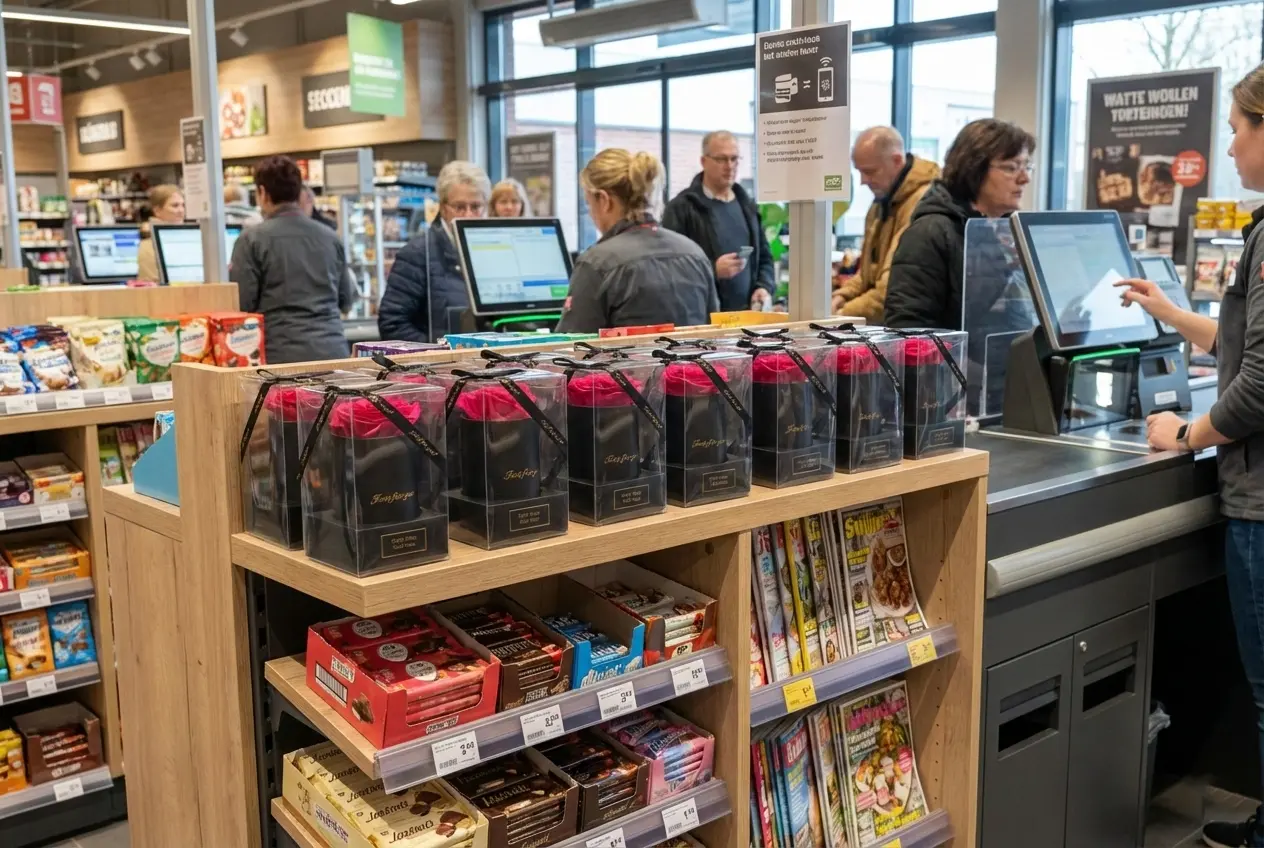
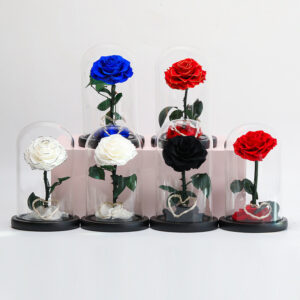
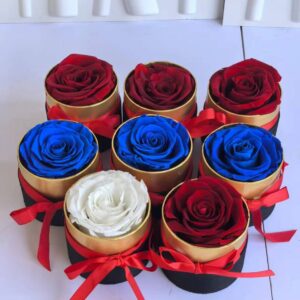
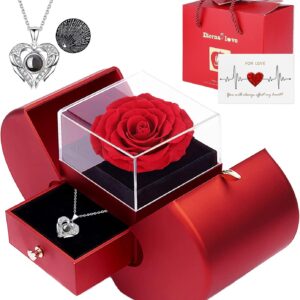
For floral gifts, clear packaging often helps. A transparent box, visible flower head, clean color story, and simple gift message can reduce hesitation. The shopper does not need to imagine the gift. They can see it.
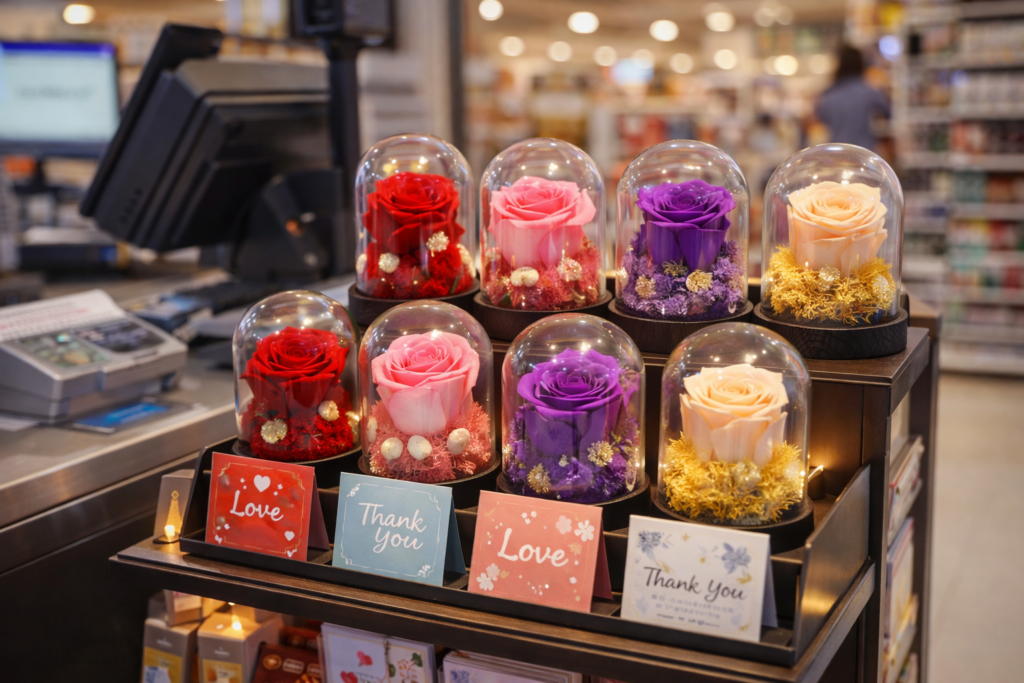
The Third Filter: Is the Product Giftable Without Extra Work?
A strong retail gift should look finished.
This is one of the biggest differences between a decorative item and a gift SKU.
Many supermarket and convenience store purchases are made close to the moment of giving. AP has reported that a large share of U.S. Valentine’s Day spending on flowers, candy, and cards happens in the final days before the holiday, with many consumers shopping between February 11 and February 14. That last-minute behavior makes ready-to-give presentation even more important.
A shopper buying at the last minute does not want to solve three more problems after purchase.
They do not want to find a box.
They do not want to wrap it.
They do not want to wonder whether it looks too casual.
This is why small gift packaging should do more than protect the product. It should complete the gift.
Good retail gift packaging usually does three things:
- Shows the product clearly
Shoppers trust what they can see. - Creates a finished gift impression
A ribbon, sleeve, card, window box, or clean display tray can make a small product feel more intentional. - Keeps handling simple
The product should be easy to pick up, scan, pack, and replenish.
For preserved flowers, soap flowers, artificial flowers, and plush flowers, the right packaging depends on the material. A preserved rose needs protection from pressure and moisture exposure. A soap flower needs clean shaping and stable presentation. A plush flower needs neat form and consistent display. The packaging solution should match the product, not just the visual style.
The Fourth Filter: Does the Price Match the Buying Moment?
For small gifts, the right price is not always the lowest price.
This is important.
A low price can attract attention, but it does not automatically create a sale. If a product looks too cheap, unclear, or unfinished, shoppers may not feel comfortable giving it to someone else. On the other hand, a slightly higher-priced item can work if it has enough perceived value.
The buyer is not only evaluating cost. The shopper is evaluating comfort.
“Can I give this without feeling awkward?”
“Does this look worth the price?”
“Will the person receiving it understand the gesture?”
That is what makes small gift pricing different from ordinary low-ticket merchandise.
A strong small gift SKU should feel easy to say yes to. It should not make the shopper pause for too long. But it also should not look like a disposable item unless that is the intended channel.
For discount retail, the priority may be entry price and volume. For pharmacy, giftability may matter more. For convenience stores, the product must balance fast decision-making with compact size. For supermarkets, seasonal color and display efficiency can make a big difference.
The price must fit the channel, not just the product.
The Fifth Filter: Can the SKU Survive the Shelf, Not Just the Shipment?
Retail-ready packaging has to survive more than international shipping.
It has to survive the store.
That means:
- Opening cartons
- Shelf stocking
- Price labeling
- Shopper handling
- Scanning
- Replenishment
- Dust and light exposure
- Display movement
- Seasonal resets
A product that looks beautiful but requires too much store labor becomes expensive in another way. Store labor, shelf confusion, and damage all reduce the value of a low-cost SKU.
Here is a simple way to evaluate whether a small gift is ready for retail execution:
| Retail Question | Why It Matters |
|---|---|
| Can the product stand or sit securely? | Reduces messy displays and store labor. |
| Is the front view strong? | Helps shoppers understand the product quickly. |
| Is the barcode easy to scan? | Prevents checkout friction. |
| Can the price label fit cleanly? | Supports store operations. |
| Is the packaging protective enough? | Reduces damage and returns. |
| Can it fit a PDQ, counter tray, shelf, or endcap? | Makes display planning easier. |
| Can staff replenish it without rearranging everything? | Saves time during busy seasons. |
For chain retailers, these details matter. A small gift SKU may be physically small, but it still enters a large retail system.
If the product does not fit that system, the buyer carries the risk.
Need retail-ready packaging ideas for small floral gifts, PDQ displays, counter trays, or private-label packaging? Contact inquiry@sweetie-group.com for sample and packaging options.

The Sixth Filter: Is There a Plan After the Holiday?
Seasonal products can sell fast, but they can also create leftover inventory.
That is why good small gift development should include an exit plan.
A Valentine’s Day SKU should clearly communicate romance. A Mother’s Day SKU should feel warm and thoughtful. A Christmas SKU should match the season. But if the product is too narrowly designed, the sales window becomes very short.
A safer approach is often:
stable product structure + seasonal visual refresh.
For example, the same small floral gift structure may be adapted through:
- Flower color
- Ribbon color
- Greeting card message
- Sleeve artwork
- Display tray design
- Seasonal label
- Outer packaging theme
This gives buyers more flexibility. The product can look fresh for each season without requiring a completely new structure every time.
For retail buyers, that matters because development time, sampling time, packaging approval, and shipment timing all affect seasonal success.
A product that can move from Valentine’s Day to Mother’s Day, birthday gifting, thank-you gifting, or everyday emotional gifting has a better chance of reducing leftover pressure.
The Seventh Filter: Can the Supplier Support a Retail Program?
A single SKU may open the door.
A retail program keeps the door open.
For supermarkets, convenience chains, pharmacies, importers, and gift distributors, a supplier often needs to support more than one product. Buyers may need several levels:
- Entry-price impulse item
- Mid-price ready-to-gift item
- Seasonal hero product
- Checkout display product
- Greeting card add-on
- Private-label version
- Replenishment SKU
- Holiday refresh series
This is where manufacturing experience becomes important.
A buyer may like the sample, but still need answers:
Can the packaging be adjusted?
Can the color be changed?
Can the product be made in a lower-cost version?
Can the supplier keep quality stable for handmade items?
Can the order ship before the seasonal window?
Can the supplier support barcodes, labels, carton marks, and display packaging?
These questions are not small details. They determine whether the product can become part of a retail assortment.
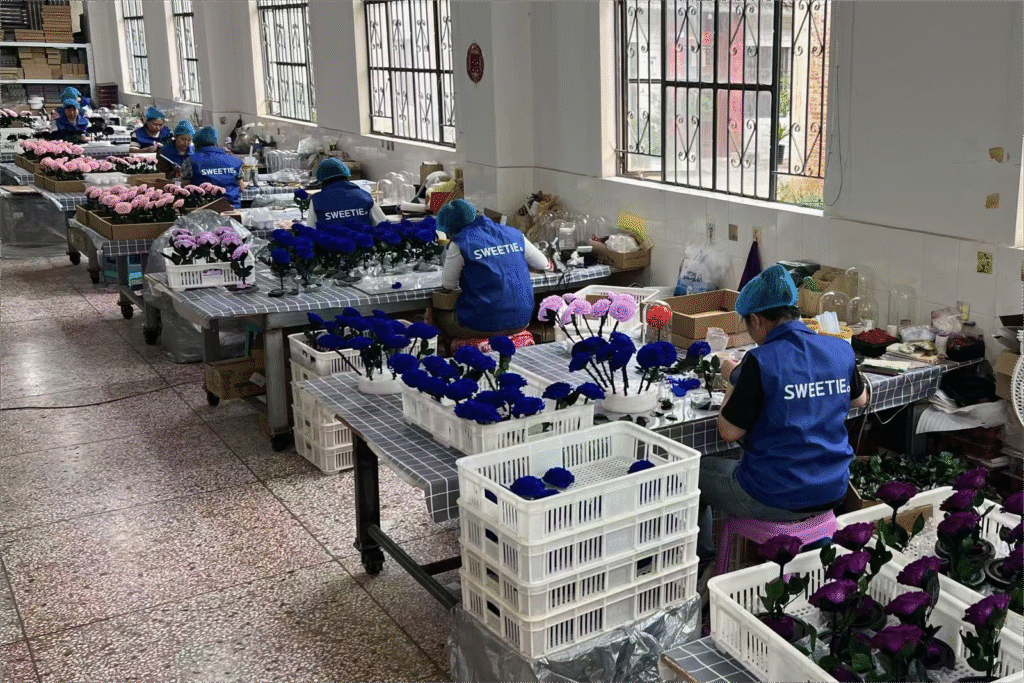
Sweetie-Gifts works with preserved flowers, soap flowers, artificial flowers, plush flowers, crochet flowers, and display packaging. This helps us think across different price points and retail channels rather than forcing every buyer into one product format.
A supermarket buyer, a convenience store buyer, and a gift importer may all ask for “small gifts,” but they usually need different structures.
A Better Way to Evaluate Small Gift SKUs
The strongest small gift SKUs usually pass six tests:
- Fast understanding
Shoppers know what it is and why they might buy it. - Clear giftability
It looks ready to give without extra wrapping. - Channel-fit pricing
The price matches the buying moment and the store type. - Retail-ready packaging
The product is easy to display, scan, protect, and replenish. - Seasonal flexibility
The SKU can be refreshed or repositioned beyond one holiday. - Supplier reliability
The factory can support samples, packaging, quality, timing, and repeat orders.
When a product passes these tests, it becomes more than a cute item.
It becomes a retail-ready SKU.
FAQ: Small Gift SKUs for Retail Buyers
What is a retail-ready small gift SKU?
A retail-ready small gift SKU is a compact gift product that is ready for real store conditions. It should be easy to understand, easy to display, easy to scan, protected for handling, and attractive enough for shoppers to buy quickly.
Are impulse gifts only suitable for checkout counters?
No. Checkout counters are important, but impulse gifts can also work in endcaps, seasonal aisles, greeting card areas, pharmacy gift sections, and convenience store display zones. The right location depends on product size, price, packaging, and buying occasion.
Should small gifts always be low-priced?
Not always. Small gifts should be low-friction, but that is not the same as being the cheapest. A product with stronger gift appeal, better packaging, and clearer emotional value may perform better than a cheaper item that feels random or unfinished.
What makes floral gifts suitable for supermarkets and convenience stores?
Floral gifts can work well when they are compact, protected, visible, and ready to give. Preserved flowers, soap flowers, artificial flowers, and plush flowers can all fit different retail channels when the packaging and price point are designed correctly.
How can retailers reduce leftover seasonal gift inventory?
Retailers can reduce leftover risk by choosing products with flexible structures, avoiding overly narrow holiday packaging, using seasonal sleeves or cards, and selecting SKUs that can also sell for birthdays, thank-you gifts, Mother’s Day, or everyday gifting.
What should buyers ask a small gift manufacturer before ordering?
Buyers should ask about MOQ, lead time, packaging options, barcode placement, display format, carton packing, customization, quality control, sample timing, and whether the supplier can refresh the product for future seasons.
Final Thought: The Best Small Gifts Make Retail Easier
A small gift SKU should not make the buyer’s job harder.
It should make the shopper’s decision easier, the store team’s display work easier, and the buyer’s seasonal planning easier.
That is the real standard.
Not just small.
Not just pretty.
Not just inexpensive.
A strong small gift SKU earns its space because it fits the way retail actually works.
At Sweetie-Gifts, we develop floral gift products with this retail journey in mind: product structure, packaging, display, transport, seasonal refresh, and custom programs for different channels.
For small gift SKUs, checkout display products, floral gift packaging, or private-label retail programs, email inquiry@sweetie-group.com.
Annie Zhang, CEO of Sweetie Group