Product managers at Amazon brands are facing a structural challenge, not a creative one. While many teams still approach product development as a linear process, Chinese sellers operate with speed, flexibility, and tight supply chain coordination. The result is a constant feeling of being one step behind, even when the product idea itself is strong.
This article explains how product managers can regain control by redesigning how innovation happens, not by copying Chinese sellers, but by building a smarter and more defensible product system.
The Real Reason Chinese Sellers Dominate Product Velocity
Most discussions focus on price or labor cost, but those are only surface factors. The real advantage lies in how products are developed and launched.
Product development is supply chain driven
Many Chinese sellers design products with manufacturing, packaging, and logistics already in mind. Instead of asking whether a product can be produced later, feasibility is embedded at the concept stage.
This approach eliminates rework and shortens the path from idea to Amazon listing.
Iteration replaces perfection
Instead of waiting for a final version, Chinese sellers often launch an acceptable version, gather data, then improve. This creates momentum and learning speed that traditional product teams struggle to match.
For product managers, this highlights a critical insight. Speed is not just execution. Speed is decision clarity.
If your team is currently reviewing how to reduce friction between design and production, our development team frequently supports Amazon brands through early stage product planning. You can reach us at inquiry@sweetie-group.com.
Why Traditional Product Development Models Fail on Amazon
Many Western brands still rely on development models designed for retail cycles that move far slower than Amazon.
Linear workflows slow innovation
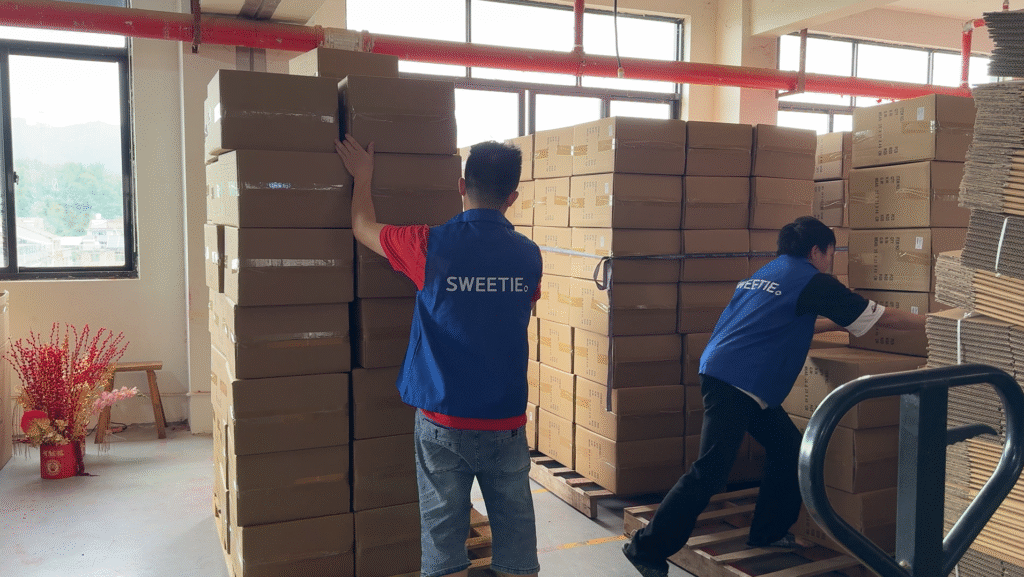
When design, sourcing, packaging, and logistics are handled in separate stages, delays compound. A small packaging issue can push a launch back weeks. By the time the product goes live, the market has already shifted.
Feature driven differentiation is fragile
Products that rely on surface features are easy to imitate. Once copied, price competition follows. Sustainable differentiation must be structural, not cosmetic.
Product managers must think beyond features and focus on product architecture.
Building Defensible Products Through System Design
Winning on Amazon requires more than a good idea. It requires a repeatable system that makes innovation faster and harder to copy over time.
Design products as expandable systems
Instead of creating isolated SKUs, strong product teams design platforms. A single product concept can support variations in color, size, function, or gifting format.
This allows rapid expansion without restarting development from zero.
Align design with real world constraints
Products should be designed with packaging durability, fulfillment efficiency, and unboxing experience in mind from day one. When these elements are integrated early, launches become smoother and returns decrease.
If you are exploring how to redesign products as scalable systems rather than single items, our team can share examples from similar Amazon brands. Contact us at inquiry@sweetie-group.com.

Collaborative Development as a Competitive Advantage
One of the most underused tools for product managers is true development collaboration with manufacturers.
Moving beyond transactional sourcing
Factories should not only execute instructions. The right partners contribute material knowledge, process optimization, and cost saving ideas that improve the product itself.
Maintaining brand control during collaboration
Collaboration does not mean surrendering brand ownership. Product managers remain responsible for user experience, brand tone, and differentiation logic. Manufacturers support feasibility and execution.
When roles are clearly defined, collaboration accelerates innovation without diluting brand identity.
A Practical Comparison of Development Approaches
| Aspect | Traditional Model | System Based Model |
|---|---|---|
| Product scope | Single SKU focused | Platform oriented |
| Speed | Slowed by handoffs | Accelerated by alignment |
| Differentiation | Feature based | Structural and experiential |
| Scalability | Limited | High |
| Copy resistance | Low | Moderate to high |
This comparison illustrates why system based thinking consistently outperforms reactive product launches on Amazon.
Using Gift and Lifestyle Context to Stand Out
Another area where product managers can outperform Chinese sellers is context driven design.
Products that tell a story convert better
Amazon shoppers respond strongly to products that fit into clear gifting or lifestyle scenarios. When context is designed into the product, listings become easier to communicate and easier to remember.
Modular gifting concepts reduce risk
Designing products that can adapt to holidays, events, or seasonal themes allows brands to refresh offerings without rebuilding inventory strategies.
This approach is particularly effective in categories where visual appeal and emotional value matter.
If you are developing gift focused or lifestyle driven product lines and want to explore modular concepts, feel free to contact us at inquiry@sweetie-group.com.
Rethinking What Innovation Means on Amazon
Innovation on Amazon is not about launching something completely new every time. It is about creating a framework where new products can be developed, tested, and improved with confidence.
Product managers who succeed long term focus on:
- Building systems instead of one off ideas
- Collaborating early with capable manufacturing partners
- Designing for scalability and differentiation simultaneously
When innovation becomes repeatable, competition becomes manageable.
Final Thoughts
Chinese sellers are not winning because they are more creative. They are winning because their product development systems are optimized for speed and iteration.
Amazon product managers can compete effectively by redesigning how products are conceived, developed, and scaled. The brands that win are not the ones that rush. They are the ones that build smarter foundations.
If you are interested in exploring collaborative product development strategies tailored for Amazon brands, our team is always open to discussion at inquiry@sweetie-group.com.
Annie Zhang, CEO of Sweetie Group