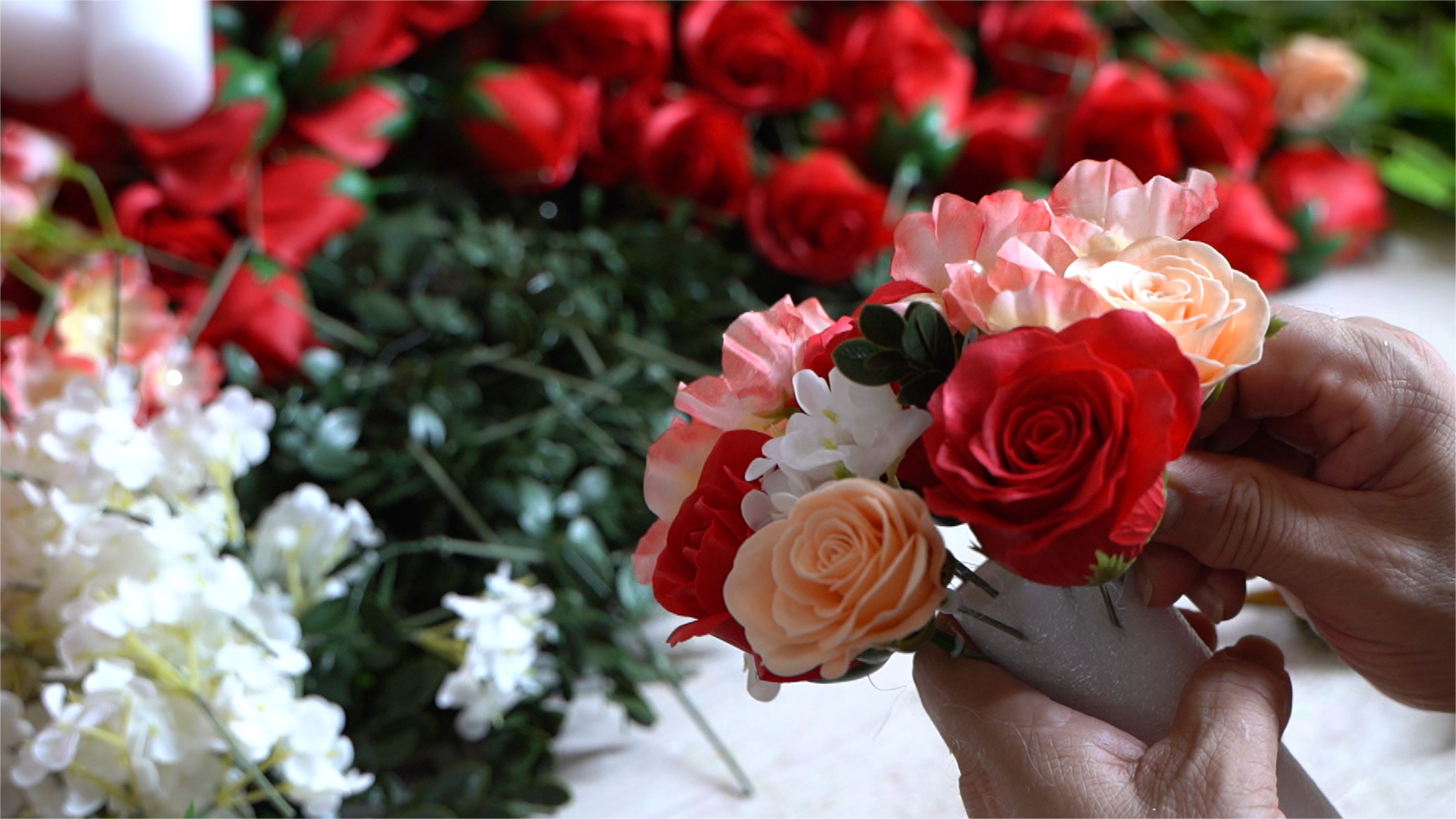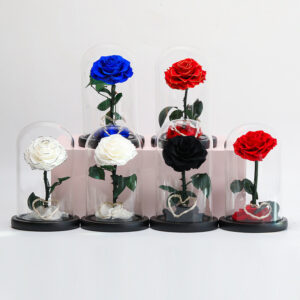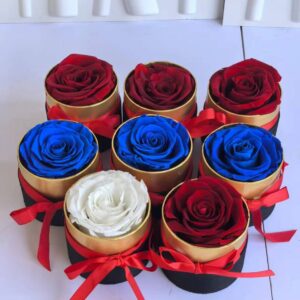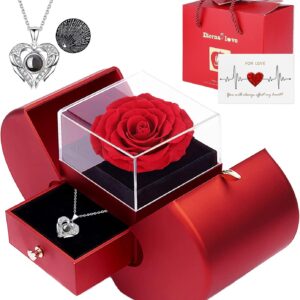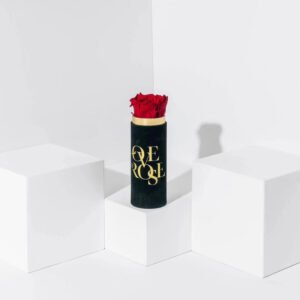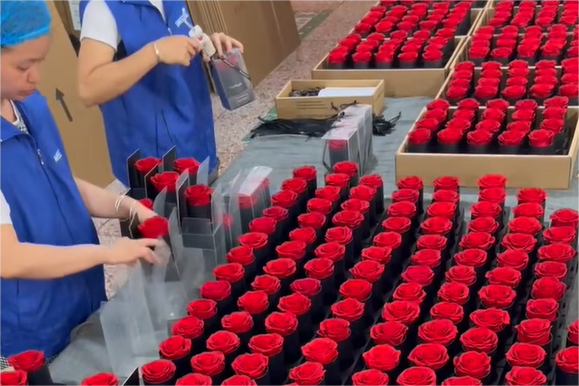
A preserved rose factory in Yunnan may be able to make a beautiful sample.
That is important, of course. But for overseas gift buyers, the harder question comes after the sample is approved:
Can this factory repeat the same product in bulk production, with stable flower quality, controlled handwork, clean packaging materials, reliable functional parts, and export-ready packing?
In preserved rose gift projects, reliability is not proven by one good sample. It is proven by repeatable production.
This matters especially when the project involves custom rose boxes, glass domes, jewelry flower boxes, acrylic displays, mini ring boxes, or seasonal gift collections. These products are not just flowers. They are finished gifts, and every part needs to work together.
A Reliable Yunnan Factory Should Understand Finished Gifts, Not Only Preserved Flowers
Yunnan is known for its flower supply chain, and many preserved flower businesses are connected to this region. But not every preserved rose factory is equally suitable for finished gift orders.
Some suppliers are strong in preserved flower materials. They may handle roses well, but they may not be experienced in full gift development.
For preserved rose gifts, the final product usually includes more than the rose itself:
- preserved rose heads
- flower arrangement
- gift box or dome structure
- acrylic or PVC display parts
- ribbon, card, logo, or sleeve
- inner tray or fixing method
- functional parts such as drawers, hinges, magnets, or lids
- protective packing for export shipment
If the factory only understands the flower but not the final assembled gift, problems may appear later in packaging, assembly, shipping, or retail presentation.
A reliable preserved rose factory in Yunnan should understand how the flower, structure, material, handwork, and packaging affect the final product. That is what separates a simple flower supplier from a finished gift manufacturer.
For custom preserved rose gift projects, you can send your concept or reference design to inquiry@sweetie-group.com for an initial feasibility discussion.
The First Sign of a Good Factory: It Can Turn a Sample into Production Rules
A serious factory does not treat the approved sample as a decoration.
It turns the sample into instructions workers can repeat.
That sounds simple, but in handmade floral gifts, this step is often where problems begin. A sample may look good because one skilled worker spent extra time adjusting it. Bulk production needs something different: clear standards.
Before a preserved rose gift moves into bulk production, the factory should be able to define:
- the visual standard of the flower heads
- the acceptable color range
- the product height and flower position
- the handmade tolerance
- the quality limit for acrylic, PVC, glass, or other visible materials
- the standard position for ribbons, cards, labels, and accessories
- the testing method for functional parts
- the final packing method
- the first bulk sample or pre-production confirmation
A good sample should not only answer, “Does this look beautiful?”
It should also answer, “Can this be made again and again without losing the approved look?”
That is the real value of sample development.
Flower Head Control Is About Consistency, Not Always the Highest Grade
One common misunderstanding in preserved rose sourcing is that the best factory must always use the highest flower standard.
In reality, different customers need different flower standards depending on the channel, retail price, product structure, and target market. A supermarket seasonal gift, an online hero product, and a premium jewelry rose box may not require the same flower level.
The important point is not that every project uses the most expensive flower head.
The important point is that the flower standard used in the sample should match the flower standard used in bulk production.
Preserved roses are natural materials. Different batches may show differences in shape, fullness, opening, and petal condition. Seasonal differences also matter. In this industry, products sold in winter may use flowers processed from summer batches, while products sold in summer may use flowers processed from winter batches. These flower batches can have different natural states.
That is normal.
What is not acceptable is obvious inconsistency inside the same gift box or the same SKU.
A buyer can usually accept small natural variation. What creates concern is when one box looks full and balanced while another looks thin, loose, or visibly lower in quality.
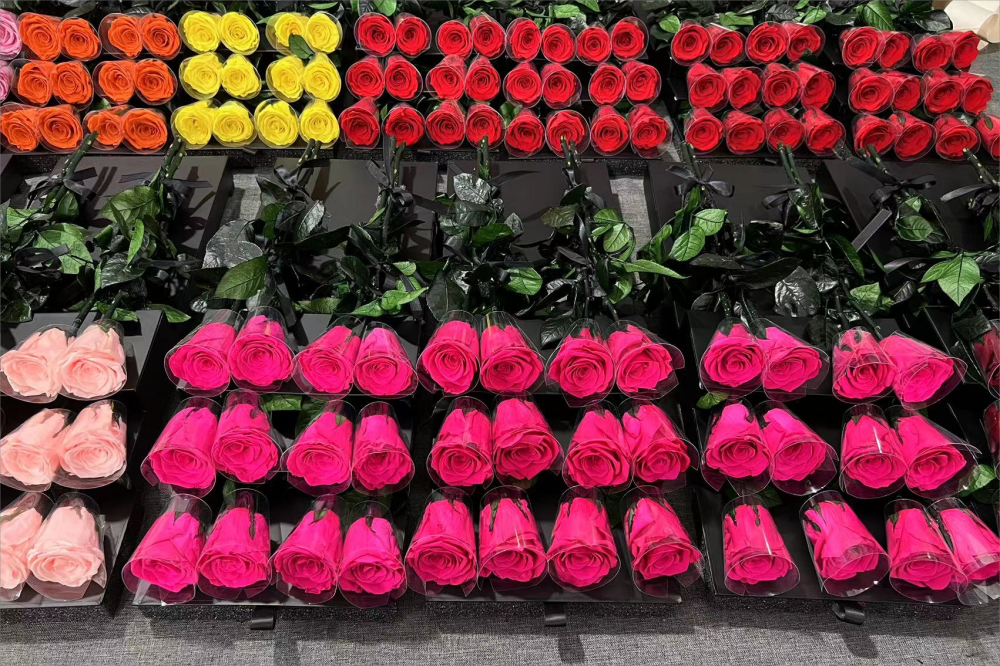
A reliable Yunnan preserved rose factory should visually sort flower heads and keep the same order within a consistent standard. The sample should not use especially beautiful flowers while bulk production uses noticeably weaker ones.
The issue is not that every rose must look identical. The issue is whether the finished gift still looks balanced, clean, and close to the approved sample.
Handmade Tolerance Must Be Controlled Before It Becomes a Quality Issue
Preserved rose gifts often involve hand arrangement. That is part of their charm.
A rose may sit at a slightly different angle. Moss, filler flowers, ribbons, cards, or small ornaments may have small position differences. This is normal in handmade preserved flower gifts.
But handmade does not mean uncontrolled.
Reasonable handwork variation is usually not obvious to the final customer. The gift should still look balanced when placed on a shelf, photographed for an online listing, or opened by the consumer.
Handmade tolerance becomes a quality issue when it affects:
- the overall visual balance
- the flower height
- the product’s front-facing appearance
- the position of ribbons, cards, logos, or labels
- the function of drawers, lids, or jewelry slots
- the space between the flower and the cover
- the safety of the product during shipping
For example, a flower head should not press against the lid. A jewelry slot should not be blocked by petals. A ribbon should not look visibly crooked across the full order. A glass dome should not contain decorations that shift during transport.
Handmade production is not the risk. Uncontrolled handmade production is the risk.
A reliable factory knows where natural tolerance is acceptable and where correction is required before packing.
Acrylic, PVC, and Small Functional Parts Reveal Factory Discipline
In preserved rose gifts, small components often show whether a factory has real bulk-order discipline.
Transparent materials are a good example.
Many finished preserved rose gifts use acrylic boxes, PVC covers, display windows, transparent drawers, or glass domes. These materials make the product more gift-ready and retail-friendly because customers can see the flower before purchase.
But transparent materials also make defects easier to notice.
Common issues include:
- bubbles
- scratches
- cracks
- worn surfaces
- pressure marks
- cloudy areas
- rough edges
- deformation
- small breakage during assembly or packing
A tiny mark on a paper box may not be serious. A scratch on an acrylic display surface can immediately lower the perceived value of the whole gift.
That is why acrylic and PVC parts should be inspected before assembly whenever possible. If the defect is found after the flower, tray, card, and accessories are already inside, rework becomes slower and more costly.
Functional parts need the same attention.
Some preserved rose gifts include mini ring boxes, drawers, magnetic lids, hinges, clips, LED lights, perfume holders, cosmetic slots, or small bases. These details may look minor, but they affect the customer experience directly.
If a mini ring box hinge falls off when opened, the product feels cheap. If a drawer gets stuck, the gift feels unfinished. If a magnet is weak, the lid feels unstable. If the glass dome does not sit securely on the base, the product becomes risky for shipping.
A beautiful rose cannot fully save a gift with poor functionality.
For custom preserved rose gift boxes, jewelry flower boxes, or acrylic display projects, ask the factory how these parts are checked during bulk production, not only during sampling.
Packaging Ability Separates a Gift Factory from a Flower Supplier
Packaging is not the final decoration. It is part of the product’s performance.
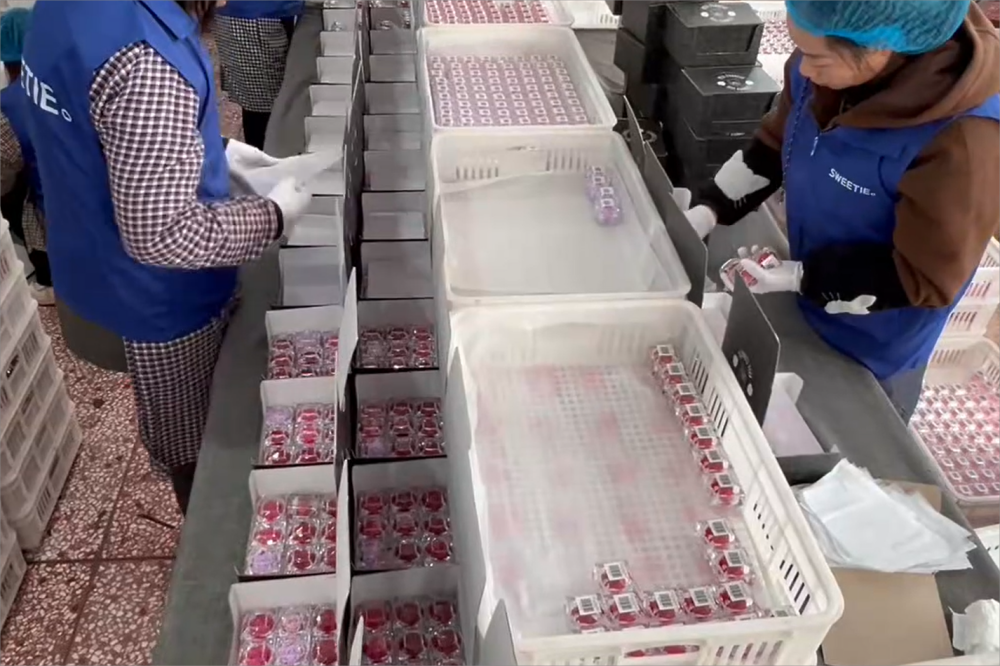
This is especially true for overseas orders. A preserved rose gift may look perfect in the factory, but it still needs to survive handling, carton loading, international transport, warehouse movement, and sometimes last-mile delivery.
Different product structures need different packing logic.
A glass dome needs fixing and shock protection.
An open flower box needs enough space above the flower head.
An acrylic display box needs scratch protection.
A mini ring box needs protection around the hinge.
A bouquet-style preserved flower gift needs support so the shape does not collapse.
A product for e-commerce may need stronger inner control than a product shipped mainly for shelf display.
Good packaging should do three things:
- Protect the flower and product structure.
- Keep the gift presentation clean.
- Avoid unnecessary carton volume and freight waste.
The lowest packaging cost is not always the lowest project cost. If weak packing leads to crushed petals, scratched acrylic, broken domes, stuck drawers, customer complaints, or reshipment, the order becomes more expensive in the end.
This is why a preserved rose factory serving overseas buyers should understand both floral presentation and shipping protection.
For packaging review on preserved rose boxes, glass domes, acrylic displays, or jewelry flower boxes, contact inquiry@sweetie-group.com.
Should You Work with One Integrated Factory or Split Flowers and Packaging?
This is a real question for many experienced buyers.
Some buyers consider sourcing preserved flowers from one supplier, packaging from another, and assembly from a third partner. For simple products, this can work. It can also work when the buyer has strong internal product development and quality control teams.
But for customized preserved rose gifts, splitting the supply chain can create hidden risk.
The flower supplier may not fully understand the box structure.
The packaging supplier may not understand flower height, petal pressure, or arrangement space.
The assembly supplier may not take responsibility for how all parts work together.
And when a problem happens, each side may say it belongs to someone else.
This becomes especially risky for:
- glass dome preserved rose gifts
- acrylic rose boxes
- mini ring boxes
- flower + jewelry sets
- flower + perfume or cosmetics gift boxes
- branded seasonal gift collections
- e-commerce preserved rose products
- premium gift boxes with functional structures
When a preserved rose gift has several components, the buyer is not only buying materials. The buyer is buying responsibility for the final assembled product.
An integrated preserved rose gift factory may not always offer the lowest line-item price for every component. But for complex projects, it can reduce communication gaps, structure mismatch, sample revisions, unclear responsibility, and final assembly risk.
The more components the gift has, the more valuable it becomes to have one supplier manage the complete finished product.
What Overseas Buyers Should Ask a Preserved Rose Factory in Yunnan
Before starting a custom preserved rose gift order, it helps to ask questions that reveal whether the factory can manage bulk production, not just sampling.
| Question | What a Reliable Factory Should Explain |
|---|---|
| Can the sample be repeated in bulk? | How the approved sample becomes production instructions |
| How are flower batches controlled? | Visual sorting and consistency within the same SKU |
| What handmade tolerance is acceptable? | The difference between natural variation and quality issues |
| How are acrylic or PVC parts inspected? | Control of bubbles, scratches, cracks, and visible wear |
| Are hinges, drawers, magnets, or lids tested? | Functional stability during bulk production |
| How is packaging tested with the real product? | Flower height, inner support, dome fixing, and carton protection |
| Who owns the final product quality? | Clear responsibility for flower, packaging, assembly, and shipment |
| Can the factory support export-ready orders? | Packing, documents, QC, and shipment experience |
These questions help buyers see whether a supplier is only good at making samples, or whether it has the discipline to manage finished gift production.
Where Sweetie-Gifts Fits as a Yunnan Preserved Rose Gift Factory
For custom preserved rose gift projects, the useful factory is usually the one that can manage more than flowers.
It should understand sample development, flower standard, handmade assembly, transparent material quality, functional parts, packaging, inspection, and export delivery together.
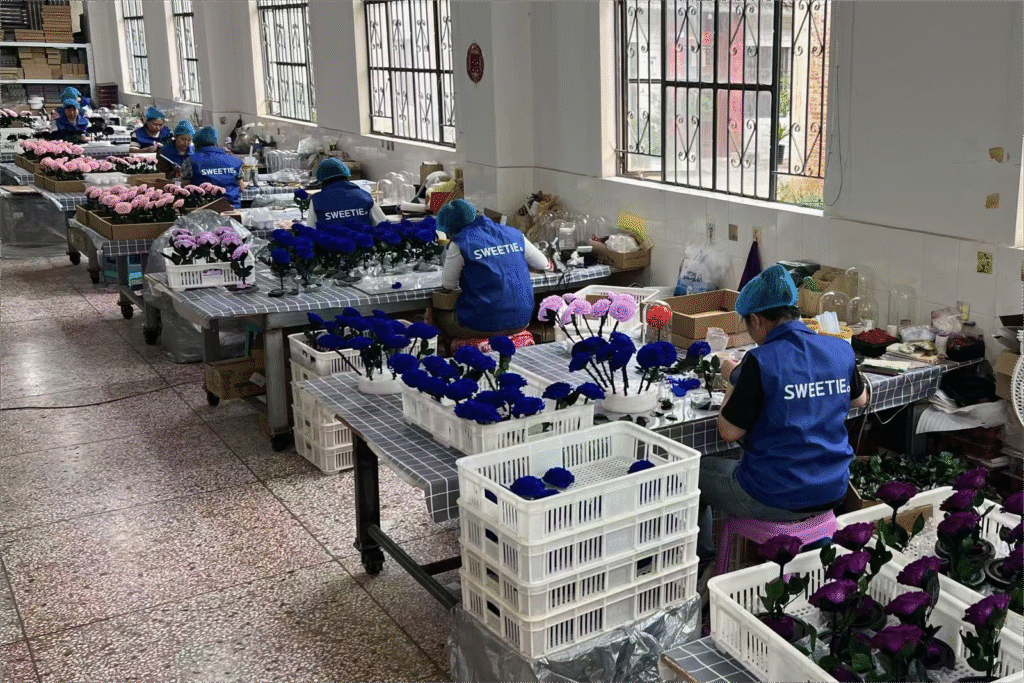
Sweetie-Gifts’s preserved flower products are mainly produced in Kunming, Yunnan. The product range includes preserved flower boxes, glass domes, preserved flower bouquets, jewelry flower boxes, and other preserved flower gifts and decorations.
For custom projects, the process may include customer needs discussion, product proposal, sampling or 3D visual presentation, feedback adjustment, production scheduling, quality inspection, shipment, and after-sales follow-up.
The focus is not only making the first sample attractive. The more important work is helping customers turn that sample into a finished gift that can be produced, packed, shipped, and reordered with more confidence.
Sweetie-Gifts’s everlasting flower factory has a production team for preserved flower gift orders and supports overseas B2B customers across retail, gift, e-commerce, floral, and brand project channels.
To discuss a custom preserved rose gift project from Yunnan, email inquiry@sweetie-group.com.
Final Thoughts
A reliable preserved rose factory in Yunnan should not only make flowers look beautiful.
It should help overseas buyers turn a sample into a repeatable finished gift product.
The real signs of reliability are flower consistency, controlled handmade tolerance, transparent material inspection, functional part stability, packaging protection, and clear responsibility for the final assembled product.
For buyers developing preserved rose gift boxes, glass domes, jewelry flower boxes, acrylic displays, or seasonal floral gift programs, the best supplier is not only the one who can make a good sample.
It is the one who can make that sample work in bulk.
Annie Zhang, CEO of Sweetie Group