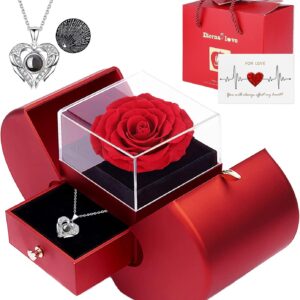
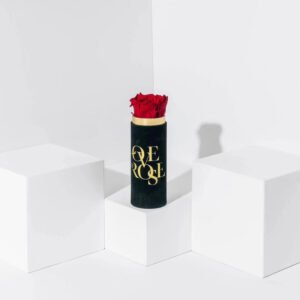
Expert Summary:
The three major preserved flower origins serve distinct business roles: Ecuador excels in luxury, giant-headed raw materials; Japan leads in delicate, artisan floral art supplies; and Yunnan, China, dominates in high-volume B2B finished product delivery.
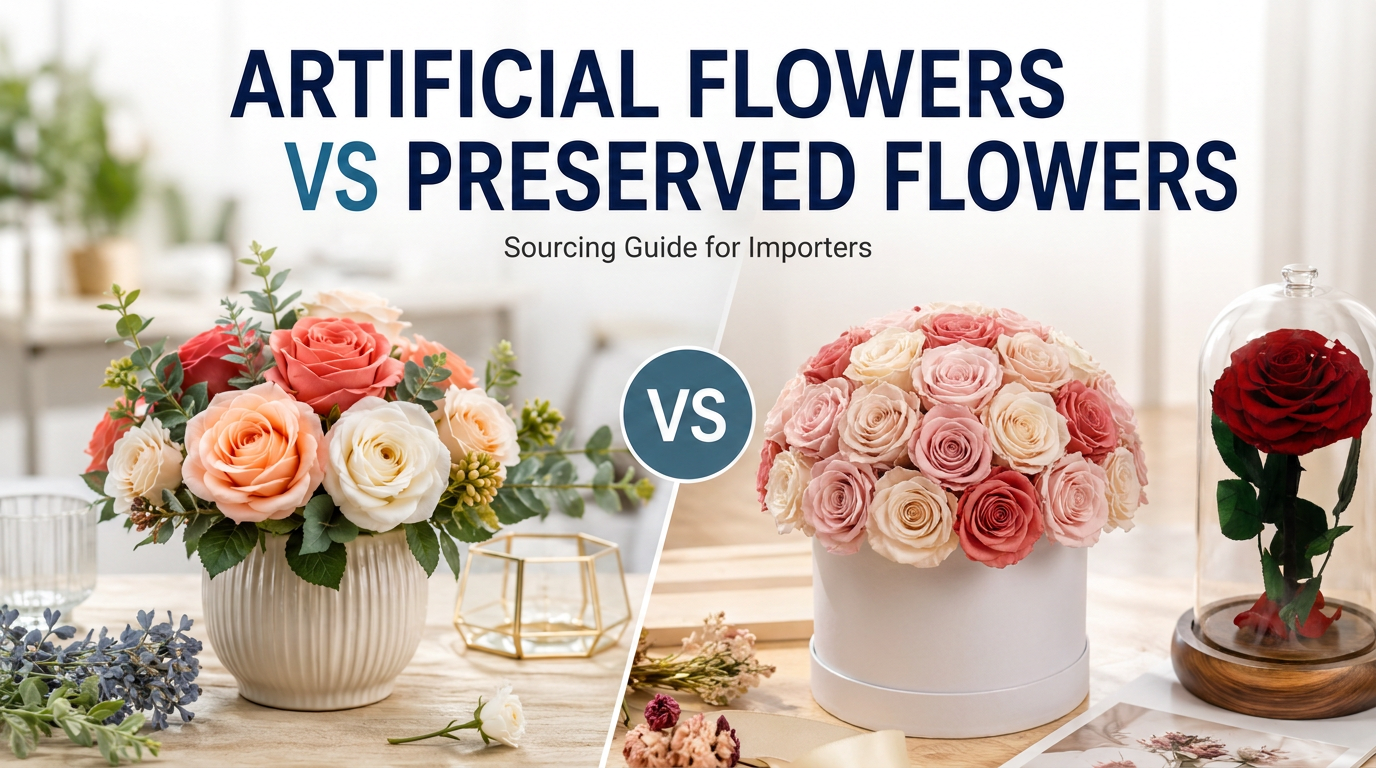
The global preserved flower market is not built around one perfect origin. Instead, it works through regional specialization. Ecuador, Japan, and Yunnan each offer a different kind of value for floral brands, wholesalers, retailers, and product development teams.
Ecuador is known for premium rose materials and dramatic floral scale. Japan is respected for refined color work, delicate preserved flower materials, and artisan floral aesthetics. Yunnan, China, is strong in high-volume production, diverse flower categories, OEM and ODM development, and turnkey preserved flower gift delivery.
To maximize product value, profit margin, and operational efficiency, wholesale and retail brands should not limit themselves to one region. A stronger approach is to build a hybrid sourcing strategy that uses each origin for what it does best.
How Do Ecuador, Japan, and Yunnan Compare in Global Preserved Flower Sourcing?
For global floral brands, preserved flower sourcing requires a clear understanding of regional strengths. No single origin fits every retail format. A luxury rose box, a delicate DIY floral kit, and a supermarket-ready preserved flower gift set all require different sourcing logic.
The table below gives a quick comparison of Ecuador, Japan, and Yunnan in the preserved flower industry.
| Feature | Ecuador | Japan | Yunnan, China |
|---|---|---|---|
| Core Specialization | Premium raw materials and giant rose heads | Niche artisan colors and miniature arrangements | Mass supply, diverse species, and turnkey gifts |
| Average Rose Head Size | 6 cm to 10+ cm, premium XXL styles | 2 cm to 5 cm, miniature and small styles | 3 cm to 8 cm, highly versatile |
| Pricing Level | High, premium luxury | Premium, artisanal niche | Cost-effective to mid-range |
| Best Business Application | Luxury single-rose gifts and grand arrangements | High-end floral art and delicate DIY kits | Large-scale retail chains and OEM finished gifts |
| Supply Capacity | Medium, influenced by weather and altitude | Low to medium, limited by artisanal production | Ultra-high, supported by mass industrial infrastructure |
Why Are Ecuadorian Preserved Roses Considered the Luxury Standard?
Ecuadorian preserved roses are world-renowned because of the country’s unique equatorial climate and high-altitude growing regions. Many roses are grown at high elevations, where strong sunlight, cool nights, and fertile soil help produce thick petals, strong stems, and large blooms.
For high-end retail brands, sourcing from Ecuador offers several clear advantages:
- Unmatched scale: Premium Ecuadorian rose heads can reach impressive sizes, making them suitable for luxury floral products and statement arrangements.
- Structural integrity: Thick petals can support preservation treatment well, helping maintain a natural texture and rich coloration.
- Brand positioning: Ecuadorian roses immediately suggest luxury, which can help justify higher retail price points for premium gift boxes.
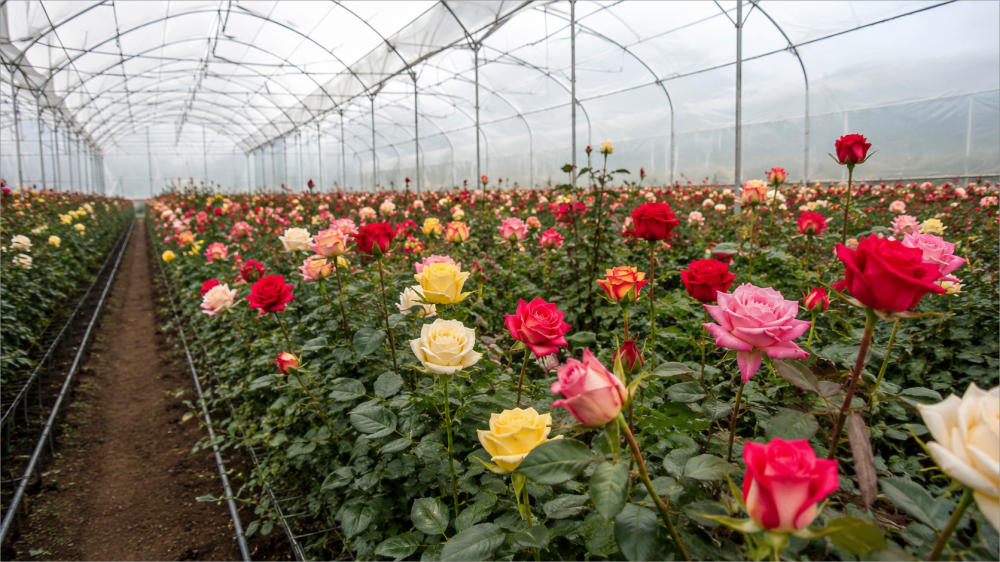
Ecuadorian preserved roses are prized globally for their size, petal thickness, and luxury visual appeal.
Ecuador is especially suitable for luxury single-rose gifts, grand rose arrangements, premium wedding florals, boutique displays, and high-ticket preserved rose boxes.
However, Ecuador is not always the most practical choice for high-volume gift programs. Costs are higher, freight can be expensive, and the final product still depends on processing, packaging, quality control, and delivery planning.
Looking for premium preserved rose options for a luxury product line?
Email us to discuss sourcing, packaging, and product positioning for high-end preserved rose gifts: sales@sweetie-group.com
What Makes Japanese Preserved Flowers the Standard-Bearer of Floral Artistry?
While Ecuador is known for scale and luxury rose impact, Japan is recognized for delicate floral materials, color theory, and refined preserved flower aesthetics. Japanese preserved flower products often focus on subtle textures, pastel tones, vintage shades, and small-scale floral compositions.
For brands serving hobbyist, artisan, boutique, or designer markets, Japanese preserved flowers offer several advantages:
- Sophisticated colorways: Japan is known for soft pastel tones, gradient colors, muted vintage palettes, and natural-looking floral shades.
- Miniature precision: Japanese preserved flowers are well suited to glass dome arrangements, jewelry boxes, miniature displays, and delicate floral craft projects.
- Strict quality expectations: Fine petal condition, careful coloring, and consistent material quality are especially important in high-end floral art studios.
Japanese preserved flowers are often a strong choice for boutique arrangements, floral art supplies, DIY kits, handcraft products, premium mini gifts, and Japanese-style floral design.
The main limitation is scalability. Japanese preserved flowers are usually more expensive and less suited to large seasonal promotions or high-volume retail programs. For commercial gift lines, Japan is often better used for premium materials, design inspiration, or niche product categories rather than mass-market finished gift production.
How Does Yunnan, China, Lead in Preserved Flowers Wholesale?
Yunnan, especially around Kunming and the Dounan Flower Market, is one of the most important floral supply regions in China. It combines strong flower cultivation resources, mature flower trading, preserved flower processing, packaging supply chains, and commercial product assembly.
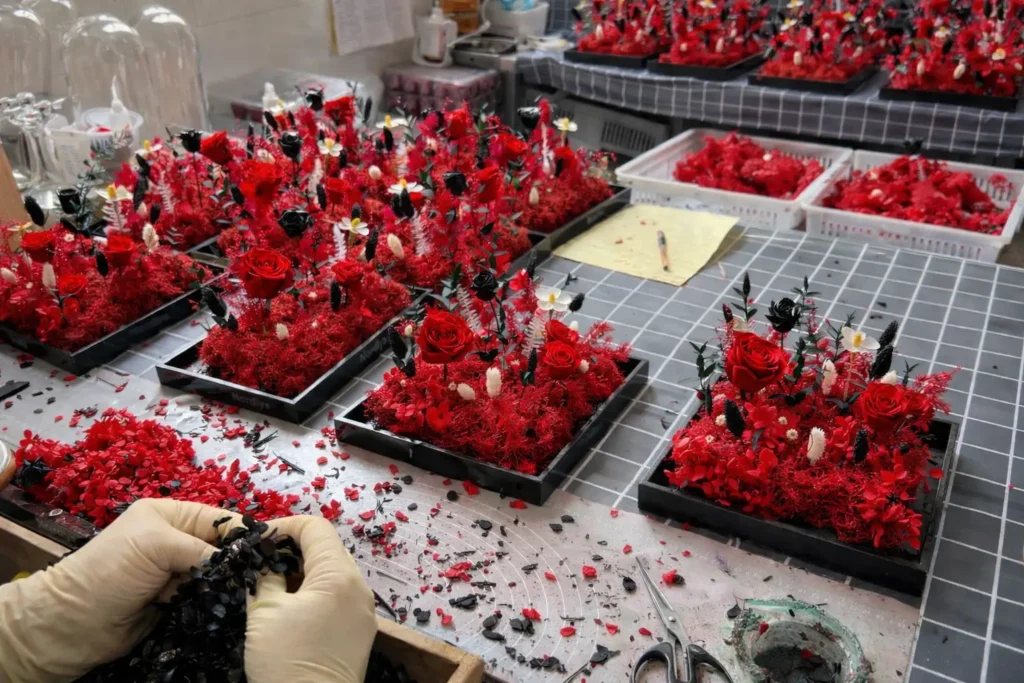
Unlike Ecuador, which is mainly valued for premium rose raw materials, or Japan, which is known for delicate floral craft, Yunnan is strong in commercial execution. It can support preserved flower wholesale, OEM finished gifts, seasonal packaging, custom flower boxes, glass domes, acrylic boxes, and large-volume B2B delivery.
For mid-to-large-scale retailers and global distributors, Yunnan preserved flowers wholesale offers several advantages:
- Cost efficiency: Industrialized processing and strong local supply chains help keep unit costs competitive while protecting retail margins.
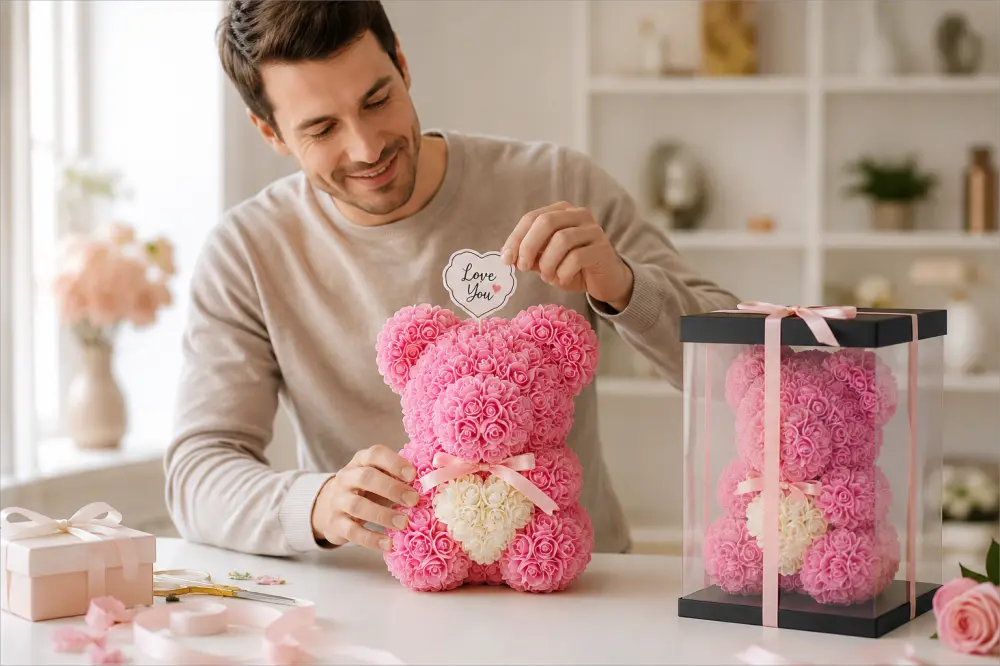
- Turnkey OEM and ODM capability: Yunnan-based factories can assemble finished products such as preserved flower acrylic jewelry boxes, LED glass domes, seasonal floral arrangements, and customized gift sets.
- Product diversification: Beyond roses, Yunnan offers preserved hydrangeas, eucalyptus, baby’s breath, moss, fillers, and mixed floral materials, making it easier to build a complete product range.
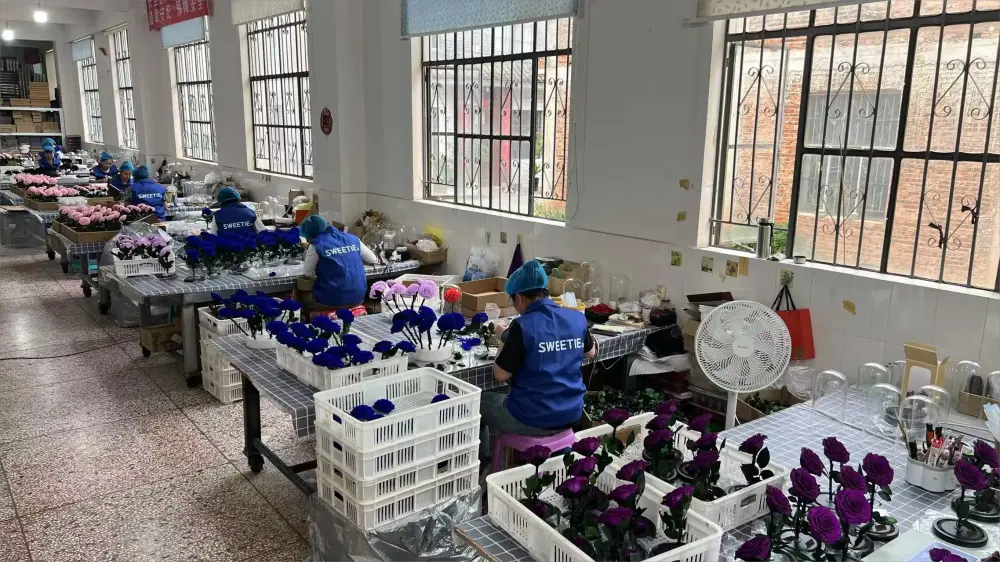
Yunnan serves as a major hub for high-volume, cost-effective, and custom-designed finished preserved flower gifts.
Yunnan is especially suitable for large-scale retail chains, e-commerce brands, supermarkets, corporate gift projects, holiday promotions, importers, wholesalers, and private-label floral gift programs.
The key risk is supplier selection. Product quality can vary between manufacturers. Color stability, packaging safety, moisture control, carton strength, and repeat-order consistency should be verified before committing to large-volume production.
Developing a wholesale preserved flower gift line?
Our team can help with product structure, packaging options, MOQ planning, and seasonal product development. Email sales@sweetie-group.com for product suggestions.
How Can Brands Reduce Sourcing Risks Like Quality Differences and Logistics Costs?
Global preserved flower sourcing can bring strong product advantages, but it also creates practical challenges. When working with multiple preserved flower suppliers, quality control and logistics planning become essential.
- Optimize freight strategy: Preserved flowers are lightweight but bulky. Raw materials from Ecuador may require expensive air freight, while high-volume finished products from Yunnan can often be planned around more cost-effective shipping solutions.
- Control moisture and mold risks: Preserved flowers are sensitive to humidity. Proper desiccant packaging, sealed inner protection, and suitable storage conditions are important during transit.
- Standardize samples before production: Before placing large wholesale preserved flower orders, sample testing should confirm color stability, petal texture, packaging strength, and transport protection.
- Confirm batch consistency: Repeat orders should be checked for color difference, flower size variation, package matching, and final product presentation.
- Match the product to the sales channel: A luxury flower box, supermarket gift item, and DIY floral kit require different materials, packaging, and cost structures.
How to Design a Hybrid Sourcing Strategy for a Stronger Product Matrix
Profitable preserved flower brands do not need to choose only one origin. A hybrid sourcing strategy can help balance luxury positioning, floral artistry, cost control, and volume supply.
- The Core Collection, Luxury Tier: Use Ecuadorian preserved roses for high-margin signature rose boxes, luxury single-rose gifts, and premium floral displays.
- The Design and Artistry Line: Use Japanese preserved flowers for delicate DIY kits, boutique centerpieces, floral workshop materials, and premium miniature arrangements.
- The Volume and Giftware Line: Work with Yunnan manufacturers for high-volume seasonal gifts, custom packaging, filler greens, cost-effective rose heads, and OEM finished products.
This tiered approach allows a brand to serve premium customers while maintaining commercial cash flow through high-volume gift products.
Why Is EterniBlossom Your Strategic B2B Preserved Flower Partner?
Managing multiple international supply chains can become difficult as a floral brand expands. Product development, supplier communication, quality assurance, packaging standards, and logistics coordination all require time and industry experience.
A centralized B2B partner can help simplify this process. EterniBlossom supports multi-origin preserved flower sourcing, quality control, product development, and streamlined logistics. By centralizing preserved flower sourcing, brands can reduce administrative work, improve product consistency, and build a more balanced product matrix across luxury, artisan, and commercial gift lines.
For brands that need both premium materials and scalable finished products, the goal is not just to buy flowers. The goal is to build a product system that can support sales growth, seasonal planning, and repeatable quality.
Scaling your preserved flower product line?
Optimize margins on bulk flower heads, custom gift boxes, seasonal collections, and finished B2B floral gift lines. Email sales@sweetie-group.com to discuss your project.
Conclusion: Use Each Origin for What It Does Best
Ecuador, Japan, and Yunnan each play a different role in global preserved flower sourcing.
Ecuador is best known for premium rose materials and luxury floral impact. Japan is strong in delicate preserved flower artistry, refined colors, and miniature design materials. Yunnan is the most practical choice for high-volume commercial products, packaging customization, OEM gifts, and B2B finished product delivery.
The strongest sourcing strategy is not always choosing one origin over another. It is often a hybrid approach that combines Ecuador’s luxury appeal, Japan’s artisan refinement, and Yunnan’s commercial supply strength.
For wholesale and retail brands, that combination can support stronger product differentiation, better margins, and more stable long-term growth.