Planning a successful plush flower event giveaway requires working backward from your event date to calculate realistic quantities based on expected claim rates, budget for the effective campaign cost per distributed unit, choose the right customization level, and manage compliance based on your target market. To execute smoothly, brands must integrate packaging, on-site display design, and strict real-world prototype testing into their procurement timeline.
How should brands calculate the realistic quantity needed for an event giveaway?
Calculating the correct volume for event giveaways is one of the most common pitfalls for procurement and marketing teams. Many brands make the mistake of ordering promotional products based strictly on the total expected venue capacity or general foot traffic. This approach inevitably leads to either massive stock overages—resulting in expensive post-event storage and return shipping costs—or a premature stockout that leaves high-value visitors empty-handed.
To understand how to plan plush flower giveaways for events accurately, brands should use a conversion-based formula that filters total foot traffic down to actual eligible, engaged visitors. The standard calculation is structured as follows:
Total Order Volume = (Total Projected Foot Traffic × Qualified Engagement Rate × Expected Claim Rate) + Strategic Event Buffer
To break down these variables:
- Total Projected Foot Traffic: The total number of people entering the venue or the specific exhibition hall.
- Qualified Engagement Rate: The percentage of that traffic expected to actively stop at your booth, participate in an activation, scan a QR code, or engage with your staff (typically 15% to 35% depending on booth size and placement).
- Expected Claim Rate: The percentage of engaged visitors who will actually accept and take the plush flower (for high-appeal items like custom plush flowers, this is highly efficient, often reaching 85% to 95%).
- Strategic Event Buffer: A dynamic buffer designed around daily distribution caps rather than a flat, arbitrary percentage. For multi-day events, allocate an extra 5% to 10% per day to account for VIP distribution, media guests, and on-site display replacements.
For example, if a three-day trade show expects 20,000 total attendees, and historical data suggests your interactive booth will engage 20% of the crowd (4,000 visitors), your base giveaway target is approximately 3,600 units. Adding a targeted daily buffer of 5% brings your optimal procurement volume to approximately 3,800 units.
By pacing your daily distribution—for instance, capping distribution at 1,200 flowers per day—you ensure the giveaway lasts throughout the entire event duration, maintaining visual impact and brand presence from day one to day three.
Planning a plush flower giveaway for an event? Send your event date, quantity, target market, branding needs, and budget range to inquiry@sweetie-group.com. We can help recommend a practical product and purchasing plan.

What is the difference between EXW price and effective campaign cost per distributed flower?
When sourcing bulk plush flowers for events, procurement teams often focus exclusively on the Ex Works (EXW) unit price quoted by a custom plush flower manufacturer. However, evaluating a campaign solely on the EXW price presents a highly distorted view of the actual financial investment. To present an accurate budget to stakeholders, project managers must calculate the effective campaign cost per distributed flower.
This metric accounts for every cost element required to get the product from the factory floor into the hands of your target audience at the venue. It is calculated by dividing the total landed, packaged, and distributed cost by the number of units actually placed with qualified visitors.
To illustrate where these costs arise, consider the following breakdown of expenses beyond the base EXW price:
| Cost Component | Description | Budgetary Impact |
|---|---|---|
| Base EXW Unit Price | The manufacturing cost per unit at the factory. | Typically 35% to 50% of the final distributed cost. |
| Branding & Packaging Accessories | Custom hangtags, sewn-in labels, printed ribbons, or individual presentation sleeves. | Adds approximately 0.15to0.60 per unit depending on complexity. |
| Volumetric Logistics & Customs | Shipping costs calculated by volume rather than weight (plush flowers are highly volumetric). Includes import tariffs, customs clearance, and port fees. | Can add 20% to 45% to the base unit price, especially for expedited air freight. |
| On-Site Storage & Handling | Drayage fees charged by exhibition centers for receiving, storing, and delivering pallets to your booth. | Significant cost driver; varies by venue rules and labor unions. |
| Wastage & Display Costs | Units used exclusively for display backdrops or damaged during high-traffic handling. | Typically accounts for 2% to 4% of total inventory. |
| On-Site Hand-out Labor | The hourly rate of brand ambassadors or staff dedicated to preparing and handing out the flowers. | Operational cost that must be amortized over the total distributed units. |
Because plush items are lightweight but bulky, shipping costs can fluctuate dramatically depending on the transit method. Sourcing far in advance allows for sea or rail freight, which drastically reduces the volumetric shipping rate compared to last-minute air express. When preparing your budget, always request a Delivered Duty Paid (DDP) or Delivered at Place (DAP) quote from your custom plush flower manufacturer to ensure transport and duty costs are clear from the outset.
If you need help matching your specific event variables with realistic product types, Sweetie offers a specialized design tool. Planners can utilize the Sweetie AI to easily input their event type, target market, quantity, and budget limits to receive tailored product recommendations and a preliminary procurement plan.
What are the three levels of customization available for branded plush flowers?
When planning branded event promotional gifts, brands must decide how deeply they need to customize the product to align with their brand identity. Customization directly impacts lead times, mold/setup costs, and minimum order requirements. At Sweetie, we classify customization into three distinct tiers to help brands balance creative vision with practical event constraints.
Tier 1: Branded Off-the-Shelf Customization
This is the fastest and most cost-effective option for tight timelines. It utilizes pre-existing, popular plush flower patterns—such as classic daisies, tulips, or sunflowers—and integrates brand assets through customized accessories.
- Customization elements: Custom-printed paper hangtags, woven brand labels sewn into the seam, or branded ribbon sleeves wrapped around the stems.
- Best for: Events with lead times under 6 weeks or projects requiring lower initial volumes.
Tier 2: Adapted Designs (Semi-Custom)
This level allows brands to modify existing plush flower templates to better match their corporate visual identity. It offers a highly customized look without the extensive development timelines or mold charges of fully bespoke items.
- Customization elements: Custom dyeing fabrics to match precise Pantone brand colors, mixing fabric textures (such as combining crystal super-soft velour with sherpa or felt), or altering physical dimensions (e.g., elongating the stem or increasing the flower head diameter).
- Best for: Annual corporate rebrands, major product launches, or pop-ups where color precision is critical for brand cohesion.
Tier 3: Full Custom OEM/ODM Development
For brands seeking a completely unique, show-stopping promotional item, full custom development turns an original concept or brand mascot into a custom plush flower.
- Customization elements: Custom shape sculpting, integration of specialized mechanics (like internal memory wire for bendable stems), sound chips, embedded LEDs, or scent-infused fabrics.
- Best for: High-profile experiential marketing campaigns, exclusive influencer mailers, or major trade shows where maximum differentiation is required.
As a professional custom plush flower manufacturer, Sweetie provides end-to-end OEM and ODM support across all three tiers, helping you select the appropriate balance of speed, cost, and brand alignment.
How can brands integrate on-site displays, packaging, and logistics for a seamless giveaway experience?
An event giveaway is only as successful as its presentation. Simply stacking bulk plush flowers in brown shipping boxes behind a counter completely diminishes their premium feel. To maximize engagement, planners must design the on-site display, packaging, and replenishment logistics as an integrated system.
Designing the Visual Display
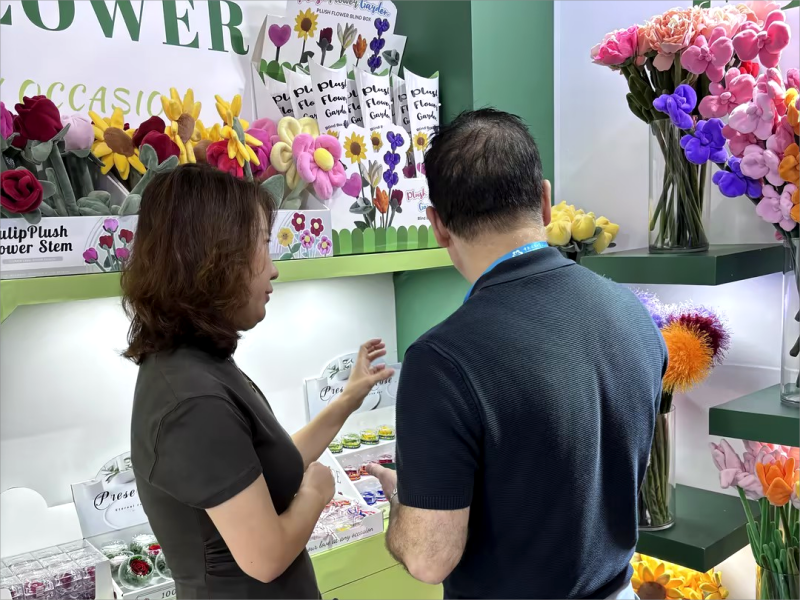
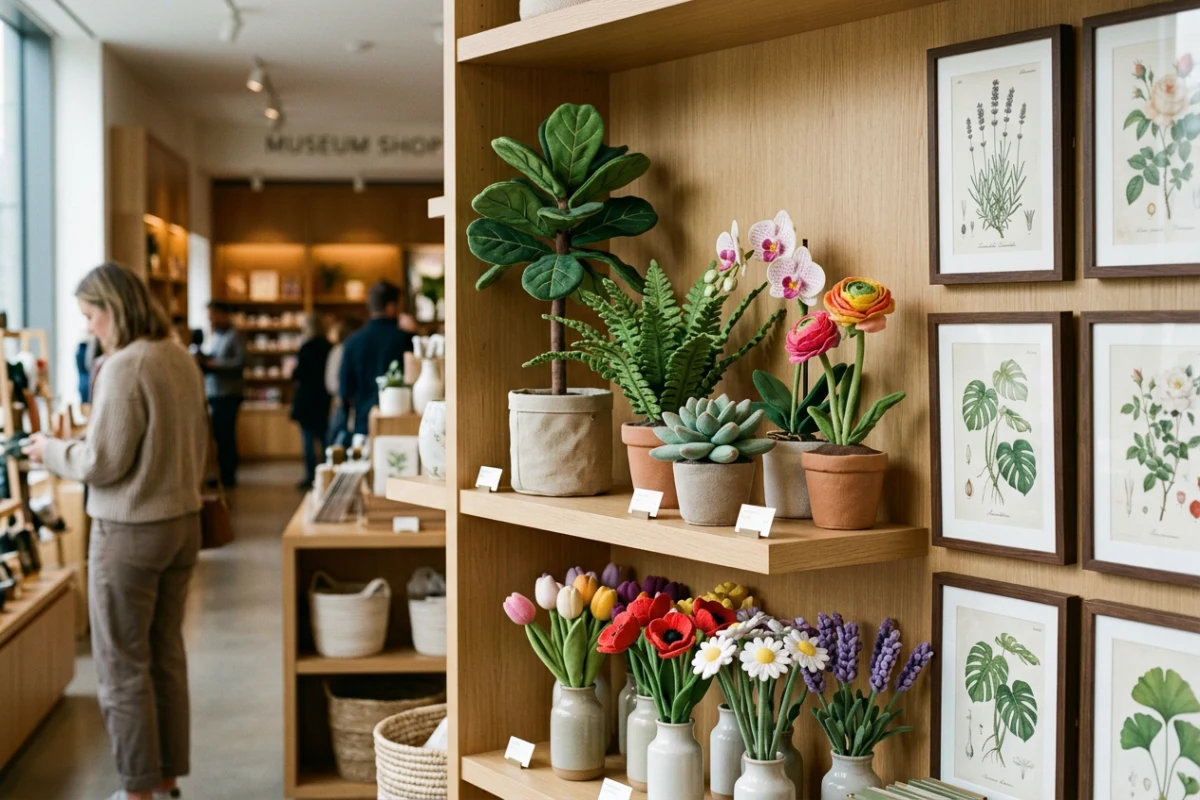
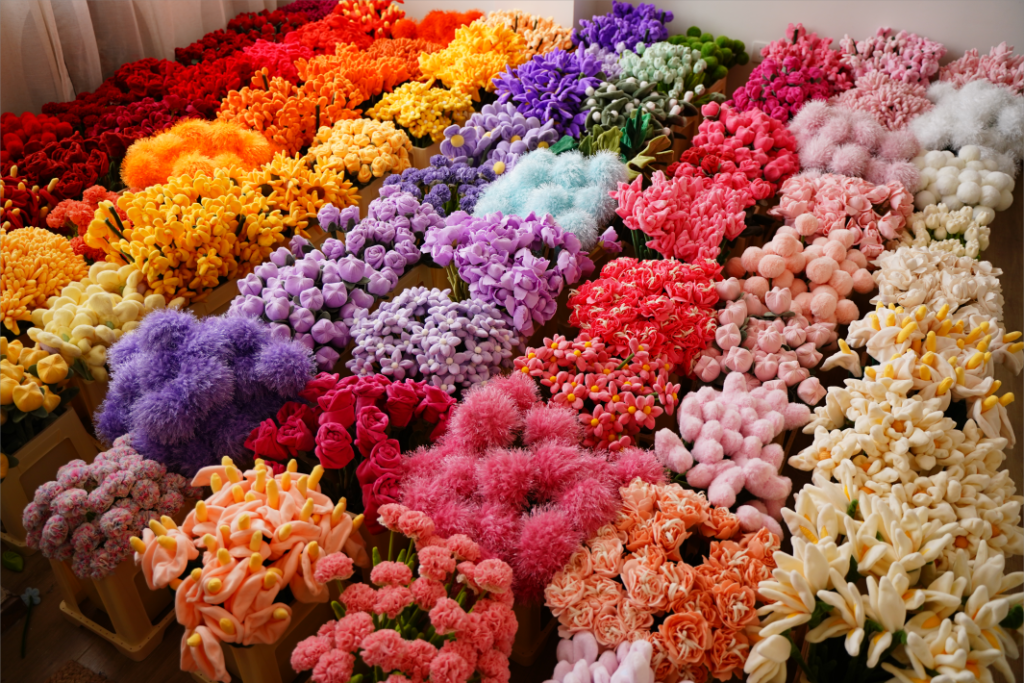
Plush flowers have an inherent advantage: they can be arranged in mass to create stunning, photo-worthy visual installations. Instead of treating them solely as take-home items, use them to build the booth’s environment.
- Plush Flower Walls: Create a dense grid of plush flowers that serves as a photo backdrop. Attendees can “pluck” their flower from the wall after completing an activation.
- Branded Floor Vases and Bins: Arrange flowers in oversized, branded wooden crates, acrylic vases, or display baskets that match the event’s aesthetic.
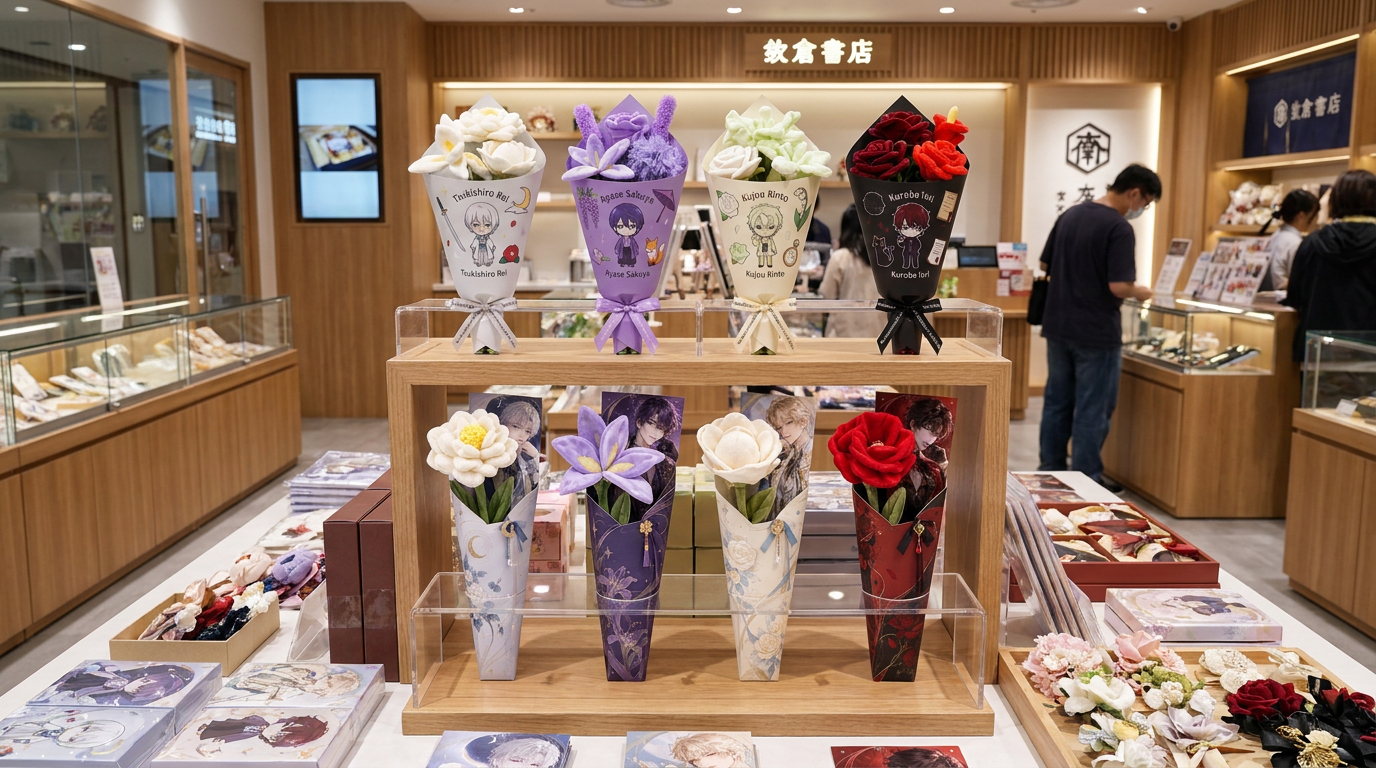
- Single Stems vs. Bouquets: Determine if you will distribute single plush stems, packaged bouquets, or smaller gift formats. Single stems work beautifully for high-volume trade shows, while elaborate plush bouquets or custom gift formats are ideal for VIP dinners or media events.
Packaging Considerations
Packaging must balance product protection during transit with speed of distribution on-site.
- Transit Protection: To prevent the plush heads from being crushed or creased during shipping, they should be packed in protective inner cartons. While vacuum compression is sometimes used to save on shipping volume, it requires a decompression period of 24 to 48 hours before the event to allow the plush fibers to regain their full shape and loft.
- On-Site Handling: If individual flowers are packaged in delicate clear cellophane sleeves, ensure your staff can unpack them quickly. If distribution speed is critical, opt for pre-attached hangtags or minimalist cardboard bands that do not require time-consuming unpacking at the booth.
On-Site Stock Management
Keep your booth clean and organized by planning your replenishment cycle. Store bulk master cartons in the venue’s designated storage area rather than cramming them into your active booth space. Bring out only enough inventory to refill your display displays every two to three hours. This maintains an aesthetic of exclusivity and keeps your presentation looking pristine.
What is the correct way to review and test plush flower samples for event suitability?
Before greenlighting a plush flower wholesale procurement order, a physical sampling phase is absolutely critical. This is the stage where abstract design files and digital mockups are translated into physical reality. To ensure the final product meets expectations, the procurement team must evaluate prototype samples under conditions that simulate a high-traffic, real-world event.
When you receive a prototype from your manufacturer, establish a systematic evaluation checklist covering the following areas:
- Tactile and Aesthetic Appeal: Feel the fabric quality. Does the velour shed fibers? Are the colors accurate to your brand guidelines under both artificial exhibition lighting and natural sunlight? Is the stitching tight and clean, especially around complex curves and brand logos?
- Structural Integrity and Flexibility: If the plush flower features a bendable stem, bend it repeatedly in different directions. The internal wire (typically a safe, coated aluminum or steel wire) should bend smoothly without snapping, poking through the plush fabric, or losing its shape over time.
- Branding Execution: Inspect the custom hangtags and sewn-in labels. Is the text legible? Are the print registration and colors accurate? Ensure the placement of the label does not interfere with how the flower is held or displayed.
- Durability and Stress Testing: Give the flower head a firm pull. The seams between the petals, leaf, and stem should withstand reasonable tension without tearing. Remember that attendees at public events—including children—will handle these items with varying degrees of care.
Never approve a sample based solely on digital photos or video calls. Always request the physical “Golden Sample” to be shipped to your office for hands-on sign-off. Once approved, this physical sample serves as the binding quality standard for the entire bulk production run.
Which safety and compliance regulations apply to promotional plush flowers?
Compliance is a major area of confusion for brand managers sourcing plush promotional items. A common misconception is that all plush flowers must undergo identical, exhaustive toy safety testing, or that a single mark like the European “CE” covers every global requirement. In reality, compliance pathways are determined by four main factors: target age, intended use, geographical market, and product classification.
First, analyze the target age and intended use. If your plush flower is designed as a decorative promotional giveaway at an adult-oriented corporate conference, it may be classified as a decorative novelty or promotional accessory rather than a toy. However, if the event is open to families, or if the item’s design has high play value for children (such as bright colors, soft textures, and a bendable stem), regulators in many jurisdictions will classify it as a soft toy. In these cases, the product must meet strict toy safety standards, regardless of the brand’s intended adult audience.
Different geographical markets enforce distinct legal frameworks:
- United States: If classified as a children’s product (for ages 12 and under), it must comply with CPSIA (Consumer Product Safety Improvement Act) standards, including lead and phthalate limits, and undergo ASTM F963 toy safety testing at a CPSC-accepted laboratory. A tracking label must also be permanently attached to the product.
- European Union & United Kingdom: Toys must comply with the EN71 standards (covering mechanical, physical, flammability, and chemical properties) and bear the CE mark (for the EU) or UKCA mark (for the UK).
- Fabric Certification: Regardless of classification, look for materials certified under OEKO-TEX Standard 100 to ensure the plush fabrics are free from harmful substances.
Before launching production, consult with your supplier to clarify these requirements. A professional supplier like Sweetie can help define the target audience and work with third-party testing labs (such as SGS, Bureau Veritas, or Intertek) to ensure the materials and construction align with your market’s legal mandates.
How should brands plan their bulk production schedules when working backward from the event date?
To ensure your promotional items arrive on time without incurring exorbitant last-minute air freight charges, procurement timelines must be planned systematically, working backward from the day of the event. Do not rely on fixed lead times or arbitrary buffer percentages; instead, build a custom milestone schedule that accounts for every phase of the manufacturing and logistics cycle.
Here is an illustrative project timeline showing how to map out key milestones leading up to your event date (Day T):
- Day T (Event Day): The day the giveaway begins.
- Day T-5 to T-2 (On-Site Delivery & Setup): Flowers arrive at the venue or local warehouse. This window allows for local drayage, unpacking, and display assembly.
- Day T-15 to T-6 (Customs Clearance & Local Distribution): Buffer time for import customs clearance, port handling, and domestic ground shipping to the venue.
- Day T-55 to T-16 (International Transit Phase): The transit window. If shipping via ocean freight (highly recommended for bulk orders to minimize costs), this takes 30 to 40 days depending on the shipping lane. If using air freight, this can be shortened to 7 to 10 days, but at a significantly higher cost.
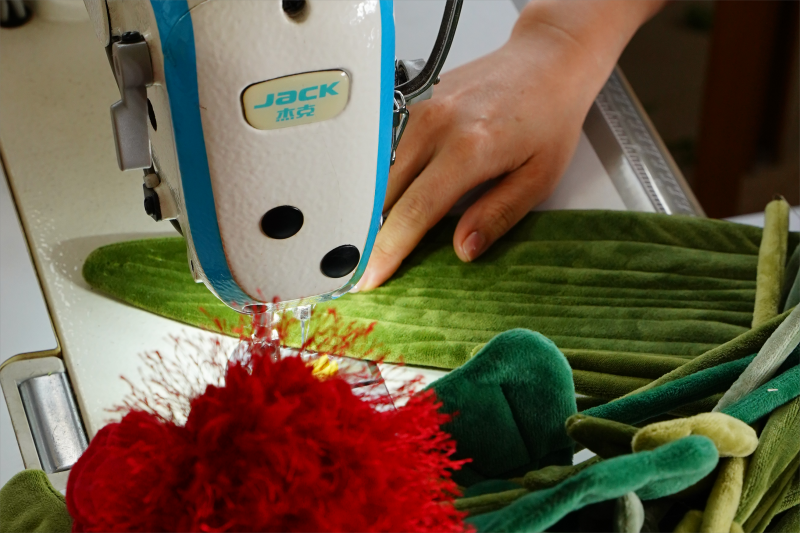
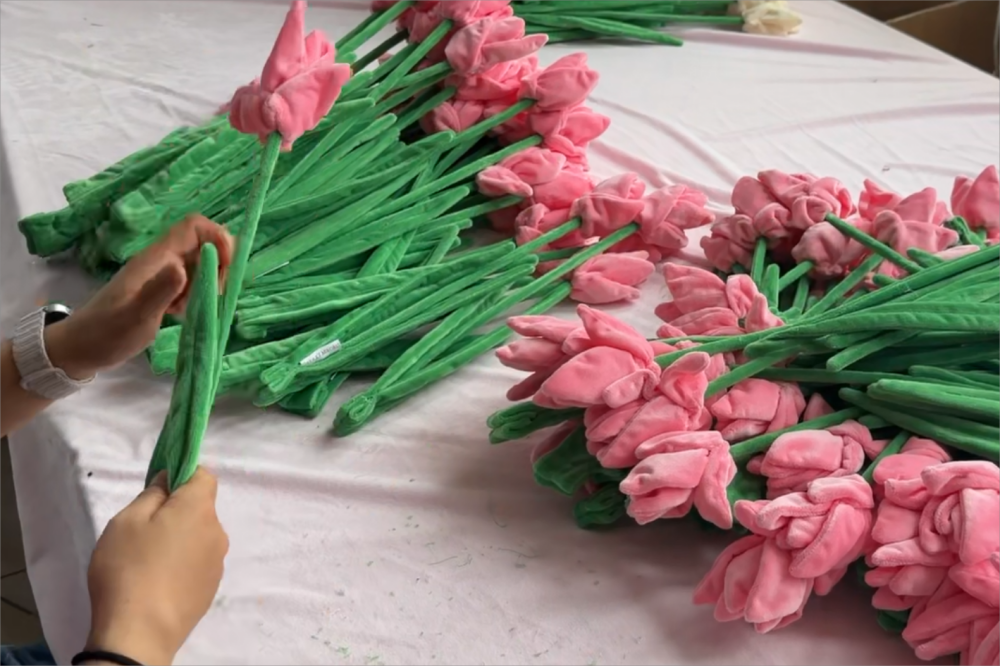
- Day T-95 to T-56 (Bulk Manufacturing & Quality Control): The actual production run at the factory. This includes fabric sourcing, cutting, embroidery/printing, stuffing, hand-stitching, metal detection, and final QA inspections.
- Day T-115 to T-96 (Pre-Production Sampling & Approval): Creating, shipping, and obtaining physical sign-off on the pre-production “Golden Sample.” This phase must allow time for at least one round of revisions if adjustments are needed.
- Day T-130 to T-116 (Contracting, Deposit, & Design Finalization): Finalizing graphic files, color matching, and issuing the initial deposit to initiate sample development.
By establishing this 18-to-20-week backward schedule, you can secure the highly economical ocean freight option, protect your project from unexpected port delays, and guarantee a stress-free delivery process.
If your timeline is significantly tighter, contact your custom plush flower manufacturer immediately. Experienced suppliers can often recommend alternative fabric options already in stock or suggest faster branding techniques to compress the production cycle without compromising on visual impact.
Conclusion: Streamlining Your B2B Plush Flower Procurement
Successful event giveaways are built on structured planning, realistic budgeting, and rigorous supply chain management. By focusing on your effective campaign cost per flower, choosing the appropriate level of customization, and designing an integrated on-site display, your brand can turn a simple promotional giveaway into a highly memorable brand experience. Partnering with a dedicated B2B supplier like Sweetie ensures that your custom plush flowers are manufactured to the highest standards of safety, quality, and aesthetic appeal.
If you are ready to explore options for your next activation, please contact our procurement experts at inquiry@sweetie-group.com to request custom templates, material swatches, or an initial production estimate.