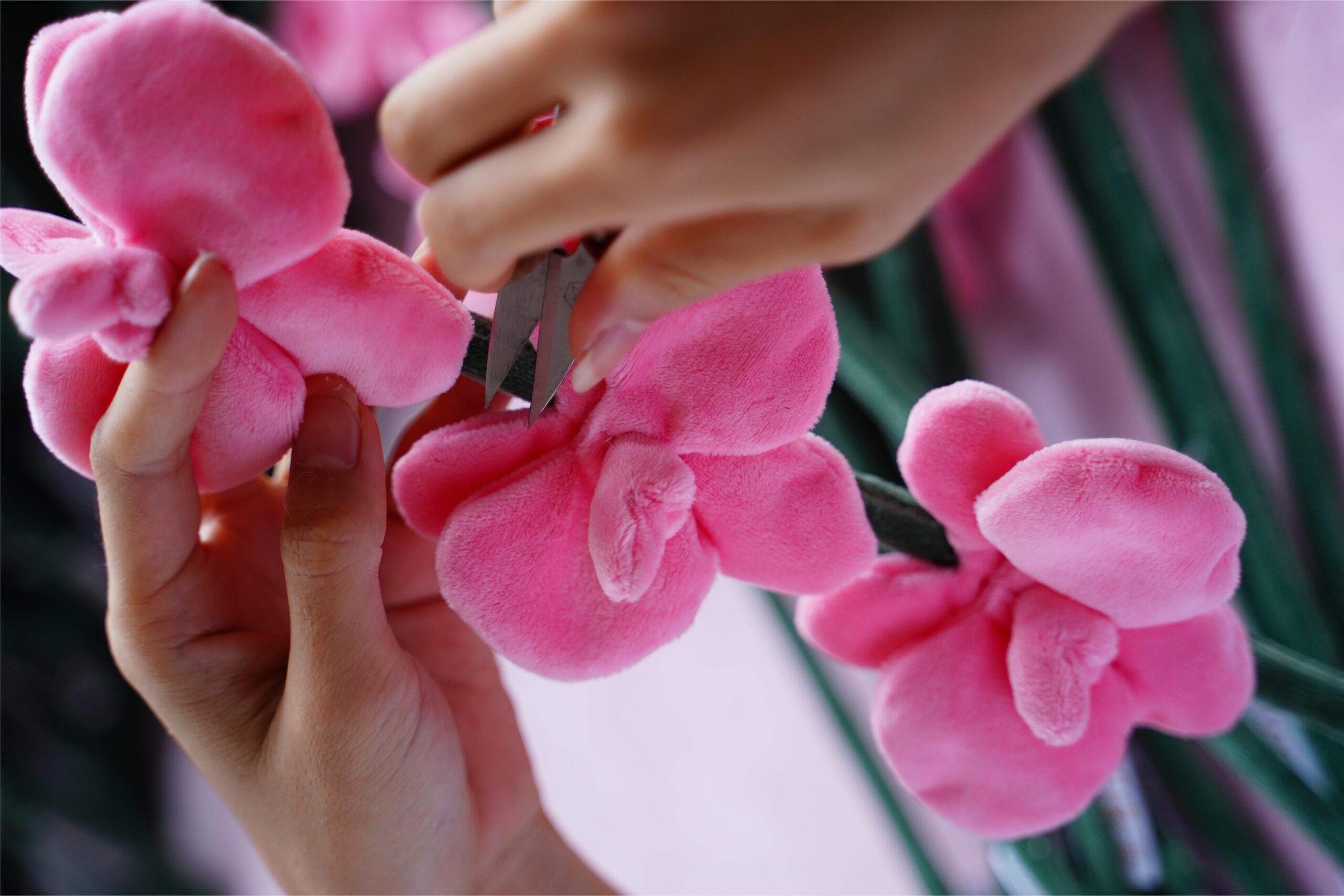
For global gift importers, retail buyers, and sourcing managers, the transition from a “golden sample” to a bulk container is the most critical phase of product development. A single handmade plush flower prototype can easily look flawless. However, when manufacturing 5,000 or 10,000 units, maintaining that exact level of craftsmanship across an entire production run is a significant operational challenge.
Unlike standard stuffed toys, plush flowers rely heavily on structural straightness, precise petal layering, and proportional symmetry to hold their retail value. Minor handwork inconsistencies—such as a slightly tilted leaf, an unevenly stuffed center, or a weak stem-to-head connection—become highly visible when products are arranged together on a retail shelf.
To protect your margins and prevent customer returns, implementing a structured plush flower quality control (QC) process prior to factory release is essential. Below is the professional inspection framework required to secure bulk consistency.
Why Batch Consistency is the Real Challenge in Plush Flower Manufacturing
Plush flowers are predominantly assembled by hand, making them inherently prone to minor variations. While some tolerance is expected in handmade goods, importers must establish clear boundaries to prevent these variations from compromising brand reputation.
[Approved Sample] ──> [Dye-Lot Control] ──> [Structural Assembly] ──> [Packing Recovery Test]
When importing fabric flowers, bulk issues generally fall into three categories:
- Material Shift: Subtle variations in fabric texture or dye-lot colors between different manufacturing batches.
- Proportion Distortion: Deviations in petal-to-stem ratios or head diameters that ruin the collective display impact.
- Mechanical Weakness: Internal wire failures or poor adhesive bonding that cause the flower heads to droop during transit.
By standardizing your pre-shipment inspection, you transition from subjective “feel” to objective, measurable quality criteria.
The 5-Core Pillars of Plush Flower Inspection
A thorough pre-shipment inspection should analyze the product across five distinct dimensions:
1. Material & Surface Integrity
The tactile feel and visual finish of the fabric define the premium positioning of the product.
- Dye-Lot Matching: Compare bulk products side-by-side under standardized D65 lighting to detect subtle color shifts.
- Nap and Direction: Ensure the fabric pile (nap) runs in the same direction on all petals to maintain uniform light reflection.
- Surface Cleanliness: Check for fabric shedding, loose fibers, oil stains from sewing machinery, or chemical odors.
2. Stitching & Structural Handwork
Because plush flowers feature complex, tight curves, stitching quality directly impacts durability.
- Seam Integrity: Inspect petal edges for skipped stitches, raw edges, or open seams where stuffing might escape.
- Adhesive Control: Many fabric flowers use hot-melt glue for leaf and center attachments. Ensure there are no visible glue strings, dried residue, or overflow on the fabric surface.
3. Dimensional Proportions
Slight deviations in diameter or height will make retail displays look disorganized.
- Symmetry Check: Measure the outer petal diameter and the alignment of the central bud.
- Leaf Placement: Confirm that leaves are attached at the specified height and angle along the stem, matching the approved design sheets.
Standard Dimensional Tolerance:
├── Total Stem Height: ±10mm
├── Flower Head Diameter: ±5mm
└── Leaf Alignment Angle: ±15°
4. Stem Mechanics and Internal Structures
The stem must provide adequate vertical support without being overly rigid or hazardous.
- Internal Wire Check: If internal metal wires are used for poseability, verify they are fully encased. No sharp wire ends should penetrate the plush wrapping.
- Head Stability: Perform a gentle pull test on the connection point between the flower head and the stem to ensure it does not wobble or detach under normal retail handling.
5. Packing Recovery and Crease Resistance
Plush items are compressed during shipping to optimize container space, but they must recover quickly upon unpacking.
- Compression Resilience: Verify that folded or packed stems can be easily straightened by hand without damaging the internal structure.
- Petal Deformity: Ensure the fabric does not retain permanent creases or flattening after being packed under standard carton pressure.
Pre-Shipment Quality Control Checklist & Defect Matrix
To simplify the inspection process for third-party inspectors or factory QC teams, use this standardized defect classification matrix based on standard AQL (Acceptable Quality Limit) principles:
| QC Area | Defect Description | Classification | Action Required |
|---|---|---|---|
| Safety | Exposed sharp internal metal wires or structural pins | Critical | Immediate rejection of affected batch; 100% sorting. |
| Workmanship | Open seams with exposed stuffing/polyester fill | Major | Rework required; check stitching tension. |
| Aesthetics | Visible hot-melt glue overflow or adhesive strings on petals | Major | Clean surface; retrain assembly line on glue dosage. |
| Material | Noticeable color shade variation within the same SKU batch | Major | Sort by shade; reject if shift exceeds approved limit. |
| Structure | Loose flower head connection causing the bud to droop | Major | Reinforce stem-to-head anchor point. |
| Aesthetics | Loose thread ends longer than 5mm along seams | Minor | Factory trimming required before final packing. |
| Dimensions | Minor height deviation (within ±10mm of spec sheet) | Minor | Acceptable within normal tolerance. |
Packaging, Labeling, and Retail Compliance
A high-quality product can still fail at the retail level if the logistics and labeling are executed poorly.
- Barcode Mapping: Confirm that barcodes (UPC/EAN) on hangtags are scannable and match the outer carton SKU description exactly.
- Carton Integrity: Heavy-duty double-wall corrugated cartons must be used to prevent box collapse during sea transit.
- Stem Protection: For long-stemmed plush bouquets, ensure they are packed flat in protective inner sleeves to prevent sharp creasing or petal compression.
How Sweetie Secures Repeat Order Consistency
At Sweetie-Gifts, we understand that importing plush gifts requires reliable, repeatable manufacturing. Our production pipelines are built around strict quality checkpoints, from raw fabric sourcing in Yiwu to final export coordination via our Suzhou and Beijing teams.
Whether you are placing a wholesale order or developing custom OEM/ODM plush floral lines, we provide:
- Pre-Production Specification Sheets: Clear dimensional, material, and packaging blueprints approved before we cut any fabric.
- Inline and Final AQL Inspections: Rigorous physical testing of stitching, stem stability, and carton recovery.
- Compliance Alignment: Guidance on whether your product is positioned as a decorative gift or requires toy safety certifications for your target market.
To discuss your upcoming plush flower project, review customization options, or request a catalog, please reach out directly to our global sourcing team at inquiry@sweetie-group.com
Frequently Asked Sourcing Questions
How can we prevent visible glue residue on bulk plush flowers?
Glue bleeding is usually caused by excessive application speed or incorrect hot-melt temperature settings. We resolve this during manufacturing by using custom-metered glue nozzles and training operators to apply adhesive strictly to internal anchor points where it remains completely hidden from view.
What AQL level is recommended for B2B plush flower orders?
For mid-to-high-end retail markets, we recommend inspecting bulk batches under AQL Level II (Critical: 0, Major: 2.5, Minor: 4.0). This ensures structural and safety defects are completely eliminated while keeping minor aesthetic variations within a manageable commercial range.
Are plush flowers classified as toys or decorative gifts?
This depends entirely on the design, labeling, and marketing of the product. If they are marketed to children or feature child-appealing designs, they must comply with regional toy safety standards (such as EN71 in Europe or ASTM F963 in the US). If they are designed strictly as home decor or floral packaging accessories, they fall under general consumer product safety regulations. We recommend defining this classification prior to production.