A shopping center can spend a lot on seasonal decoration and still see shoppers walk past it in seconds.
That is the weakness of any display that gives people nothing to do.
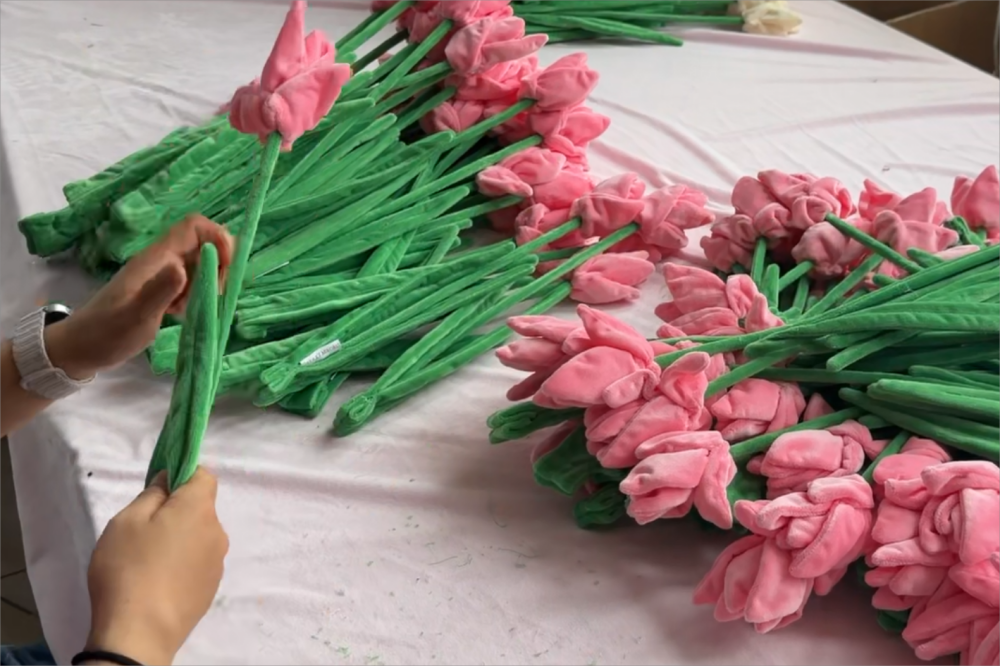
Plush flowers offer a different possibility. They can be part of the visual setting, but they can also be held, chosen, collected, wrapped, redeemed, or taken home. That makes them useful for shopping center campaigns where the goal is not simply to decorate a space, but to encourage a specific shopper action.
The most useful starting question is therefore not, “What should the flower display look like?”
It is:
What do we want shoppers to do?
That answer could be taking a photo, reaching a spending threshold, visiting another floor, joining a loyalty program, participating in an activity, or returning for a limited release.
Here are seven practical ways to build a campaign around those behaviors.
What Can Plush Flowers Do in a Mall Campaign?
Different campaign formats serve different purposes.
| Campaign format | Shopper action | Possible marketing goal |
|---|---|---|
| Photo moment | Stop, interact, take photos | Engagement and social visibility |
| Spend-and-receive reward | Reach a purchase threshold | Support promotional spending |
| Bouquet activity | Choose and assemble flowers | Participation and dwell time |
| Mall flower trail | Visit several locations | Traffic distribution |
| Loyalty reward | Register, redeem, or return | Membership and repeat visits |
| Tenant promotion | Shop across participating stores | Cross-tenant engagement |
| Limited collection | Purchase or collect designs | Retail sales and repeat interest |
The value comes from matching the product to the objective rather than using the same giveaway format for every event.
1. Create a Photo Moment Shoppers Can Interact With
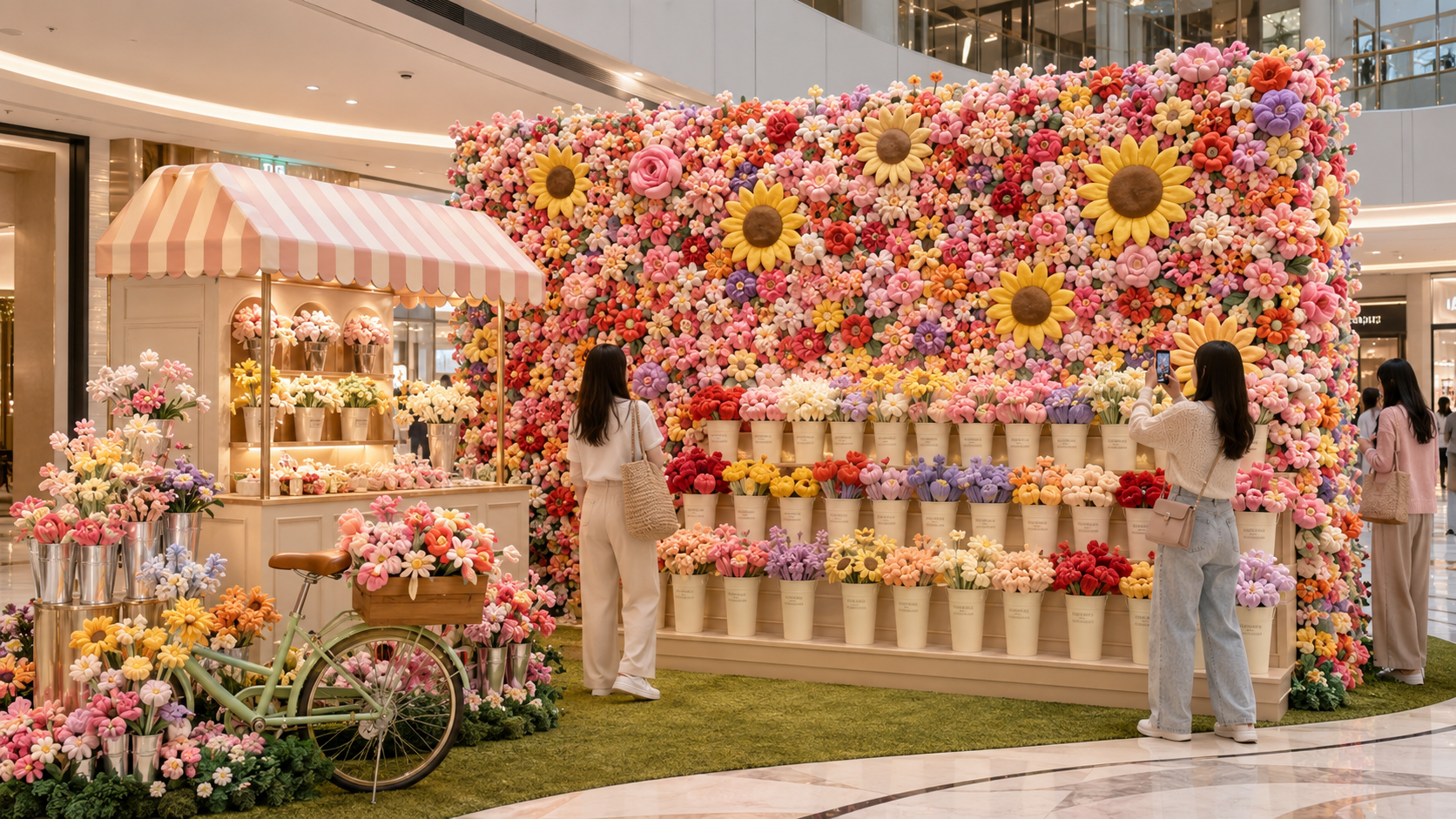
A photo zone works better when visitors are not simply standing in front of a backdrop.
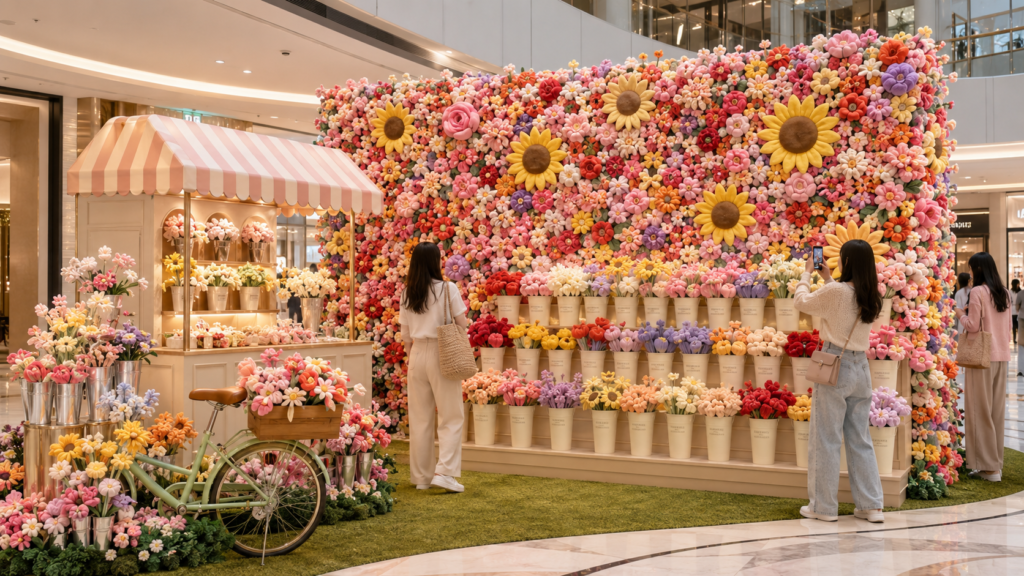
Plush flower stems or small bouquets can become handheld props that help people interact naturally with the setting. The visual area might use a seasonal garden theme, a branded floral wall, an oversized flower setting, or a simple color-led backdrop.
The design does not need to be complicated.
What matters is that shoppers quickly understand where to stand, what they can touch, and how they can participate.
For a shopping center, this type of activation can support several goals at once. It can encourage visitors to stop in a specific area, create more visible activity around the campaign, and give shoppers content they may choose to share online.
Branding should usually stay secondary to the experience. A hangtag, small campaign sign, ribbon, or background logo can often communicate the sponsor without making the flower itself feel like an advertisement.
2. Use Plush Flowers as Spend-and-Receive Rewards
This is one of the simplest formats for a shopping promotion.
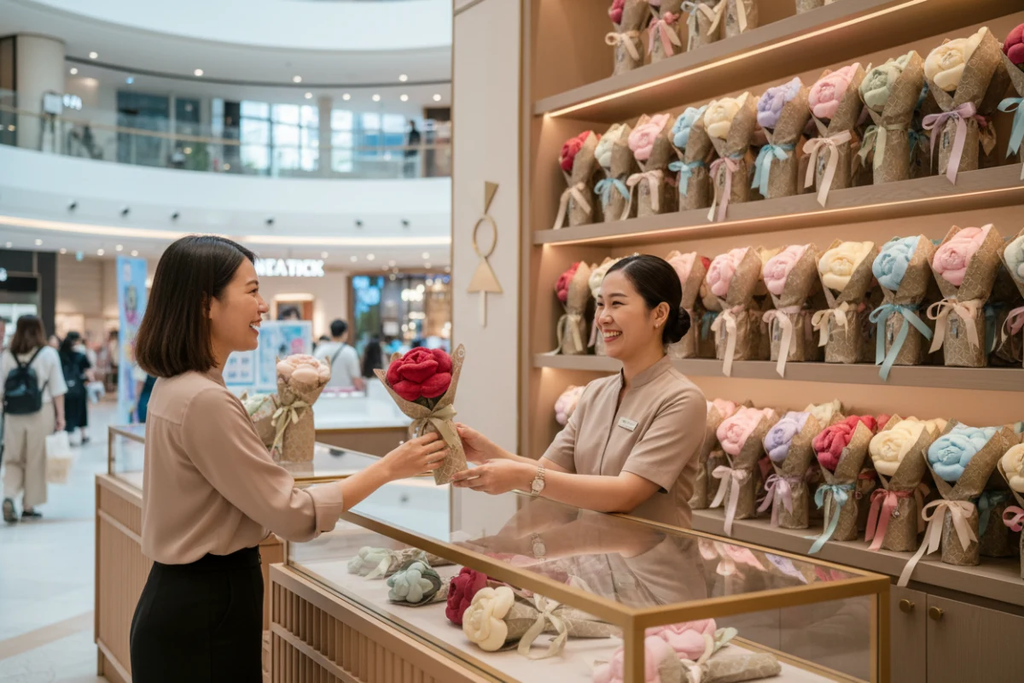
A shopper reaches a qualifying purchase amount and receives a plush flower, a small bouquet, or the opportunity to choose one design from a collection.
For example:
Spend $100 and choose one plush bloom.
The exact threshold will depend on the center, tenant mix, market, and campaign budget.
The important part is that the reward feels worth receiving. Plush flowers have an advantage over many disposable promotional items because they can remain visible after the shopper leaves the mall.
Choice can make the activity more engaging. Instead of giving everyone the same item, the campaign could offer several coordinated flowers or colors. The range should still be manageable, since too many SKUs make forecasting and replenishment harder.
For large campaigns, procurement teams should also think about how quickly staff can distribute the gifts. A beautiful package that takes several minutes to assemble at the redemption counter may create unnecessary queues.
Planning a spend-and-receive campaign? Send your target quantity, market, event date, and preferred flower styles to inquiry@sweetie-group.com for a practical product recommendation.
3. Let Shoppers Build Their Own Plush Bouquet
Sometimes the activity itself is more valuable than the giveaway.
A simple bouquet station can allow shoppers to select a few finished plush flower stems, combine colors, add wrapping, choose a ribbon, and attach a message card.
This works particularly well when the campaign already has an emotional gifting occasion behind it.
Mother’s Day is an obvious example, but the same format can work for spring events, friendship themes, family weekends, Valentine’s Day, or other local celebrations.
The interaction does not need to become a complicated craft workshop. In many cases, giving people a few meaningful choices is enough.
For buyers, the products need to be planned as a collection rather than as individual flowers. Stem length, flower-head size, color combinations, leaves, wrapping materials, and finished bouquet proportions should work together.
This is also a useful format for shopping centers that want visitors to stay longer in the activity area rather than simply collect a gift and leave.
4. Create a Flower Trail Through the Shopping Center
Not every part of a mall receives the same amount of traffic.
A flower-themed trail can encourage shoppers to explore several areas instead of remaining around the main entrance or ground-floor anchor stores.
The format can be simple.
Visitors receive a card or digital task and visit selected locations around the center. They might collect stamps, scan codes, find different flower symbols, or complete small activities. After finishing the route, they receive a plush flower or complete a small bouquet.
This format can be useful when a shopping center wants to introduce visitors to:
- a new retail area,
- an upper floor,
- a dining zone,
- recently opened stores,
- or several participating campaign locations.
The route should remain easy enough to complete. If visitors feel that they are being sent on a long walk purely to earn a small gift, participation may fall.
The reward and the journey need to feel balanced.
5. Add Plush Flowers to a Loyalty Campaign
A loyalty program does not always need another digital coupon.
A physical reward can make membership activity feel more tangible.
A mall might offer one plush flower for a new registration, another design for a later visit, or a limited color for members who reach a points or spending milestone.
The flower does not have to be valuable in a luxury sense. Its job is to give the customer something recognizable and collectible.
This approach becomes more interesting when the campaign runs in stages.
Instead of giving the whole reward on day one, the mall can release several coordinated flowers over a period of time. That creates a reason for interested shoppers to return.
For the buyer, the key issue is keeping the collection easy to understand. If each design has a different qualification rule, the campaign may become difficult for both customers and staff.
Simple mechanics usually work better.
For member-exclusive flower collections, custom colors, tags, ribbons, and coordinated packaging can help distinguish each release. Project briefs can be sent to inquiry@sweetie-group.com.
6. Build a Cross-Tenant Floral Promotion
Shopping center campaigns become more valuable when several tenants can participate without every store running an identical offer.
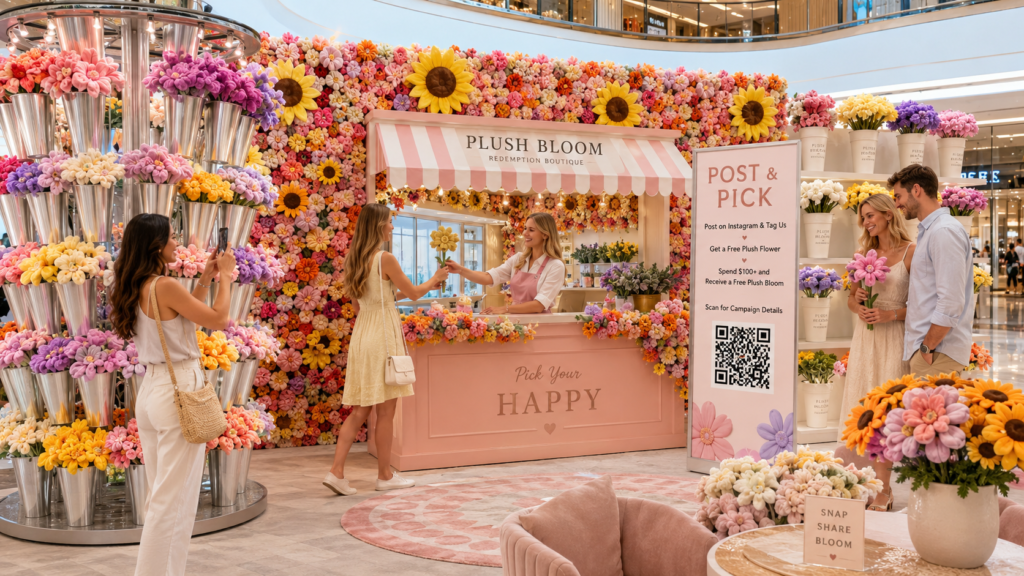
Plush flowers can provide a common visual theme while individual retailers contribute different parts of the promotion.
For example, a beauty retailer might participate in the qualifying purchase program, a café might provide an add-on offer, and a gift or fashion store might join a center-wide reward campaign. The customer experiences one coordinated event even though several businesses are involved.
Another option is to create a flower collection linked to tenant categories.
Different colors or flower types can represent beauty, fashion, dining, family, or lifestyle zones. The purpose is not to make shoppers collect every item, but to give the whole campaign a recognizable identity across the property.
Operational simplicity is especially important here.
Participating stores need clear redemption rules, stock allocation, and instructions for what happens when one product runs out.
A promotion that is easy for shoppers but confusing for store staff will quickly become difficult to manage.
7. Test a Limited-Edition Plush Flower Collection
Plush flowers do not always have to be free promotional gifts.
They can also become short-term merchandise.
A shopping center, destination retail property, lifestyle center, hotel retail area, or tourist shopping location could develop a small seasonal collection using selected flowers, colors, or packaging.
The collection might connect to spring, a local flower, an anniversary, a festival, or another campaign theme.
Starting with a focused range makes it easier to learn what shoppers actually prefer.
Which design sells first? Do customers buy single stems or bouquets? Are soft neutral colors more popular than brighter seasonal shades? Does special packaging justify a higher retail price?
Those answers can inform future campaigns.
A limited collection can later evolve into a loyalty reward, seasonal gift, tenant collaboration product, or recurring souvenir.
Seasonal Themes Can Change Without Rebuilding the Whole Program
The same campaign mechanics can be reused throughout the year.
A bouquet activity might become a Mother’s Day event in spring and a friendship campaign later. A spend-and-receive program can change from tulips and daisies to roses or warmer holiday colors. A loyalty collection can use new ribbons, tags, or packaging without requiring an entirely new product structure.
This is often more practical than developing an unrelated concept for every seasonal promotion.
For B2B buyers, reusable product architecture can also make sampling, budgeting, and repeat ordering easier.
Before Ordering Plush Flowers for a Mall Campaign
The plush flowers sourcing process becomes much easier when five questions are answered early.
First, what will the flower actually do? A photo prop, giveaway, workshop stem, collectible, and retail product may need different specifications.
Second, how many designs are really necessary? More variety creates choice, but also more forecasting risk.
Third, what needs to be customized? This may include the flower shape, colors, hangtags, ribbons, cards, bouquet wrapping, sleeves, or retail packaging.
Fourth, how will the products be distributed onsite? Pre-wrapped bouquets save staff time but require more storage volume. Single stems are easier to pack in bulk but may need more onsite preparation.
Finally, what should the approved sample control? For a bulk order, buyers should confirm expectations for flower shape, color consistency, stitching, stems, leaves, labels, and packaging before production begins.
Sweetie develops and supplies single plush flowers, bouquets, flower baskets, pots, toy bouquets, and other plush and fabric flower formats, with OEM and ODM support available for B2B projects. Current product materials also show multiple single-stem plush flower designs and bulk-order formats intended for larger orders.
If you already have a mall campaign concept, send the event date, destination market, expected quantity, branding requirements, and reference images to inquiry@sweetie-group.com. We can help turn the idea into a workable product brief.
Frequently Asked Questions
Are plush flowers suitable only for family-oriented shopping centers?
No. The positioning depends heavily on design and presentation. Bright and playful flowers may suit family events, while botanical forms, coordinated colors, restrained branding, and premium packaging can work for fashion, beauty, lifestyle, hospitality, and higher-end retail environments.
What are the most practical plush flower ideas for a mall promotion?
Common options include spend-and-receive gifts, interactive photo props, bouquet activities, mall-wide trails, loyalty rewards, tenant promotions, and limited-edition merchandise. The best choice depends on the behavior the campaign is trying to encourage.
Can plush flowers be customized for a shopping center?
Yes. Depending on the project, customization may include flower style, color, branding, hangtags, ribbons, cards, bouquet wrapping, and packaging. Sweetie also supports OEM and ODM development for plush flower projects.
How many flower styles should a campaign use?
There is no fixed number. A small coordinated assortment is often easier to forecast and replenish than a very large range. The right number depends on campaign volume, duration, customer choice, and whether the flowers are rewards, collectibles, or merchandise.
How early should a custom campaign begin sourcing?
Work backward from the event date. Custom projects may require time for concept review, sampling, revisions, packaging approval, mass production, inspection, international shipping, customs clearance, and local setup. More complex designs and larger quantities generally require earlier planning.
Start With the Shopper Action
Plush flowers are most useful in shopping center marketing when they have a job to do.
They can give shoppers a reason to stop for a photo, reach a spending threshold, spend more time in an activity, explore another part of the property, join a loyalty program, participate with several tenants, or return for a new release.
Once that shopper action is clear, the product decisions become much simpler.
The flower is no longer just decoration.
It becomes part of the campaign.
Annie Zhang